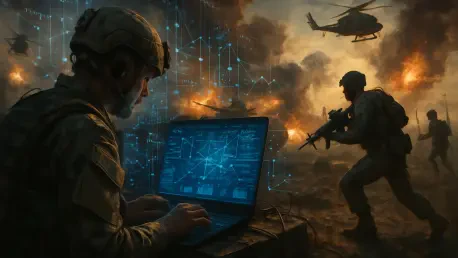

The reality of modern conflict dictates that every kinetic strike is preceded, enabled, or followed by a digital operation, effectively erasing the traditional boundary between the physical and electronic battlefields. This paradigm shift means that commanders no longer view cyber capabilities as niche technical supports but as core components of their maneuver strategy. In the high-intensity environments observed during recent years leading into 2026, the reliance on digital intelligence has reached a point where tactical success is often contingent upon the immediate synchronization of “cyber-to-physical” data. However, the current infrastructure for processing this data remains heavily reliant on commercial platforms that were never built for the rigors of state-on-state warfare. This creates a critical vulnerability where the speed of information flow is throttled by tools that prioritize corporate risk management over the life-and-death requirements of a military engagement. Consequently, the defense community must address the widening gap between commercial software design and the doctrinal necessities of joint operations to ensure that intelligence remains a force multiplier rather than an administrative bottleneck.
Overcoming the Constraints of Commercial Software Design
Standardized military operations are built upon doctrine, a rigorous set of rules such as NATO’s AJP-2 or the US Joint Publication 2-0, which provide the essential blueprints for intelligence gathering and decision-making cycles. These documents establish a precise lexicon and strict reporting formats that allow a multinational coalition to operate as a single, cohesive unit. In contrast, commercial cyber threat intelligence products were developed to serve the needs of enterprise security operations centers, which prioritize automated threat blocking and high-volume data ingestion. While these commercial features work well for protecting corporate financial assets, they lack the structural alignment necessary to feed into a military commander’s situational awareness picture. The disconnect forces military analysts to manually reformat and interpret commercial data streams, creating an “analytical friction” that consumes hundreds of man-hours and delays the dissemination of time-sensitive information across the theater of operations.
The reliance on proprietary nomenclature within commercial platforms further complicates the interoperability required for successful coalition warfare between allied nations. Each commercial vendor uses its own unique naming conventions for threat actors and malware variants, which often contradicts the standardized terminology used in military reports. When a unit in one country identifies a threat using commercial software, the reporting might not align with the definitions used by a partner unit across the border, leading to confusion during critical maneuvers. To mitigate this risk, defense organizations must transition toward intelligence systems that are “military by design,” integrating doctrinal standards directly into the software’s user interface and data schemas. By ensuring that digital tools speak the language of the soldier rather than the language of the IT administrator, the military can eliminate the need for cumbersome translation processes. This shift allows for a more fluid transfer of knowledge from the edge of the battlefield to the strategic command centers.
Integrating Multi-Domain Fusion and National Sovereignty
Effective military intelligence cannot operate in a vacuum, as the modern battlefield requires the seamless fusion of cyber insights with signals, human, and geospatial data sources. Currently, many commercial cyber platforms are designed as standalone silos, making it nearly impossible to cross-reference digital threats with physical movements tracked through satellite imagery or field reports. For instance, an intrusion detection alert in a communications network should ideally be correlated immediately with the movement of an enemy’s electronic warfare unit detected via signals intelligence. However, the architectural limitations of enterprise-centric tools prevent this type of multi-domain synthesis, leaving commanders with a fragmented view of the operational environment. Bridging these silos is not merely a technical challenge but a strategic imperative that requires a unified data layer where all forms of intelligence are processed through the same doctrinal lens. Without this integration, the military risks making decisions based on incomplete information.
Balancing the requirement for national data sovereignty with the need for rapid intelligence sharing among international partners remains one of the most complex challenges in the digital age. Many commercial cyber intelligence solutions rely on centralized, cloud-based architectures that may not meet the stringent security requirements of individual nations or the protocols for handling classified data. This creates a paradox where forces must collaborate to defend against a common adversary while also protecting their own sensitive information and technological secrets. To resolve this, future defense platforms must offer modular architectures that allow for national-level gatekeeping while still facilitating the lightning-fast exchange of relevant indicators across the coalition. Such systems would enable a “need-to-share” culture that respects sovereign boundaries without sacrificing the collective defense capability. By embedding these controls into the core functionality of the software, defense organizations can ensure that their intelligence sharing is both secure and instantaneous.
The defense community recognized that the era of merely adapting commercial security tools for complex military missions had reached its logical limit. Strategic planners emphasized that the path forward required a fundamental reimagining of how digital intelligence tools are built, focusing on systems that prioritize doctrinal compliance from the initial design phase. Actionable steps involved the development of open-architecture standards that allowed cyber insights to flow into all-source intelligence databases without manual intervention. Furthermore, leaders advocated for the implementation of training programs that bridged the gap between technical cyber proficiency and doctrinal intelligence analysis. By moving toward a model where software mirrors the operational realities of the battlefield, allied forces positioned themselves to maintain a technological edge. The focus shifted to creating a unified digital environment where intelligence served the commander’s intent, ensuring that digital and physical maneuvers were synchronized. This evolution guaranteed that the digital domain remained an asset for collective security.