
Quantum computing’s scale problem has been well known for years, yet the bind has sharpened as practical workloads demand far more logical qubits than any standalone device can deliver, making networking not a luxury but a necessity for progress. Cisco’s prototype universal quantum switch enters this moment with an audacious promise: let heterogeneous quantum machines talk over today’s fiber, keep entanglement intact, and do it at room temperature with split‑second agility. This review examines whether that promise looks like a practical, near‑term investment path toward scalable quantum computing or remains a clever lab curiosity.
The scope covers what the device is, how it works, and how it fits within distributed quantum computing strategies. It considers prototype maturity, technical approach, early field validation on commercial fiber, interoperability aims across multiple photonic encodings, and alignment with broader orchestration layers. Evaluation focuses on usefulness, performance, interoperability, deployment practicality, ecosystem momentum, and risk, with an eye to what would be needed to move from pilot to production.
The central question is not whether the switch is theoretically sound, but whether it meaningfully reduces friction for real‑world quantum networking. If the answer leans yes, the product could shift roadmaps away from monolithic bets and toward federated architectures that spread risk, accelerate experimentation, and compound capacity across vendors and modalities.
What the Universal Quantum Switch Is and How It Works
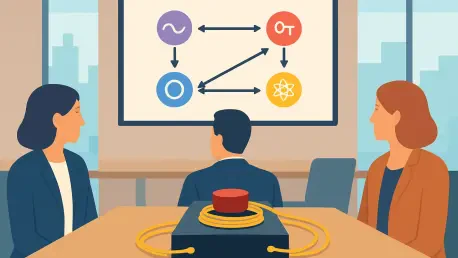
Cisco positions the universal quantum switch as a room‑temperature, fiber‑compatible device that routes quantum states while preserving entanglement and cleanly translating between polarization, time‑bin, frequency‑bin, and path encodings. Unlike optical transponders that measure and regenerate signals, this system performs reversible, non‑destructive conversion, maintaining coherence as qubits cross network boundaries. In effect, it acts like a data center switch for quantum states, substituting a neutral internal representation where packets would otherwise be buffered.
Three core behaviors define the product value. First, it supports entanglement‑preserving routing over commercial fiber, a baseline requirement for any practical quantum network. Second, it converts among multiple encodings without collapsing the state, which is crucial for bridging dissimilar hardware. Third, it reconfigures paths at nanosecond timescales while sipping sub‑milliwatt power, enabling dynamic topologies and multi‑tenant scenarios where entanglement must be established and steered quickly.
Internally, the switch relies on a silicon‑based quantum state converter guided by tomography to set and verify conversion parameters. That approach yields a modality‑agnostic, neutral representation inside the box, then reconstructs the desired encoding on egress. Placed in the stack, it sits between heterogeneous quantum processors and the classical control, scheduling, and orchestration layers that stitch distributed workflows together. Compared with alternatives that hardwire to a single encoding or demand cryogenics, its differentiators are neutrality across four modalities, room‑temperature operation, and compatibility with installed telecom infrastructure. Partnerships with IBM, Atom Computing, and Qunnect connect the switch to upstream processors, memory elements, and networking gear, aligning with Cisco’s prior work on entanglement chips and network‑aware compilers.
Performance and Real‑World Validation
A prototype lives or dies on field proof, and the early signal here is encouraging. In collaboration with Qunnect, Cisco reported distributing roughly 5,400 entangled qubit pairs per hour over about 17.6 kilometers of noisy, commercial fiber from Brooklyn to Manhattan’s 60 Hudson Street. The team characterized that throughput as orders of magnitude faster than previous demonstrations and, importantly, achieved it without cryogenic environments. The test signaled that urban‑scale entanglement distribution can run on legacy fiber, not just pristine lab links.
From a deployment lens, those numbers imply near‑term pilots could proceed within city networks and metro rings using existing plant, power, and space. Nanosecond reconfiguration suggests the device can keep up with dynamic routing demands, while the low‑power profile and room‑temperature operation lower operational friction at the edge and in central offices. The practical read is that an operator could stand up a small quantum testbed, iterate rapidly, and scale lessons forward without specialized facilities.
However, the performance envelope still needs fuller characterization. Fidelity under conversion and routing must be quantified across all supported encodings, as do throughput and latency for dynamically changing paths. Stability and calibration in multi‑vendor environments remain open questions, especially as topologies grow and drift accumulates. Power, footprint, and thermal characteristics appear favorable, but long‑haul viability will inevitably depend on quantum repeaters, and sustained high‑fidelity rates across multi‑hop networks have not yet been shown at production scale. End‑to‑end orchestration under realistic workloads also warrants demonstration, including telemetry, scheduling, and error‑aware routing.
Strengths and Weaknesses in Context
The device’s strengths align tightly with what distributed quantum computing needs right now. Modality‑agnostic interoperability across polarization, time‑bin, frequency‑bin, and path reduces vendor lock‑in and unlocks resource pooling. Room‑temperature, telecom‑band operation allows reuse of existing fiber networks and colocation practices, sidestepping cryogenic constraints that complicate field deployment. Nanosecond, sub‑milliwatt reconfiguration supports dynamic topologies and shared infrastructure, while tomography‑guided, entanglement‑preserving conversion tackles the core challenge of moving fragile states through heterogeneous interfaces. Early validation over busy urban fiber, though preliminary, points to pragmatic feasibility.
Yet prototype status brings limits. There is no commercial SKU, no public price, and no hard service envelope. Long‑haul scaling hinges on viable quantum repeaters and memory, which remain in development. Control planes, entanglement routing protocols, and resource allocation standards are not settled, introducing ecosystem risk. Unknowns persist in long‑term fidelity, loss budgets, and multi‑vendor calibration workflows. Integration complexity will surface as teams stitch together processors, memories, and network equipment from different suppliers, each with unique noise profiles and operational quirks.
These factors underscore how quantum networking differs from classical paradigms. Networks cannot simply store and forward; they must maintain end‑to‑end coherence. Noise compounds with each device and interface, raising the bar for conversion fidelity and switch insertion loss. Heterogeneity is not an edge case but a design constant, which makes a neutral, encoding‑agnostic fabric more than a convenience—it is foundational to any realistic path toward distributed quantum capacity.
Synthesis and Recommendation
Taken together, Cisco’s universal quantum switch outlines a credible path to federate heterogeneous quantum systems over today’s fiber while avoiding destructive measurement. Practicality signals stand out: it runs at room temperature, interoperates across four encodings, and reconfigures in a nanosecond with sub‑milliwatt power. Field results support the notion that urban‑scale pilots are achievable without custom fiber or cryogenics, even as broader scalability continues to hinge on repeaters and standards for control and orchestration.
For operators, cloud providers, national labs, and quantum hardware vendors, the recommendation is to pursue staged pilots and joint R&D. Focus on hardening interop across modalities, benchmarking fidelity under conversion, and integrating the switch with entanglement‑aware control planes. For enterprises exploring quantum, the prudent move is to monitor progress, join consortia, and architect for distributed‑first scenarios rather than wagering on a single monolithic platform. For standards bodies and ecosystem partners, near‑term priorities include modality‑neutral interfaces, entanglement routing protocols, calibration and monitoring hooks, and shared performance benchmarks that make multi‑vendor deployments viable.
The upshot is that cautious optimism is warranted. The prototype advances quantum networking from concept toward fieldable systems, and investment should concentrate on pilots that validate end‑to‑end stacks, clarify total cost on existing fiber, and accelerate learning curves for operations teams. Progress along these lines would shorten time to practical impact and help avoid fragmented silos.
Who Should Engage Now and What to Consider Before Investing
Best‑fit early adopters include telecom operators and cloud platforms building quantum network testbeds, research consortia and national programs pursuing distributed quantum processing, and hardware vendors that must bridge divergent encodings. These groups derive immediate value from a fabric that can route and translate among modalities without forcing a singular technology bet. Integrators with cross‑stack mandates will also find the switch relevant as a keystone for multi‑vendor proofs of concept.
Near‑term pilots should target use cases that benefit from coordination rather than brute qubit count alone. Aggregated compute across small processors can tackle optimization and simulation tasks that exceed a single node’s limits. Error management workflows coordinated over a network—such as distributed syndrome extraction—can probe how connectivity offsets local noise. Quantum‑native services like secure key distribution, distributed sensing, and clock synchronization offer practical footholds, while exploratory finance workflows can test decision protocols that rely on pre‑shared entanglement within physical limits.
Due diligence should weigh fidelity and throughput targets against use case tolerance, with clear success criteria and rollback plans. Roadmaps must address repeaters, calibration, and monitoring at scale, since these determine whether pilots graduate to metro and wide‑area footprints. Control plane maturity matters: operators will need entanglement routing, resource scheduling, and telemetry that integrates with existing observability stacks. Multi‑vendor interoperability and participation in evolving standards reduce strategic risk, while total cost should account for leveraging installed fiber, power, and space rather than bespoke buildouts.
Conclusion
Cisco’s universal quantum switch read as a pragmatic bid to make distributed quantum computing usable sooner by preserving entanglement while bridging four photonic encodings over commercial fiber. The prototype paired room‑temperature operation with nanosecond, low‑power reconfiguration and delivered meaningful field results in a noisy metro link. Strengths centered on modality neutrality, telecom compatibility, and dynamic control; risks centered on prototype maturity, repeater dependency, and unsettled standards. The final recommendation leaned toward staged pilots led by operators, clouds, labs, and hardware vendors, with enterprises planning for distributed‑first architectures. The most actionable next steps involved building interop testbeds, codifying fidelity and routing benchmarks, and maturing control planes and monitoring so that early wins could compound into scalable, production‑grade quantum networks.