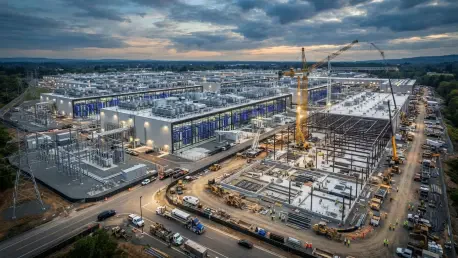

Google’s eighth-generation Tensor Processing Units, specifically the TPU 8t and 8i, are now being offered to third-party providers like Oracle to generate new revenue streams. This development signals a profound shift in how hyperscalers view their internal infrastructure, evolving from proprietary assets into commercialized commodities. The global technology sector is currently experiencing a massive surge in capital expenditures as Google, Microsoft, and Amazon funnel billions of dollars into data centers to anchor their positions within the expanding artificial intelligence economy. This aggressive spending serves as a primary indicator of a company’s capacity to host next-generation large language models and complex agentic workloads that are becoming standard in 2026. As the demand for data processing hits record highs, these tech giants are treating infrastructure development as a non-negotiable requirement for survival in a highly competitive and evolving technological landscape.
Strategic Capital Allocation and Capacity Expansion
Comparing the Financial Footprints of Industry Leaders
Currently, Amazon maintains its position as the undisputed leader in raw investment volume, with third-quarter expenditures reaching nearly $76 billion across its global operations. A significant majority of this capital is diverted to support Amazon Web Services as it scales to accommodate the explosion in generative AI training requests and enterprise-level deployments. Financial analysts observing the sector note that Amazon’s total cash outlay is expected to reach a staggering $220 billion throughout 2026 as it prepares for even more intensive requirements in the following years. When viewed collectively, the primary hyperscalers are now spending approximately $2 billion every single day on infrastructure projects. This strategy reflects a broad industry consensus that immediate, massive investment is the only viable way to capture the generational opportunity presented by AI. Such levels of spending have effectively raised the barrier to entry for any potential competitors.
While Amazon leads in total volume, the hierarchy among its peers has seen a notable shift, with Alphabet recently surpassing Microsoft in quarterly investments to reach over $50 billion. This capital is being directed toward expanding cloud capacity to ensure that AI-driven applications have the necessary physical space and electrical power to operate efficiently. Microsoft slightly trailed this figure due to specific logistical bottlenecks in hardware delivery, but the organization has already signaled its intent to escalate spending immediately to meet the demand. The objective remains clear: secure the essential CPUs, GPUs, and high-bandwidth memory storage required to meet the soaring costs of cutting-edge hardware. These firms are no longer just software providers but have become the primary architects of the physical world’s compute capacity. The race is defined by who can build data centers faster than the market can consume resources in this unprecedented era of digital growth.
Market Returns and the Paradox of Market Share
Despite the eye-watering costs associated with this infrastructure build-out, these massive investments are generating significant financial returns across the sector. The global cloud market has nearly tripled in size since the middle of the decade, proving that the appetite for managed compute services remains insatiable. Recent reports indicate that cloud revenue has seen massive year-over-year growth, yet a curious trend has emerged where the combined market share of the top three providers is actually shrinking. As the total market expands, it is also becoming more fragmented, suggesting that the industry is entering a new phase of diversification. While the incumbents are growing faster than ever in absolute terms, the sheer scale of the artificial intelligence boom is creating ample space for a wider variety of participants to thrive. This paradox highlights a healthy ecosystem where demand is currently outstripping the supply provided by the largest and most established players.
The fragmentation of the market share is largely a result of the specialized nature of modern AI workloads. Enterprise customers are increasingly seeking out environments that are optimized for specific types of model training or inference, rather than general-purpose cloud storage. This shift has allowed for a proliferation of niche providers that cater to these exact requirements, even as the “Big Three” continue to see record-breaking revenues. The narrative of a winner-take-all market is being challenged by the reality of a multi-cloud strategy where redundancy and specialization are prized. Consequently, the hyperscalers are being forced to innovate not just on scale, but on the variety of services they offer to prevent further erosion of their positions. The current financial climate suggests that while the largest companies have the most to spend, the diversity of the AI economy ensures that no single entity can realistically claim total control over the global infrastructure.
Technological Sovereignty and Efficiency Through Custom Silicon
Internalizing Hardware Production for Performance Gains
A pivotal shift in the strategy of hyperscalers is the move toward proprietary silicon, reducing reliance on external chip manufacturers that have struggled with supply chain constraints. Google is currently leading this movement with its eighth generation of Tensor Processing Units, which are specifically optimized for training and running complex agentic workloads. By making these systems available to third parties, Google has successfully transformed its internal hardware needs into a fresh revenue stream that competes directly with traditional hardware vendors. This transition allows hyperscalers to fine-tune their data center environments for specific artificial intelligence tasks, maximizing performance while controlling the long-term costs of hardware procurement. The ability to design a chip that fits the exact thermal and power profiles of their proprietary data centers gives these companies a significant advantage in terms of operational overhead and sustained performance.
This move toward internalization is driven by the need for vertical integration in an era where software and hardware are becoming inseparable. When a company controls the entire stack from the silicon layer up to the user-facing application, it can achieve efficiencies that are impossible with off-the-shelf components. The performance gains observed in proprietary chips often translate to lower latency and higher throughput for the end user, which is a critical differentiator in the competitive cloud market of 2026. Furthermore, owning the hardware design process mitigates the risks associated with geopolitical fluctuations and global semiconductor shortages. As the complexity of large language models increases, the demand for specialized hardware that can handle billions of parameters simultaneously will only grow. Hyperscalers that have invested in their own engineering talent to produce these chips are now seeing those efforts pay off in the form of superior product offerings.
Strategic Outcomes and Sustainable Market Leadership
The current trajectory of the cloud industry points toward a future defined by operational efficiency and massive scale rather than just raw server counts. Capital expenditure has become the entry fee for the AI era, and the window for building out the necessary infrastructure is narrow for those who wish to remain competitive. As hardware costs continue to climb and power availability becomes more constrained, the industry is likely to see a period of consolidation where smaller, specialized players are integrated into larger, more stable ecosystems. The success of these multi-billion-dollar investments will ultimately be judged by how effectively these companies can turn raw compute power into high-margin, sustainable AI services. Organizations must now look toward long-term resilience, ensuring that their data centers are not only powerful enough for today’s tasks but also flexible enough to adapt to the architectural shifts that will occur throughout the decade.
In reflecting on the recent shifts, industry leaders recognized that infrastructure was no longer a background utility but the primary driver of organizational value. Decision-makers prioritized the development of silicon sovereignty to insulate their firms from external market shocks and supply chain vulnerabilities. They realized that the path to sustainable growth involved a careful balance between aggressive capital expansion and the meticulous optimization of regional power resources. By investing in proprietary hardware and specialized cloud environments, these organizations established a foundation that supported the rapid evolution of complex agentic workloads. They moved away from generalized, third-party solutions in favor of vertically integrated stacks that offered superior performance at a significant reduction in operational cost. Ultimately, the focus shifted from simple capacity to the long-term viability of high-margin services that defined the technological standards.