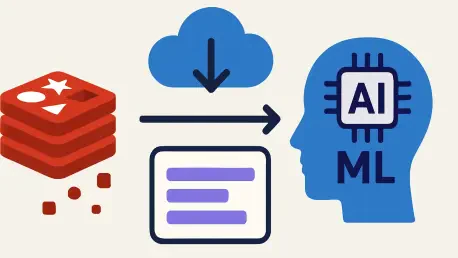

Thousands of sophisticated machine learning models are meticulously crafted in laboratory settings every year, only to vanish into obscurity the moment they encounter the unpredictable volatility of a live enterprise data stream. This phenomenon represents more than just a technical hurdle; it is a systemic failure that prevents organizations from realizing the true return on their computational investments. While the industry has mastered the art of model architecture, the bridge between a static training environment and a dynamic production system remains precariously thin. Redis is now positioning its new Feature Form suite as the essential infrastructure to stabilize this crossing, evolving from a traditional high-speed cache into a robust, governed foundation for operational artificial intelligence.
The production gap often manifests when the pristine, cleaned datasets used during a model’s development phase meet the noisy, high-velocity data of the real world. In many cases, a model that achieved ninety-nine percent accuracy in a sandbox environment experiences a catastrophic drop in performance upon deployment because the underlying data signals shifted or lost their original context. This disconnect turns promising AI initiatives into expensive laboratory experiments that fail to deliver tangible value to the business. By addressing these inconsistencies at the architectural level, Redis intends to provide the structural integrity required for models to function reliably under the pressures of live traffic and massive scale.
The High Cost: Why the Production Gap Stifles Artificial Intelligence
The financial and operational repercussions of the production gap are becoming impossible for modern enterprises to ignore as they attempt to scale their digital transformations. When a machine learning project fails to transition from a notebook to a live environment, the loss includes not only the research and development budget but also the opportunity cost of the unrealized insights. This gap often stems from a fundamental mismatch between the tools used by data scientists for exploration and the rigid infrastructure managed by DevOps teams for production. The result is a fragmented ecosystem where high-quality models are left stranded, unable to interact with the real-time data streams that give them purpose.
Furthermore, the lack of a standardized path to production creates a culture of “shadow AI” where individual teams build their own bespoke, fragile pipelines to bypass institutional bottlenecks. These custom solutions are rarely documented or governed, making them prone to failure during updates or when the original developer leaves the organization. Redis identifies this fragmentation as a primary barrier to enterprise-wide AI adoption. By serving as a unified bridge, the Feature Form framework seeks to eliminate the need for these artisanal data bridges, allowing organizations to treat machine learning features as managed assets rather than temporary scripts buried in a data scientist’s local environment.
From Rapid Storage to Intelligent Feature Governance
The evolution of Redis into the AI space reached a significant turning point with the strategic acquisition of Featureform, a move designed to solve the inherent fragmentation of modern data science. For years, Redis was the preferred choice for low-latency storage, yet it remained a passive participant in the machine learning workflow. The integration of Featureform shifts this paradigm, allowing the platform to manage the logic behind the data signals themselves. Traditionally, teams have struggled with a “dual pipeline” problem, utilizing one set of tools for historical batch data to train models and an entirely different infrastructure for real-time streaming data during live inference.
This separation is the primary catalyst for “model drift,” a state where the data a model sees in the real world no longer matches the data it was trained on, leading to increasingly inaccurate predictions over time. By rearchitecting these disparate capabilities into a unified platform, Redis is addressing the urgent need for a single source of truth that ensures data consistency across the entire machine learning lifecycle. This unified approach means that the logic used to transform raw data into a predictive feature is identical during both the learning phase and the execution phase. Consequently, the operational risk associated with training-serving skew is virtually eliminated, providing a level of reliability that was previously difficult to achieve without massive engineering overhead.
Streamlining the Lifecycle: Managing Machine Learning Features
The integration of Feature Form introduces a suite of capabilities that fundamentally transform how engineers manage the specific data signals—or features—that drive AI predictions. A core pillar of this new framework is the unification of data pipelines, which allows developers to define a feature once and use it for both training and real-time execution. In traditional setups, rewriting the transformation logic from Python-based research code into a production-hardened language like C++ or Java often introduced subtle bugs. Feature Form removes this requirement by providing a consistent abstraction layer that handles the translation between historical records and live event streams, effectively eliminating the need for custom, fragile glue code.
To support the complexities of large-scale corporate operations, Redis has implemented multi-tenant workspaces and fine-grained role-based access control within the Feature Form suite. These features ensure that different departments can innovate independently on shared infrastructure without the risk of data corruption or unauthorized access to sensitive predictive signals. Furthermore, the introduction of Atomic Directed Acyclic Graphs, or DAGs, provides a clear visual history of data lineage. This capability makes it possible for teams to track exactly how a data point evolved through various transformations. If a model’s performance begins to degrade, engineers can look back through the DAG to identify the precise moment a data source changed, allowing for rapid troubleshooting and remediation in high-stakes environments.
Why Low Latency: The Ultimate Competitive Advantage
Industry analysts emphasize that while cloud giants like AWS and Google offer their own feature stores, Redis maintains a unique edge through its sub-millisecond performance. In the modern landscape of high-frequency trading, real-time logistics, and instant cybersecurity, the difference between a ten-millisecond response and a one-millisecond response can equate to millions of dollars in prevented fraud or captured revenue. Simba Khadder, the AI product lead at Redis, notes that the true bottleneck for the next generation of “Agentic AI”—autonomous agents that perform tasks on behalf of users—is the “context problem.” These agents require massive amounts of relevant, real-time data to be delivered instantaneously to make accurate decisions in shifting environments.
Expert observers from organizations like IDC and Omdia point out that by embedding feature management directly into a low-latency data store, Redis enables applications that were previously technically impossible. For instance, a hyper-personalized recommendation engine in a retail environment must ingest a user’s current clickstream, compare it against years of historical behavior, and generate a prediction, all before the next page loads. Cloud-based feature stores often struggle with the “round-trip” latency required for such tasks. By keeping the feature definitions and the data in the same high-speed memory layer, Redis allows for a seamless flow of information that supports the instantaneous processing required for truly autonomous, agentic systems to thrive.
Strategies: Implementing a Governed AI Environment
To successfully adopt this new approach, organizations should focus on centralizing their feature definitions to prevent the “silo effect” where different teams recreate the same data signals in isolation. A practical framework involves moving away from homegrown, fragile pipelines and toward a governed environment that prioritizes feature observability. This strategy requires a cultural shift where data scientists and DevOps engineers collaborate on a shared platform, ensuring that every predictive signal is documented, versioned, and monitored. This centralization not only reduces computational waste by preventing redundant data processing but also ensures that the entire organization is working from the same validated set of information.
Modern enterprises should also prioritize the implementation of automated alerts to monitor the “health” of their data features. This involves setting up thresholds to ensure that features remain fresh and stable before they ever reach a live model. Additionally, organizations should look toward building a comprehensive “context engine” that unifies structured data with unstructured memory. This preparation is essential for the shift toward autonomous AI agents that require deep, real-time situational awareness to function. By creating an environment where data is treated as a living, governed asset, companies can move beyond simple automation and begin to deploy intelligent systems that can adapt to changing conditions with minimal human intervention.
The introduction of Feature Form represented a significant shift in how the industry approached the intersection of data storage and machine learning. By synthesizing high-performance architecture with rigorous governance, the platform addressed the most persistent bottlenecks in the AI lifecycle. Organizations that utilized these unified pipelines were able to reduce the time spent on data engineering, allowing their scientists to focus on model refinement rather than troubleshooting infrastructure. The move toward a context-driven engine also provided the necessary groundwork for the rise of autonomous agents, ensuring they had immediate access to the situational data required for independent decision-making. Ultimately, the integration of these tools fostered a more reliable and scalable environment where artificial intelligence moved from a speculative experiment to a core operational reality.