
Boardrooms did not debate whether agentic AI would arrive so much as how fast it could move from lab demos to dependable systems that run the business, and this event answered with a blueprint that fused research, infrastructure, and enterprise guardrails into one production posture. The headline was unambiguous: integrated stacks now decide outcomes, and the winners align compute, governed data, and action-taking agents behind measurable cost and performance targets. That framing set expectations for concrete progress—faster training on next-gen TPUs, cross-cloud data governance without brittle stitching, and agents that reason across tools rather than stall at chat. It also clarified a stance on openness that felt pragmatic rather than performative, with Apache Iceberg support and partner-built workflows indicating a belief that interoperability is a route to scale, not a concession.
Strategy and Stack
Integrated-but-open Positioning
The event’s strategy narrative emphasized a vertically optimized stack that does not force lock-in behaviors, reflecting a “one Google” flywheel that links DeepMind’s model research, Cloud’s secure and performant infrastructure, and distribution through widely used applications. The analogy to consumer ecosystems mattered less as marketing flair and more as shorthand for predictable latency, managed context windows, and coherent governance. Support for open table formats and federated access aimed to reduce the switching penalty that has historically discouraged platform consolidation. Rather than shun third-party ecosystems, the approach hinged on shared context and durable identifiers that let agents coordinate actions across systems without replatforming every dataset or tool.
That stance surfaced in specific product and go-to-market details. Apache Iceberg landed as a keystone, flattening friction in the lakehouse tier and aligning with practices already common in enterprise data engineering. Partnerships provided the connective tissue: Salesforce workflows co-orchestrated with Gemini, ServiceNow agents exchanging state with enterprise agents, and SAP scenarios where Gemini Enterprise delegated precise actions to Joule in SAP CX. The integration pattern was consistent: let the agent runtime own skills, tools, and guardrails; let the data plane enforce lineage and policy; and let standardized interfaces keep specialized domain systems in the loop. The net effect was a stack that felt opinionated on architecture yet tolerant of customer heterogeneity.
Product Pillars: Compute, Data, Agent Platform
Compute advances centered on next-generation TPUs positioned as both training and inference accelerators with better cost-performance envelopes for large-scale workloads. The message did not dismiss CPUs; it recast them as an essential part of a heterogeneous fleet that suits retrieval, feature processing, and lighter inference. This pragmatism acknowledged real-world budget lines and procurement cycles. It also underlined a bet that throughput and energy efficiency, not only raw FLOPs, will matter as production agents call models continuously. Performance claims gained credibility through named examples—quantitative research teams reporting 2x–4x speedups and material cost reductions—grounding the theory in measurable impact rather than synthetic benchmarks.
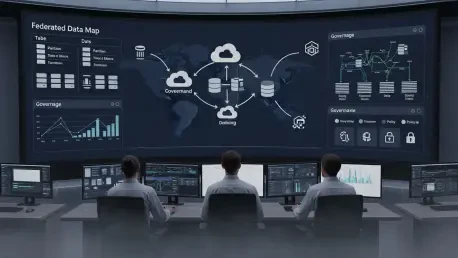
The data pillar, branded as Agentic Data Cloud, tied BigQuery, AlloyDB, Spanner, and a managed Spark service to a cross-cloud lakehouse and a knowledge catalog designed for context-rich agents. The architecture prioritized consistent governance, bidirectional connectors between operational and analytical systems, and built-in lineage that surfaces provenance inside agent reasoning flows. That design choice matters when agents execute actions: without trustworthy metadata and entitlements, autonomy becomes risk. The agent platform rounded out the stack with a fuller runtime and control plane—skill, tool, and agent registries; universal context management; a hardened agent engine; and a marketplace. Together, these components aimed to reduce the toil of orchestrating multi-step, cross-system work while making oversight—tests, policies, and audit—an integral feature, not an afterthought.
Market Dynamics and Adoption
Data-Layer Competition and Migrations
Competitive dynamics in the data layer pivoted on the standardization wave around Apache Iceberg, which has chipped away at proprietary table format advantages and made cross-platform data mobility less punitive. Google Cloud used that moment to challenge incumbents with migration kits that promised timelines measured in months rather than years, especially for cloud-to-cloud moves. The pitch rested on a unification argument: putting AI and data on one stack minimizes cross-billing anxiety, reduces connector sprawl, and gives agents a consistent contract for context. In practice, that means fewer brittle pipelines, faster schema evolution, and an easier path to applying governance and PII controls across both historical and operational datasets.
This migration narrative gained weight because it attached performance economics to the move, not only architecture purity. By binding the Agentic Data Cloud to the agent runtime and to TPUs, the platform argued for end-to-end optimization that compounds: faster training shortens iteration loops, cheaper inference expands use cases, and governed context reduces failure rates in production. The company did not claim that heterogeneity disappears; it leaned into coexistence, offering bidirectional connectors and federation so teams can phase migrations without halting projects. The strategic bet was clear: once governance, discovery, and lineage feel native, the switching costs borne by data teams and app owners decline, making consolidation not just feasible but operationally attractive.
From Pilots to Production: Industries and Examples
The shift from pilot to production emerged most clearly in industry stories that showed repeatable patterns. Retail stood out, not just because of long-running competitive dynamics that steer some chains away from rival clouds, but because the stack bundled commerce-specific agents and marketing integrations that map cleanly to revenue metrics. One example featured a customer-facing agent spanning inspiration through purchase and in-store project support, reporting higher conversion alongside faster content retrieval. In parallel, a big-box retailer stitched store, supply chain, and enterprise systems into a single context layer, allowing agents to update fulfillment and recommendations with fewer manual escalations—evidence that workflows, not chat, define value at scale.
Other sectors contributed proof points that highlighted different strengths of the stack. A building technology company used graph reasoning over product-specification graphs and digital twins to generate millions of insights for complex facilities, blending structured and unstructured data. A quantitative research firm documented TPU-led gains—multiplying throughput while trimming costs—that suggest an emerging specialty for model training at scale. A media and telecom provider activated more than 20,000 previously dark data assets through the knowledge catalog, showing how metadata and lineage can be as valuable as raw data volume. Healthcare and finance examples added signs of compliance-aware execution, while a pharmaceutical deal valued up to a billion dollars underscored enterprise-scale commitment to agentic AI.
Ecosystem and Operating Model
Partner and Investment Push
Execution at production scale demanded more than product features; it required change management, integration muscle, and industry playbooks. To that end, the company earmarked $750 million to underwrite deployments, prototypes, and forward-deployed engineering, an approach that shifts risk early and accelerates path-to-value. Consulting alliances filled in the operating model: a new Agentic Transformation practice at a global integrator, plus expanded programs with major firms, signaled a move to codify patterns—reference architectures, validation suites, and process maps—so agents can land inside existing controls. This partner-led ground game aimed to ensure that governance and outcomes travel together, not separately.
Deep application partnerships extended the play from strategy to frontline workflows. Agents from CRM and IT service platforms now coordinated with Gemini Enterprise using shared context and entitlement-aware actions, which meant that sales, service, and operations data could stay in place while agents routed work with traceable states. In manufacturing and marketing scenarios, SAP integrations demonstrated a hub-and-spoke model: Gemini Enterprise operated as the orchestration hub, while Joule agents executed domain actions such as campaign building and optimization in SAP CX. The outcome was not a single super-agent but a federation of specialized agents that exchanged intents and artifacts under common guardrails, improving reliability and auditability while containing blast radius.
Industry Trends and What’s New in 2026
The broader consensus coalesced around a few assertions: integration beats fragmentation, data and AI are now one planning motion, and production value depends on vertical specificity. This event added operational completeness to that consensus. A fuller agent runtime, standardized data foundations, and pragmatic migration tooling turned last year’s proofs into blueprints. Security and governance moved from policy documents into enforcement points embedded in the agent engine and data plane. Crucially, openness did not vanish under integration pressure; support for open formats and cross-platform agent cooperation preserved customer choice without forfeiting performance or oversight. The signal for the market was plain: the stack is opinionated, not closed.
For enterprises charting next steps, the path had been concrete and actionable. Start by inventorying decision-critical data and mapping it to a knowledge catalog with lineage; pilot cross-cloud access where necessary, but adopt a single policy model early. Select two or three high-variance workflows—claims adjudication, merchandising optimization, network operations—and prototype agents that execute multi-step tasks with human-in-the-loop checkpoints. Benchmark TPU-backed training and inference against existing fleets to quantify cost-performance tradeoffs before committing tiering policies. Finally, structure delivery with a partner playbook that pairs domain expertise with FDE support; projects that locked these elements together reached production faster, governed risk more tightly, and translated model sophistication into outcomes that endured.