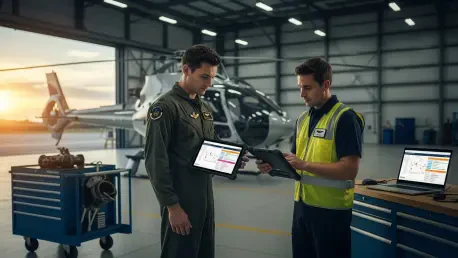

Operational missteps in aviation rarely stem from a lack of data; they arise when flight events, maintenance actions, and parts movements live in silos that resist timely reconciliation and leave crews guessing at the truth on the ramp. When a flight logbook update must traverse email chains before a mechanic can clear a task, minutes turn into delays, and delays turn into cost. A new approach tied to unified data flows has reshaped that equation by collapsing flight operations and maintenance into a single workflow, treating a sortie, a snag, a part request, and a compliance check as one continuous narrative. The aim is not novelty for its own sake but measurable improvements in speed, traceability, and regulatory confidence. That focus has begun to move the market conversation from “How many features?” to “How fast did the right decision reach the right person?”
The Integration Play: From Flights to Fixes
Seamless integration between NXT Flight and Alkym has anchored a workflow where operational data does not wait on handoffs to inform maintenance. Flight records are created once and flow instantly into work orders, MEL/CDL compliance, and parts reservations, closing the gap between cockpit entries and hangar execution. That tight coupling has carried weight in real deployments. Korean public-sector fleets—from the National Fire Agency and National Police Agency to the Korea Forest Service and Korea Coast Guard—validated the approach in mission-critical settings where dispatch reliability is a safety multiplier. Army and Navy helicopter units extended the proof, stress-testing traceability under high-tempo operations. With each turn, the systems produced a shared source of record that auditors could follow and technicians could trust, reducing duplicate data entry and the rework it spawns.
Building on this foundation, the integration design prioritized operational fidelity rather than a feature checklist. Maintenance planning aligns to actual flying programs, not theoretical cycles; discrepancy capture is tied to specific tails and missions; and airworthiness directives surface alongside the affected configuration, not in a separate portal. In practice, that means a vibration alert documented in-flight can auto-populate the condition-based maintenance queue and pre-stage required tooling before touchdown. Parts management and warranty checks stay linked to serials, closing the cost loop as work closes. Moreover, safety management and incident reporting draw from the same event timeline, improving root-cause clarity. These mechanics gained credibility because they handled edge cases—rotorcraft ops, mixed civilian and defense procedures, and terrain-challenged missions—without breaking the data narrative. The result was less interpretation, more execution.
SaaS Shift: Engineering for Scale
The operational win would have stalled without an equally deliberate business and engineering shift toward subscription-based SaaS. Enabled by Kyungpook National University’s Startup Leap Package, Seabury secured 150 million won to standardize its development system and modularize its codebase. The payoff was reuse at scale: roughly 70% of new features now ship as shared modules, while customer-specific layers remain thin and maintainable. Release lead time was cut in half, and the cadence moved from monthly toward biweekly, aligning delivery with frontline change windows. Change lead time declined from 10 to 5 days as pipelines matured, and maintenance incident resolution tracked down from 8 to 4 hours, reflecting sharper on-call runbooks and better observability. These are not vanity metrics; they are the currency of trust for operators who treat downtime as an existential cost.
This approach naturally led to new markets where software speed must match airspace innovation. Through “NXT MRO,” the platform extended into Advanced Air Mobility and Urban Air Mobility, linking flight ops, maintenance, safety, and commercial transactions into one ecosystem fabric. Battery health cycles, eVTOL component lifing, and vertiport turnaround constraints entered the same unified data model that governs conventional fleets. In parallel, a defense MRO roadmap focused on high-value components adopted CBM+ and lifecycle analysis to steer spares provisioning and depot workloads with predictive signals. The actionable playbook for operators had already been clear: consolidate sources of record, insist on workflow continuity from cockpit to component, and contract for measurable delivery metrics—release cadence, change lead time, and mean time to restore service. Adoption proceeded fastest when procurement framed requirements as outcomes, incentivized API openness, and phased deployments by mission risk. By following those steps, stakeholders translated integration into readiness, and readiness into return.