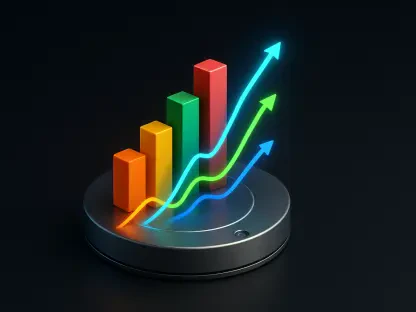

Users can now refine specific aesthetic details of a chart, such as changing colors or adding growth projections, by simply chatting with the assistant. This capability marks a dramatic shift in how humans interact with large language models, moving beyond the constraints of static text blocks into a more fluid and creative environment. Anthropic has reimagined the Claude interface to function as a collaborative canvas where complex ideas are instantly rendered into functional diagrams and charts. This transition effectively transforms the AI from a simple respondent into a sophisticated design partner capable of visualizing abstract concepts in real-time. By moving toward a visual-first philosophy, the platform addresses a long-standing limitation of generative AI: the difficulty of conveying spatial or numerical relationships through words alone. Instead of sifting through dense paragraphs to understand a trend, individuals can now interact with a dynamic whiteboard that updates as the conversation progresses for every user request that bridges the gap between digital thought and tangible graphic representation.
Underlying Mechanics: The Shift to Code-Based Graphics
Unlike early iterations of image-generating AI that relied on diffusion models to create pixels, Claude utilizes standard web technologies such as HTML and Scalable Vector Graphics (SVG) to construct its visual outputs. This architectural choice is significant because it allows the visuals to be treated as functional software components rather than static, unalterable files. Because SVG elements are defined by mathematical coordinates and code, they maintain perfect clarity at any scale and can be modified instantaneously by the underlying model. When a user requests a change to a chart, the AI does not redraw an entire image from scratch; instead, it revisits the existing code block and swaps out specific parameters to reflect the new data. This programmatic approach ensures that the output remains lightweight and responsive, fitting seamlessly into the browser environment without the heavy processing overhead typically associated with complex graphical rendering or video generation in modern systems.
The integration of live code execution within the chat window means that every visualization is essentially a living document that evolves alongside the dialogue. As the conversation shifts from a broad overview to a more granular analysis, the AI assistant can append new data points or reorganize the layout of a diagram to emphasize different variables. This creates a feedback loop where the visual representation and the textual explanation support one another, reducing the cognitive load on the human participant. For example, if a user identifies a discrepancy in a projected revenue graph, the assistant can immediately recalculate the coordinates and update the SVG paths to correct the trend line. This level of responsiveness is only possible because the system understands the structure of the code it generates, allowing for surgical precision when editing visual elements. Consequently, the workspace becomes an iterative environment where users can experiment with different what-if scenarios through a simple exchange.
Strategic Integration: Accessibility and Global Industry Impact
Anthropic has prioritized broad accessibility by rolling out these interactive features across its entire spectrum of user tiers, ensuring that even those on the free version can experience high-level data visualization. This democratization of design tools reflects a strategy aimed at making visual literacy a core component of digital communication. Currently, the full suite of interactive capabilities is optimized for web and desktop applications, providing the necessary screen real estate for complex renderings to flourish. While mobile applications on platforms like iOS and Android currently offer a more streamlined, text-centric experience, the groundwork has been laid for a future where high-fidelity graphics are consistent across all devices. For particularly intricate or data-heavy tasks, the high-end Opus model is recommended, as its superior reasoning capabilities ensure that multi-layered architectural maps or financial models maintain the highest degree of accuracy and aesthetic polish in every render.
The transition toward interactive graphics proved to be a pivotal moment for digital collaboration, offering a solution to the static nature of earlier language models. Users who adopted these visual tools early found that they could communicate abstract ideas more effectively, leading to faster decision-making processes in corporate and academic settings. By enabling these visualizations to integrate with established productivity platforms such as Figma and Slack, the system moved into the territory of professional design. This integration allowed users to export their AI-generated visuals into specialized environments, effectively bridging the gap between a private chat and a public presentation. As the industry moved away from purely conversational interfaces, the capacity to provide a multifunctional workspace became the new baseline for high-end AI utility. This evolution suggested that the future of human-AI interaction would be defined by a multimodal approach where the assistant functioned as a versatile engine.