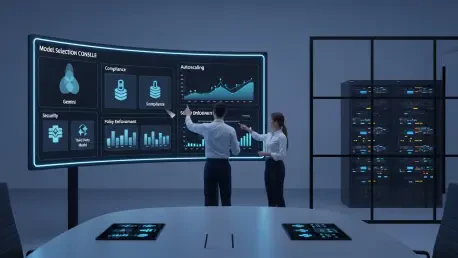

Boardrooms kept asking for proof that AI agents could manage messy, real-world work instead of chat-script parlor tricks, and the answer arrived with a staged but telling trial: a multi-agent system planning a full marathon through the chaos of Las Vegas while showcasing the entire lifecycle of enterprise AI engineering from design and development to deployment, evaluation, observability, and security. The demonstration did more than dazzle; it mapped a disciplined path from whiteboard flows to repeatable, governed operations, then released the code so teams could reconstruct every step. In a landscape where pilots often stall at the threshold of production, the Gemini Enterprise Agent Platform bundled the missing pieces—identity, policy, registry, runtime, memory, and rigorous evaluation—into a single stack meant to run at scale. Model choice was not an afterthought; by threading Gemini with Model Garden, the platform let a planner reason with Google’s models while another agent evaluated plans using a different model tuned for scoring. The keynote’s stakes were clear: reliability, not novelty, would decide whether agents earned a seat in enterprise systems.
What Google Unveiled
The announcement packaged the agent journey as a single continuum, compressing ideation, prototyping, and deployment into a toolchain that emphasized speed without discarding control. Teams started in Agent Designer to sketch behaviors with low and no-code flows, then exported Python scaffolding through the Agent Development Kit to codify prompts, tools, and memory policies. That handoff mattered because it cut out the brittle rework between demo and delivery, replacing throwaway prototypes with code primed for tests, evaluation runs, and CI pipelines. The capstone was a serverless Agent Runtime that absorbed orchestration and autoscaling, so application logic stayed focused on domain tasks rather than container tuning or traffic management. Through this lens, “going live” shifted from a leap to a glide path, with tracing, tool-call logging, and quota-aware scheduling stitched in from the start.
Building on this foundation, the platform’s leaders argued that production agents should be auditable components rather than opaque black boxes. To that end, Model Garden brokered model plurality, letting teams pick Gemini Pro or Flash for fast planning and slot a third-party model like Claude for risk-sensitive evaluation. The A2A protocol, contributed to the Linux Foundation, formalized cross-agent communication, while an Agent Registry served as a catalog where services could discover, authenticate, and cooperate without hardwiring endpoints. A2UI pushed interaction beyond text, enabling agents to emit interface elements that adapt to context and task state. Taken together, the stack resembled a microservices playbook—identity, policy, registry, logging—reimagined for autonomous systems that think, talk, and act in evolving contexts. The keynote used this framing to argue that enterprise-grade agents demand both cognitive flexibility and operational rigor.
Why It Matters for Enterprises
Enterprises did not need another coding sandbox; they needed a way to make agents dependable alongside ERP systems, data platforms, and security controls. The agent marathon scenario surfaced the non-negotiables: stateful memory that persisted across sessions, retrieval that grounded decisions in verified sources, and evaluators that enforced acceptance criteria independent of the planner’s enthusiasm. In this reading, Gemini’s edge was not only raw model capability but also the surrounding governance: immutable Agent Identities that bound actions to principals, policies enforced through an Agent Gateway, and a stable runtime that scaled agents without ceding visibility. These controls were meant to satisfy auditors and architects alike, enabling least privilege, zero-trust posture, and traceable outcomes even as agents invoked tools and models across domains.
Moreover, the stack addressed a frequent failure mode: brittle loops that toppled under variability. By encouraging multi-agent specialization—planners, evaluators, simulators—and enforcing A2A contracts, the platform created separations of concern that looked a lot like software architecture best practices. Evaluation became systematic rather than ad hoc, with a dedicated model and constrained context assessing compliance against metrics from canonical ones like the fixed marathon distance to qualitative factors like community impact and access to city services. Memory Bank supplied continuity so agents did not forget constraints after each turn, while RAG pipelines built on Document AI, Lightning Engine for Apache Spark, and AlloyDB with auto-embeddings kept decisions tied to trustworthy documentation. The bet was simple: if agents acted like production software in how they were governed, tested, and observed, they could be trusted with work that mattered.
Inside the Stack
The Agent Development Kit and Agent Designer anchored the build phase, translating product intents into executable behaviors. Designers could drag skills, slot tools, and define evaluation stages, then export code ready for tests and deployment. This scaffold encouraged engineers to separate concerns early: instruction templates for planners, acceptance rubrics for evaluators, and telemetry hooks for every tool call. A serverless Agent Runtime took over at go time, allocating compute, handling parallelism, and autoscaling agents based on load. That abstraction freed teams from babysitting infrastructure while still exposing metrics and traces for tuning. When teams needed low latency, the runtime supported colocation strategies so a customized “Gemma 4” instance could live inside a GKE cluster right next to tool-calling microservices.
Model Garden made model selection an implementation detail rather than a lock-in. A planner might run on Gemini Pro to balance reasoning depth and speed, while an evaluator scored candidate routes on a third-party model known for conservative judgments. Swapping models did not require a rearchitecture; the registry and A2A contracts kept collaboration stable, and policy enforcement rode along with Agent Identity at every hop. For state, Memory Bank backed session and long-term memory behind simple bindings so developers added durable context with minimal code. Retrieval tightened the loop: Document AI chunked policies and safety rules; Lightning Engine preprocessed and indexed large corpora; AlloyDB’s auto-embeddings enabled low-latency semantic search. A2UI extended responses beyond text, letting an agent emit a table, a map overlay, or a control panel as a first-class artifact that the client could render and wire to follow-on actions.
Demo: Planning a Marathon With Multi-Agent Collaboration
The keynote’s marathon made the abstract concrete. A planner agent proposed candidate routes through Las Vegas, a simulator agent populated runners and vehicles to stress-test those paths under non-deterministic conditions, and an evaluator agent scored results against formal rules and softer objectives. The planner used geospatial skills, each packaged with YAML metadata and Markdown bodies, to call a Google Maps MCP server for landmarks and constraints like road widths, public spaces, and staging areas. Users interacted through dynamic UI components generated via A2UI, which surfaced overlays for hydration stations, medical tents, and detours. Even a “Follow the leader” view illustrated how agent-defined experiences could adapt to context, switching from planning to live simulation data without reloading or manual configuration.
Evaluation provided the guardrails. The evaluator ran on a dedicated model with a narrowed context window to avoid tool bleed and prompt leakage, checking hard constraints such as the official marathon distance of 26 miles 385 yards (42.195 km) and verifying proximity to transit hubs and emergency access lanes. It then weighed qualitative factors, including predicted community impact based on operating hours, noise corridors, and venue calendars, pulling evidence through RAG pipelines backed by Memory Bank. That grounding mattered: one run surfaced an odd but authoritative rule—no camel on public roads—which the planner then had to accommodate by rerouting ceremonial elements off certain stretches. When the simulator stumbled, observability pinpointed the cause: Gemini API request chains had exceeded a one million context token limit because ADK’s Event Compaction was not trimming history often enough. Engineers adjusted token thresholds, redeployed, and restored stability, demonstrating how tracing and compaction policies turned vague failures into actionable fixes.
Engineering, Security, and Operations
Operational stories were not stagecraft; they mapped to real cost, latency, and resilience decisions. When the simulation’s “runners” component pushed start-up time north under heavy load, teams migrated it from Cloud Run to GKE and colocated a customized “Gemma 4” model in the same cluster. Gemini Cloud Assist flagged a model-loading bottleneck and recommended moving from GCS FUSE to Lustre for high-throughput I/O. That switch increased effective read bandwidth and smoothed tail latencies during scale-up, which mattered when route revisions triggered bursts of generation and simulation. These adjustments illustrated a broader point: agent systems are distributed systems, and token budgets, event compaction schedules, and storage choices show up as dollars on the bill and seconds on the clock.
Security landed as a first-class runtime concern rather than a post-hoc audit. Every agent instance carried a unique, immutable Agent Identity, and the Agent Gateway enforced IAM-backed policies on each call path. One policy set allowed the planner to read budgeting data but blocked any write to a finance tool, while another denied open internet egress to contain data exfiltration risks. An integration with Wiz added a red-team perspective: Wiz’s Red Agent traced an attack path through a potential authentication bypass to reach sensitive configuration data, then Wiz’s Green Agent proposed prioritized remediations such as downgrading IAM privileges, rotating secrets, and patching service images. After remediation, validation runs confirmed the issues were closed. The message was unambiguous: agent autonomy must operate within layered controls that detect, prevent, and verify, or the operational gains are not worth the exposure.
How Developers Build and Why Openness Counts
The developer journey followed a predictable arc with better tooling. Teams began in Agent Designer to sketch intent flows, attached domain skills drawn from internal playbooks, and used the ADK export to generate Python projects already wired for tracing, memory, and evaluation hooks. Skills combined human know-how with utilities such as GIS functions and remote MCP servers, helping planners reason with street closures while evaluators checked ADA guidance or crowd-flow policies. Deployment to the serverless Agent Runtime registered each agent in the Agent Registry, enabling clean A2A connections without brittle service discovery. With Memory Bank turned on, agents retained session state and institutional context, so follow-up requests built on what the system already knew rather than repeating a chatty interrogation.
Openness shaped the ecosystem strategy. Model Garden let teams mix Gemini with third-party models for specific roles; A2A, contributed to the Linux Foundation, codified how agents negotiated tasks; and A2UI opened the door for interface components that any compliant client could render. Crucially, the keynote’s marathon and tooling were open-sourced, complete with labs and architectural notes, so developers could reproduce the build and tailor it to domains like logistics, field service, or financial operations. This approach favored portability over lock-in and invited scrutiny that typically improves reliability. In practice, that meant a risk team could swap in a stricter evaluator model, or an operations unit could extend the simulator with industry-specific stressors, without refactoring the entire stack. The platform’s stance was clear: collaborative standards and reproducible patterns accelerate trustworthy adoption.
Path Ahead for Enterprise Teams
The next moves for enterprises had been concrete rather than aspirational: start by carving a single process into planner, evaluator, and simulator roles, then bind each to Agent Identity with explicit IAM policies before writing domain skills. Teams had profiled token usage during dry runs, set Event Compaction thresholds early, and kept evaluator contexts lean to avoid entanglement. For latency-sensitive paths, they had colocated models next to tools, measured cold-start behavior, and, where throughput lagged, switched from GCS FUSE to Lustre as Cloud Assist suggested. On the governance front, they had enforced egress restrictions at the Agent Gateway, documented registry entries with ownership and SLAs, and wired Wiz or an equivalent to validate assumptions through red-green cycles.
Strategically, leaders had treated agents as long-lived software components with CI/CD, test fixtures, and observability dashboards, not as ephemeral experiments. A2A contracts were versioned; A2UI components were cataloged with schema checks; and Memory Bank retention policies were aligned with compliance mandates. Before scaling beyond a pilot, teams had run simulation-based evaluations that mirrored production volatility, then locked in acceptance criteria the evaluator enforced with independent models. Finally, they had leaned on the open-sourced marathon patterns to shorten the path from concept to control, adapting RAG pipelines with Document AI, Lightning Engine, and AlloyDB auto-embeddings to ground responses in institutional truth. If those steps sounded procedural, that had been the point: the stack turned ambition into a playbook where autonomy met accountability, and that blend had distinguished experiments from enterprise-ready agents.