
The massive concrete walls of industrial research facilities no longer hold a monopoly on the creation of sophisticated autonomous systems as the democratization of hardware continues to accelerate at an unprecedented pace. This fundamental shift mirrors the personal computer revolution that redefined the late twentieth century, moving the needle of innovation away from high-capital laboratories toward a decentralized ecosystem of independent startups, academic labs, and suburban home workshops. In this contemporary landscape, the speed of technological advancement is no longer tethered to the whims of corporate gatekeepers who once controlled the flow of high-grade components and proprietary documentation. Instead, a much broader demographic of engineers, hobbyists, and researchers is empowered to solve complex challenges in mobility, sensing, and autonomy using shared blueprints and accessible tools. Historically, the robotics sector was defined by extreme financial and technical barriers that required multi-million dollar investments and elite teams of specialists. However, the convergence of high-performance sensors, commodity computing, and sophisticated additive manufacturing has driven the entry price of development to historic lows. A proof-of-concept robot that once demanded a budget comparable to a luxury estate can now be conceptualized and assembled for roughly the cost of a professional-grade laptop, effectively sparking a global wave of grassroots experimentation that ignores traditional geographic and economic borders.
Digital Sovereignty: Microcontrollers and Single-Board Computers
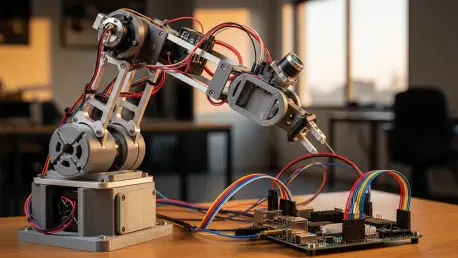
The proliferation of accessible microcontrollers like the Arduino ecosystem has established a robust electronic foundation that functions as the primary nervous system for modern decentralized robotics. By simplifying the interaction between code and physical movement, these platforms have successfully stripped away the intimidating complexities once associated with embedded electronics and low-level firmware development. The open nature of these hardware designs has encouraged a massive, worldwide manufacturing base, ensuring that compatible components, expansion shields, and sensor modules are readily available to any developer with an internet connection. This availability means that a student in a developing nation can access the same precise motor control and sensor integration capabilities as a researcher at a top-tier university. Furthermore, the extensive libraries of community-contributed code allow for the rapid implementation of complex behaviors, such as PID control or serial communication protocols, without the need for a deep background in computer engineering. This collective intelligence has effectively transformed the microcontroller from a specialized tool into a universal building block for physical computing and mechanical automation.
While microcontrollers handle the immediate reflexive actions of a machine, high-level cognitive tasks are now frequently delegated to powerful single-board computers like the Raspberry Pi. These low-cost, Linux-based systems provide the significant computational overhead required for demanding applications such as computer vision, real-time networking, and sophisticated simultaneous localization and mapping. By running full-scale operating systems, these boards allow developers to leverage the Robot Operating System, which has become the industry standard for creating interoperable robotic software modules. The transition to these standardized computing platforms has drastically reduced the time spent on fundamental plumbing, such as writing drivers for cameras or managing wireless data streams. Instead, engineers can focus their energy on high-level logic and behavioral design, utilizing the immense processing power that was once reserved for expensive, heavy industrial workstations. The portability and energy efficiency of these boards further enable the creation of compact, mobile robots that can operate autonomously in diverse environments, from cluttered indoor offices to rugged outdoor terrains, without being tethered to external servers.
Mechanical Accessibility: Digital Fabrication and Standardized Frameworks
The physical manifestation of robotic systems has undergone a radical transformation through the widespread adoption of additive manufacturing and digital fabrication techniques. Initiatives like the RepRap project have turned 3D printing into a ubiquitous utility, enabling the rapid prototyping of structural components and complex mechanical assemblies in a matter of hours rather than weeks. This shift eliminates the need for expensive tooling or reliance on external machine shops, which previously acted as significant bottlenecks for smaller teams with limited budgets. Because the design files for these components are typically shared in open-source CAD formats, a mechanical improvement developed by a hobbyist in Europe can be downloaded, modified, and printed by a startup in North America almost instantaneously. This digital supply chain fosters a culture of iterative design where mechanical flaws are identified and corrected by a global community of contributors. The ability to print specialized parts, such as custom end-effectors or lightweight chassis frames, allows for a level of customization and specialization that was previously impossible for anyone without access to high-end industrial manufacturing equipment.
Beyond individual components, the emergence of standardized robotic platforms has provided a common baseline for researchers to conduct repeatable experiments and share their findings. Systems like the TurtleBot or the OpenManipulator serve as open-source reference designs that provide a reliable, well-documented starting point for various applications in mobile navigation and robotic grasping. By adopting these standardized platforms, developers can bypass the tedious process of designing a functional mobile base or a multi-axis arm from scratch, allowing them to jump directly into solving higher-level research problems. This interoperability ensures that software developed for one TurtleBot will likely function on thousands of others worldwide, creating a unified ecosystem where code and hardware are seamlessly integrated. This standardization has been instrumental in accelerating the pace of academic research, as laboratories can now build upon each other’s work with a high degree of confidence and consistency. The existence of these blueprints has effectively lowered the barrier to entry for educational institutions, making it possible for undergraduate students to work with the same hardware and software stacks used by leading industrial researchers.
Economic Disruption: Lean Startups and Hybrid Industrial Models
The economic landscape of the robotics industry has been permanently altered by the availability of open-source hardware, fundamentally changing how new ventures are launched and funded. In the previous decade, a significant portion of early-stage venture capital was consumed by the intensive research and development required to build basic proprietary hardware from the ground up. Today, lean startups are leveraging existing open-source foundations to build functional, high-fidelity prototypes at a fraction of the traditional cost and time. This strategic shift allows these organizations to preserve their capital and focus their limited resources on developing unique software algorithms, specialized sensor integrations, or specific industry-focused applications. Investors are now more likely to support teams that demonstrate rapid progress using off-the-shelf, open-source components, as the technical risk associated with building the fundamental machine has been largely mitigated. This trend has led to a more diverse market where niche robotics companies can survive and thrive by solving localized problems in sectors like precision agriculture, urban delivery, and environmental monitoring without the burden of massive overhead.
Despite the rapid rise of open-source solutions, the industry has maintained a productive synergy with proprietary systems, evolving into a sophisticated hybrid model of development. Industrial environments and critical infrastructure often require the specific safety certifications, rigorous reliability guarantees, and long-term technical support that only established proprietary manufacturers can provide. In this context, open-source hardware acts as a powerful engine for experimentation and proof-of-concept development, while proprietary systems manage the heavy-duty demands of large-scale commercial deployment and safety-critical operations. Large corporations have recognized the value of this ecosystem, frequently contributing back to open-source projects to benefit from the community’s rapid debugging and feature expansion. This collaborative approach allows for a faster transition from laboratory discovery to factory-floor implementation, as the underlying architectures often share common communication protocols and software frameworks. Consequently, the boundary between “open” and “closed” has become increasingly porous, with many of the world’s most advanced robotic fleets running on a foundation of open-source principles even if the final hardware is sold as a proprietary product.
Intelligent Embodiment: The Intersection of Open Hardware and Physical AI
The current phase of democratization is characterized by the integration of open hardware with physical artificial intelligence and embodied intelligence models. There is a growing movement toward robots that learn to interact with their environment through data-driven training and foundation models rather than through rigid, manual programming sequences. In this paradigm, open-source hardware provides the essential physical bodies required to collect massive amounts of real-world data, which is then used to train the next generation of intelligent machines. By keeping the hardware designs open and accessible, the community ensures that the development of AI-driven robotics remains a collaborative and transparent effort rather than a black-box technology controlled by a few dominant firms. This approach is particularly vital for the development of humanoid robots and general-purpose assistants, where the complexity of the physical movements requires constant refinement and diverse testing environments. The ability to share trained neural network weights that are compatible with standardized open hardware means that a breakthrough in robotic dexterity can be disseminated as easily as a software update, further accelerating the collective intelligence of the entire ecosystem.
The transition toward a democratized robotics landscape required organizations to prioritize interoperability and community engagement over traditional secrecy. Developers recognized that the path to widespread adoption involved creating modular systems where components from different manufacturers could communicate through open protocols. Companies that successfully navigated this shift focused on building robust developer kits and comprehensive documentation, ensuring that their hardware was easy to integrate into the existing open-source pipeline. Research institutions played a critical role by adopting these open standards for their curriculum, which produced a workforce of engineers who were already fluent in the tools of the decentralized movement. Looking ahead, the focus moved toward establishing more rigorous safety and security standards for open-source designs, ensuring that these accessible machines could be safely deployed in public spaces and shared human environments. By fostering a culture of open collaboration and radical transparency, the robotics community effectively dismantled the barriers that once limited innovation, paving the way for a future where the power of autonomous technology is available to solve the world’s most pressing challenges across every continent and industry.