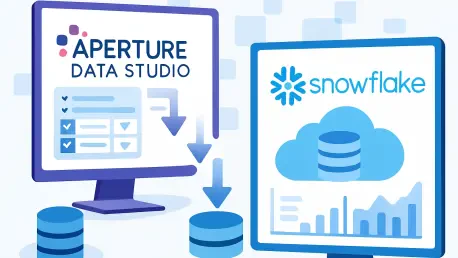

In a strategic maneuver that could redefine the foundations of enterprise data management, the global data giant Experian has deeply integrated its flagship Aperture Data Studio directly into Snowflake’s AI Data Cloud, challenging a decades-old paradigm of data processing. Announced in early 2025, this collaboration is far more than a simple technical handshake; it represents a profound bet on a future where data quality and enrichment tools are brought directly to the data, rather than requiring massive datasets to be moved across different environments. This native integration addresses long-standing bottlenecks related to data friction, operational efficiency, and governance, positioning itself as a pivotal development for businesses aiming to harness the full potential of their data for advanced analytics and artificial intelligence initiatives. The move signals a critical industry convergence, where the power of specialized data management is fused with the scale and security of centralized cloud platforms, potentially setting a new standard for how organizations cleanse, manage, and leverage their most valuable asset.
A Fundamental Shift in Architecture
For years, the process of ensuring data quality has been a cumbersome and inefficient cycle that data teams know all too well. Organizations had to undertake the complex procedure of extracting vast volumes of information from a central repository like Snowflake, transferring it to a separate, external environment for processing in a tool such as Experian’s, and then painstakingly reloading the cleansed data back into the source platform. This constant movement of data was not just slow; it was a major source of operational expense, introducing significant latency that hindered real-time analytics and created numerous security vulnerabilities. Every transfer outside the secure perimeter of the data cloud represented a potential point of failure, data breach, or compliance violation, making the entire process a high-stakes balancing act for data engineers and governance officers. This traditional approach created a significant barrier to agility, forcing businesses to choose between data quality and speed.
The Experian-Snowflake native integration fundamentally dismantles this outdated model by bringing the full suite of data management capabilities directly into the Snowflake environment. Joint customers can now execute complex workflows, including data profiling, cleansing, standardization, validation, and enrichment, without their data ever leaving the secure and governed confines of the AI Data Cloud. This architectural evolution delivers immediate and substantial benefits, starting with a dramatic reduction in latency that allows data quality improvements to be reflected almost instantaneously—a critical advantage for operational workflows and real-time decision-making. Furthermore, it significantly lowers the total cost of ownership by eliminating data egress fees, the need for separate processing infrastructure, and the extensive engineering hours required to build and maintain fragile data pipelines. By streamlining the entire process into a seamless, in-platform experience, the partnership makes advanced data management more accessible and less intrusive for modern enterprises.
Riding the Waves of Industry Transformation
This landmark partnership serves as a clear bellwether for several powerful trends shaping the future of enterprise data. The most prominent among them is the strategic imperative for best-of-breed software vendors to “meet the data where it lives.” As cloud data platforms like Snowflake, Databricks, and Google BigQuery increasingly become the gravitational centers for corporate data, standalone tools that require data to be moved are rapidly losing their viability. Experian’s move to embed its capabilities within Snowflake is a shrewd tactical decision, acting as both a defensive strategy to maintain relevance in a cloud-centric world and an offensive maneuver to tap into Snowflake’s expansive and growing customer base as a new distribution channel. This approach acknowledges that the value is no longer just in the tool itself, but in its seamless integration into the ecosystems where customers already operate.
The timing of this integration is strategically aligned with the enterprise-wide push toward adopting artificial intelligence and machine learning. It is a well-established fact that the reliability of any AI model is fundamentally dependent on the quality of the data used for its training; incomplete, inconsistent, or inaccurate data inevitably leads to flawed outcomes such as biased predictions and poor decision-making. These AI failures can carry severe financial and reputational consequences. By providing a streamlined path to cleanse, validate, and enrich data directly within the Snowflake platform before it is fed into AI pipelines, the Experian integration directly addresses a critical prerequisite for successful AI deployment. This aims to slash the significant portion of a data scientist’s time—often estimated at 60 to 80 percent—that is typically spent on manual data preparation, thereby accelerating the development and deployment of trustworthy and effective AI solutions.
The Unmatched Value of In-Place Enrichment
While several data quality vendors operate within the Snowflake ecosystem, the integration with Experian offers a compelling value proposition that extends far beyond standard functionalities. The most significant differentiator is Experian’s vast repository of proprietary reference data. The company maintains one of the world’s most extensive and curated collections of consumer and business data, including highly accurate address verification databases and detailed demographic information. The native integration allows Snowflake customers to securely enrich their internal datasets with this valuable external data without their sensitive information ever leaving their own controlled environment. This capability for secure, in-place enrichment provides a powerful competitive advantage, enabling organizations to build deeper customer profiles, improve analytical models, and gain richer insights in a manner that is both highly efficient and compliant with stringent privacy regulations.
This partnership had far-reaching implications for the broader data landscape. For Snowflake, hosting a premier application from a major industry player like Experian significantly strengthened its strategic “ecosystem moat.” By continuing to expand its array of high-quality, native partner applications, Snowflake made its platform stickier and more indispensable to its enterprise customers, increasing the value proposition and making it more difficult for competitors to lure them away. For enterprise data teams, the integration delivered a more streamlined and effective data management experience, promising the consolidation of tools, the simplification of vendor management, and a faster time-to-insight. This collaboration ultimately exemplified the future of enterprise data management, a future where data quality was no longer a siloed, after-the-fact activity but a seamless and embedded component of the core data platform itself.