
The long-standing dominance of centralized artificial intelligence is finally meeting its match as the capability to run sophisticated, large language models on personal hardware moves from a niche hobby to a viable professional standard. This shift represents more than just a technical curiosity; it is a fundamental realignment of the relationship between a developer and their tools. By transitioning the “brain” of the development environment from a distant data center to the local silicon sitting under a desk, engineers are reclaiming a level of autonomy that seemed lost in the era of subscription-fed cloud services. This review explores how local workflows are currently redefining the software engineering sector, assessing whether today’s consumer hardware can truly handle the cognitive demands of modern coding.
The Shift Toward Local AI Development Infrastructure
The transition from proprietary, cloud-hosted AI services to local execution marks a significant departure from the “black-box” model of software development. For years, the industry leaned heavily on API calls to massive clusters, trading data privacy and long-term cost-efficiency for immediate access to high-tier reasoning. However, as 2026 progresses, a growing cohort of developers is prioritizing data sovereignty. The ability to process sensitive intellectual property without it ever leaving the local machine is a powerful motivator, especially for sectors governed by strict compliance and security protocols.
This move is fueled by the emergence of small-parameter models, most notably the Qwen3.5 family, which have challenged the notion that size is the only metric of intelligence. These models demonstrate that high-quality training data and architectural efficiency can allow a compact engine to rival the performance of much larger, cloud-bound predecessors. Consequently, the reliance on a constant internet connection and the recurring expense of token-based billing is becoming an optional luxury rather than a mandatory requirement for AI-assisted engineering.
Core Components of the Local Development Ecosystem
Hardware Benchmarks and VRAM Constraints
The feasibility of local inference is strictly governed by the physical limitations of the graphics processing unit, specifically the Video Random Access Memory (VRAM). In a typical consumer-grade setup, such as one featuring an NVIDIA RTX 5060, the 8GB of available memory acts as a hard ceiling for performance. When a model’s weights exceed this capacity, the system is forced to offload calculations to the much slower system RAM and CPU, resulting in a “token-per-second” rate that is too sluggish for a real-time coding environment.
Maintaining acceptable inference speeds requires a delicate balance between the model’s complexity and its memory footprint. If the entire model cannot fit within the VRAM, the interactive nature of the workflow breaks down. This constraint necessitates a trade-off where developers must often choose between a larger, more intelligent model with a tiny context window or a smaller model that can remember more of the codebase but might lack the deep reasoning needed for complex debugging.
Middleware and Integration Tools
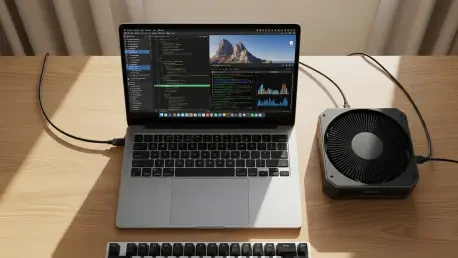
Running a model locally is only half the battle; the other half is integrating that model into the professional tools developers use daily. Middleware like LM Studio serves as the essential infrastructure, acting as a local host that manages the model’s execution and provides a standardized API endpoint. This setup allows the local machine to mimic the behavior of a cloud provider, essentially “tricking” development tools into thinking they are talking to a remote server while the data remains strictly local.
The bridge to the Integrated Development Environment (IDE) is typically completed by extensions like Continue for Visual Studio Code. These tools facilitate the bidirectional communication required for features like inline code completion and chat-based refactoring. By creating this software bridge, developers can maintain their existing habits and shortcuts while swapping out the expensive, privacy-invasive backend for a local alternative that operates under their total control.
Model Specialization and Quantization Techniques
Optimization is the secret sauce that makes local development viable on mid-range hardware. Techniques like quantization—where the precision of a model’s weights is reduced from 16-bit to 4-bit or 5-bit—allow larger models to fit into smaller memory spaces with surprisingly little loss in “intelligence.” The Qwen3.5 family exemplifies this, offering various parameter counts that allow developers to tailor their setup to their specific hardware constraints.
Beyond mere compression, the rise of distilled variants has changed the landscape. These versions are trained using the outputs and reasoning paths of much larger “teacher” models, effectively “distilling” high-level logic into a smaller, more efficient package. This means a 9-billion parameter model can often exhibit the architectural understanding of a much larger engine, providing a significant boost to a developer’s local capabilities without requiring a server-grade hardware investment.
Emerging Trends in Local Model Optimization
A pivotal trend in the current landscape is the move toward “distilled reasoning” models that prioritize logical consistency over broad, general knowledge. Developers are increasingly moving away from using AI as a general-purpose search engine and toward using it as a specialized “consultant.” This behavior shift reflects a maturing understanding of AI’s role; instead of asking an autonomous agent to build an entire application, engineers are using local models to solve specific, isolated logic problems where privacy is paramount.
Moreover, the community is focusing on optimizing the “attention” mechanisms within these models to handle longer context windows on limited hardware. By improving how a model prioritizes which parts of a codebase to look at, developers can feed larger portions of their projects into the local engine without a linear increase in memory usage. This efficiency is critical for maintaining a “consultant” workflow where the AI has enough context to be useful but stays within the boundaries of consumer-grade VRAM.
Real-World Applications in Software Engineering
In practical, day-to-day scenarios, local LLMs have proven remarkably effective for static code analysis and architectural brainstorming. Developers are utilizing these models to refactor legacy Python utilities, modularize monolithic scripts, and manage complex environment configurations. Because the model is local, there is no latency associated with uploading large files to a server, allowing for a rapid-fire iteration cycle where a developer can test multiple architectural patterns in minutes.
These implementations often focus on the “heavy lifting” of structural changes that do not require external API access. For instance, a developer might use a local Qwen3.5 instance to identify circular dependencies in a project or to generate comprehensive type hints for an untyped codebase. In these cases, the local model acts as a highly capable pair programmer that understands the private logic of the project without ever risking a data leak or incurring an external cost.
Technical Hurdles and Functional Limitations
Despite the progress, a significant “agentic gap” remains between local models and their cloud-hosted counterparts. While a local model can discuss code brilliantly, it often struggles when tasked with autonomous tool use, such as actually writing to the file system or managing multi-step execution chains. This frequently leads to syntax corruption or “internal looping,” where the model becomes stuck in a logic cycle and fails to produce a usable output, occasionally even mangling file indentation to the point of breakage.
Furthermore, the competition for memory between the model’s reasoning weights and the context window remains a primary obstacle. As a project grows, the amount of “memory” required to hold the relevant code snippets in the model’s mind increases. On an 8GB or 12GB card, this often means that as the developer provides more context, the model has less “room” to think, leading to a noticeable decline in the quality of its suggestions and an increase in hallucinated logic.
Future Outlook and the Path to Autonomous Local Agents
The trajectory of this technology points toward a future where local models will eventually close the gap in autonomous tool use. Improvements in attention efficiency and the release of hardware with higher VRAM capacities at consumer price points will likely provide the “breathing room” these models need to manage complex file manipulations. As the software and hardware continue to converge, the role of the local AI will evolve from a passive consultant into an active agent capable of managing entire refactoring pipelines independently.
We are likely to see a shift where the “middle-ground” models become the industry standard for daily development. These models will likely feature even better distillation from massive “frontier” models, allowing for near-perfect syntax and logic on hardware that is currently considered entry-level. This evolution will further decentralize the power of AI, making high-tier development assistance a standard feature of the local workstation rather than a rented service.
Final Assessment of Local Development Workflows
The current state of local LLM development workflows provided a compelling look at a technology in a critical transition phase. It was clear that while local models have mastered the art of high-level guidance and architectural advice, they were not yet reliable enough for fully autonomous code manipulation. The tendency for models to corrupt file structures or lose their logical thread during complex tasks highlighted the remaining gap between localized inference and high-end cloud-hosted agents.
However, the value of these workflows as private, cost-effective consultants was undeniable. For the modern developer, the ability to iterate on private codebases without external data transmission or recurring costs offered a level of freedom that outweighed the current functional limitations. The movement toward local AI was established as a viable path for those prioritizing security and efficiency, signaling that the future of software engineering lies in a hybrid approach where the local machine finally regains its status as the primary seat of intelligence. To move forward, developers should begin integrating these local consultants into their brainstorming phases while maintaining manual control over final file commits to ensure structural integrity.