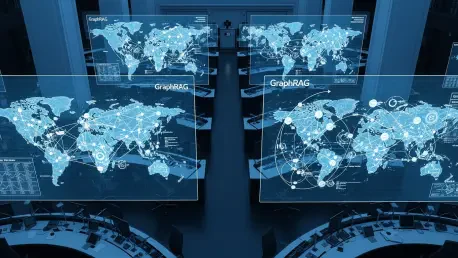

The relentless accumulation of unorganized data within modern corporate infrastructure has historically created an insurmountable barrier to achieving true artificial intelligence autonomy. As of 2026, the transition from traditional, isolated data silos toward fluid, interconnected architectures known as Enterprise Knowledge Graphs has become a defining characteristic of the digital landscape. These sophisticated systems do more than simply store information; they map out entities and their complex, multi-dimensional relationships to provide a level of context that both human operators and machine learning algorithms can intuitively understand. By imbuing raw data with semantic meaning, companies are finally successfully bridging the long-standing gap between simple information storage and actionable business intelligence. The market for this technology is currently positioned for massive expansion, with projections suggesting a rise from a valuation of approximately $1.05 billion in 2026 to an impressive $6.55 billion by 2036. This rapid trajectory is primarily fueled by a direct and urgent response to the rigorous demands of generative AI, which requires high-quality, structured data to function effectively within a high-stakes corporate environment. Without this foundational layer, many AI initiatives have historically struggled to move beyond the experimental phase, failing to deliver the scale or precision required for global enterprise deployment.
Enhancing Reliability: Building Trust Through Semantic Context
A primary driver for the current market growth is the urgent need for what industry experts call trustworthy AI, which must operate without generating the false or misleading information commonly known as hallucinations. Knowledge graphs provide the necessary ground truth to anchor artificial intelligence models in factual, organization-specific data, which significantly reduces the risk of incorrect outputs. By providing a structured reference point, these graphs allow large language models to verify their generated responses against the actual state of the company’s records. This makes artificial intelligence significantly safer for customer-facing applications and mission-critical production environments where even a minor error can lead to substantial financial or reputational damage. When an AI system can query a knowledge graph to confirm the relationship between a specific product and its regulatory requirements, the level of reliability increases exponentially compared to models relying solely on probabilistic text generation. Consequently, the enterprise sector is seeing a shift where accuracy is no longer a luxury but a fundamental requirement for any deployed system.
Furthermore, these knowledge graphs serve as a vital semantic fabric that weaves together data from legacy systems, cloud buckets, and various disparate applications into a single, cohesive view. For Chief Information Officers, this unification has become a top priority as it effectively eliminates the fragmentation that has plagued corporate IT departments for decades. By creating a holistic and interconnected view of the entire enterprise, organizations can accelerate their decision-making processes and vastly improve overall operational efficiency across all departments. This semantic integration layer allows users to ask complex questions that span multiple databases, such as how a supply chain delay in a specific region might affect the quarterly sales targets for a particular product line. In the past, answering such questions required manual data extraction and reconciliation that could take days or weeks. Today, the knowledge graph enables these insights in real-time, providing a competitive edge that is becoming increasingly indispensable for navigating the complexities of the modern global economy.
The Shift Toward GraphRAG: Transitioning to Advanced Contextual Reasoning
A pivotal trend currently reshaping the technology market is the transition from traditional Retrieval-Augmented Generation to a more sophisticated approach known as GraphRAG. While traditional models often retrieve information from flat, unstructured text, GraphRAG utilizes the structured relationships within a graph to enable deeper reasoning and more nuanced understanding of organizational logic. This allows AI systems to identify indirect connections between business entities that would otherwise be missed by standard keyword searches or simple vector embeddings. For example, GraphRAG can trace the influence of a specific regulatory change through a web of contracts, supplier relationships, and internal policies to provide a comprehensive impact analysis. By understanding the “why” and “how” behind data points, rather than just the “what,” enterprises are able to build systems that reflect the actual complexity of their business operations. This shift is essential for moving beyond basic chatbots toward sophisticated reasoning agents that can assist in high-level strategic planning and complex problem-solving.
As enterprises seek more intelligent and responsive platforms, the demand for sophisticated ontology management is also experiencing a significant rise. This process involves the meticulous definition of specific categories, properties, and the intricate relations between data points to ensure the entire system remains both reliable and scalable as the data volume grows. By 2026, these advanced infrastructure needs are expected to account for a substantial portion of the total market demand, reflecting a maturing understanding of data architecture. Effective ontology management ensures that as new data sources are added, the knowledge graph can integrate them without breaking existing logical connections or creating inconsistencies. This structural integrity is what allows a knowledge graph to function as a living map of the organization, evolving alongside the business while maintaining a consistent and accurate representation of its core assets. The focus on ontology signifies a shift from merely collecting data to actively managing knowledge as a strategic asset that powers the next generation of enterprise intelligence.
Technical Pillars: Solving the Entity Resolution Challenge
Metadata and entity graph platforms are currently leading the charge in the technical sector, specifically by solving the difficult and persistent problem of entity resolution. These platforms are designed to identify when different data points across various internal systems actually refer to the same real-world object, such as a specific customer, a specific product part, or a single legal entity. This creates a unified metadata layer that is an absolute prerequisite for any successful AI strategy, ensuring that the AI is not confused by redundant or conflicting information records. Without effective entity resolution, an organization might have ten different profiles for the same client across different departments, leading to fragmented service and inaccurate analytics. By resolving these discrepancies, knowledge graphs provide a clean, single source of truth that serves as the bedrock for all downstream AI applications. This technical foundation allows for more personalized customer experiences and more accurate risk assessments, as the system can finally see the complete picture of every entity it interacts with.
Because the technology behind these systems involves complex graph theory and semantic web standards, many companies are increasingly turning to managed implementation services to bridge the skills gap. Third-party experts handle the intricate design, deployment, and ongoing optimization of these complex ecosystems, allowing businesses to reap the benefits of a knowledge graph without needing to build an entire internal department of specialists from scratch. These services are particularly valuable for organizations that lack the deep technical expertise required to navigate the complexities of triple stores, query languages like SPARQL or Cypher, and the logic of semantic reasoning. By outsourcing the foundational build-out, companies can focus their internal resources on developing the specific AI applications that will drive their unique business value. This model of managed services is accelerating the adoption of knowledge graphs across the board, making advanced data architecture accessible to a wider range of organizations regardless of their internal technical maturity or historical legacy constraints.
Sector Adoption: High-Stakes Use Cases Across Industry Verticals
The adoption of knowledge graphs is currently most aggressive in sectors characterized by high data complexity and strict regulatory requirements, with banking and financial services leading the way. Financial institutions are utilizing these tools for high-stakes applications such as fraud detection and anti-money laundering, where they map the relationships between millions of accounts and locations to identify suspicious patterns. By visualizing these connections in a graph format, analysts can quickly spot circular transactions or hidden links between seemingly unrelated entities that traditional relational databases would likely overlook. This capability is not just about efficiency; it is about maintaining the integrity of the global financial system in an era where cybercriminals are using increasingly sophisticated methods to hide their tracks. The knowledge graph provides the transparency and traceability required to meet stringent compliance standards while simultaneously improving the accuracy of risk models and reducing the incidence of false positives in fraud detection systems.
Other critical industries, including healthcare and manufacturing, are also seeing significant contributions and improvements from the implementation of this technology. In the healthcare sector, knowledge graphs are facilitating accelerated drug discovery and comprehensive patient journey mapping by connecting disparate research papers, clinical trial results, and patient electronic health records. Meanwhile, in the manufacturing sector, these systems support the creation of digital twins, which are virtual representations of physical assets and supply chains that help predict maintenance needs and optimize production schedules. By mapping every component of a manufacturing process within a graph, companies can simulate the impact of a part failure or a logistics delay before it happens, allowing for proactive rather than reactive management. These sector-specific applications demonstrate that knowledge graphs are not just a general IT tool, but a versatile foundation that can be tailored to solve the unique challenges of different industries, driving innovation and resilience across the entire global economy.
Geographic Landscapes: Regional Growth Leaders and Market Dynamics
North America currently remains the largest market for enterprise knowledge graphs, sustained by a high concentration of technology giants and a highly advanced cloud infrastructure. The region’s early investment in AI research and development has provided a fertile environment for the maturation of semantic technologies, with many of the leading platform providers headquartered in this geography. However, the Asia-Pacific region is emerging as a primary engine of growth, with India projected to be the fastest-growing market globally due to massive digitization efforts and a booming AI innovation ecosystem. The push for digital transformation in these rapidly developing economies is creating a unique opportunity to leapfrog older technologies and adopt graph-based architectures from the outset. As businesses in these regions scale, the need for efficient data management becomes paramount, driving a surge in local demand for both the software and the specialized services required to implement knowledge graphs at a national and international scale.
In Europe, market growth is being driven by the dual need for regulatory compliance and the modernization of robust manufacturing bases in countries like Germany and the United Kingdom. Strict data privacy laws, such as the General Data Protection Regulation, have made the transparency and traceability offered by knowledge graphs particularly attractive for European enterprises. Meanwhile, Singapore has established itself as a global hub for financial technology, where proactive government stances on AI governance make it a fertile ground for the adoption of semantic technologies. The city-state’s focus on creating a trusted environment for digital innovation has encouraged financial institutions to invest heavily in knowledge graphs to ensure their AI systems are both compliant and explainable. This regional diversity illustrates that while the underlying technology is the same, the drivers for adoption vary significantly based on local economic priorities and regulatory environments, creating a complex and vibrant global market for enterprise knowledge management solutions.
Navigating Implementation: Overcoming Barriers for Strategic Resilience
Despite the overwhelmingly optimistic outlook for the market, businesses still face several significant hurdles, including a notable talent shortage and the technical complexity of integrating new models with deeply entrenched legacy systems. Success in this field depends heavily on maintaining high data quality, as even the most sophisticated knowledge graph cannot produce reliable or actionable insights if the underlying information is fundamentally flawed or outdated. Organizations must invest not only in the technology itself but also in the data governance practices that ensure the information entering the graph is accurate and well-documented. Furthermore, the cultural shift required to move from a siloed mindset to an interconnected data strategy cannot be underestimated. Employees across the organization must understand how their data contributes to the larger knowledge ecosystem, requiring a concerted effort in training and change management to ensure the long-term viability of the graph initiative.
Looking toward the next decade, the role of the knowledge graph is expected to expand into the central operating system for enterprise artificial intelligence. Future trends include the development of autonomous AI agents that use graphs as a form of long-term memory, allowing them to learn and adapt based on a deep understanding of the historical context of the business. Additionally, the rise of multimodal graphs that incorporate video, audio, and sensor data will provide a truly comprehensive representation of information, making the knowledge graph an indispensable asset for any data-driven organization. To prepare for this future, leaders should have prioritized the construction of a robust semantic layer and sought out partnerships that provided the necessary technical expertise. By focusing on entity resolution and ontology management today, organizations secured their ability to scale AI effectively. The transition toward knowledge-driven architectures proved to be the most critical step in ensuring that artificial intelligence moved beyond a mere curiosity to become the primary driver of enterprise value and operational resilience.