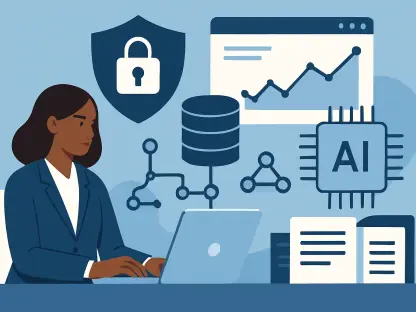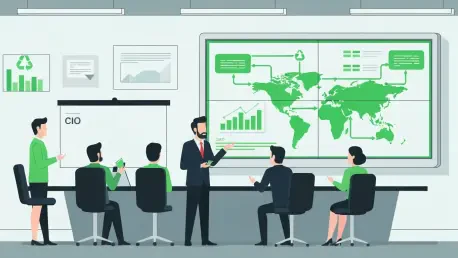

In a world where technology is no longer just a department but the very core of business strategy, the role of the Chief Information Officer is undergoing a seismic shift. To explore this transformation, we’re joined by Chloe Maraina, a leading Business Intelligence expert renowned for her ability to translate complex data into clear strategic narratives. With a keen eye for the future of data management and integration, she has charted the course for how leadership must adapt to an AI-driven world. Today, she shares her insights on how the CIO role is expanding beyond traditional IT, encompassing new mandates for AI governance, strategic platform consolidation, and corporate sustainability, ultimately recasting the CIO as a central architect of enterprise-wide innovation.
You mention that a “responsible AI” mandate will become non-negotiable. Beyond the concept, what are the first concrete steps a CIO should take to build a governance framework that spans the entire AI lifecycle, from data sourcing to monitoring, and satisfies both regulators and customers?
That’s a critical question because the move from theory to practice is where the real work lies. The very first step isn’t technical; it’s organizational. A CIO must establish a cross-functional council that includes legal, ethics, and business unit leaders, not just technologists. Once that team is in place, the initial focus should be on creating a documented framework for data sourcing. You have to be able to answer, with absolute certainty, where your data comes from and whether it carries inherent biases. From there, you build out requirements for model transparency and explainability before a single line of code for a new model is deployed. This isn’t just a legal checkbox; it’s about building trust. You have to be prepared for regular audits and have clear lines of ownership for risk assessment at every stage, from training to ongoing monitoring in a live environment.
The article predicts a shift from SaaS sprawl to AI-driven consolidation. Can you walk us through the strategic process for this transition? What metrics would you use to measure success, and how do you prevent these consolidated platforms from becoming single points of failure?
Absolutely. The transition away from the chaos of managing dozens of niche applications begins with a ruthless audit. CIOs must map their entire landscape of point solutions and measure their true cost, not just in licensing fees but in integration overhead and security vulnerabilities. The next step is to identify core business functions that can be orchestrated by a single, intelligent, AI-first platform. Success isn’t just about cost reduction, though that’s a key metric. We should also be measuring the decrease in integration complexity and the strengthening of our security posture. To avoid creating a single point of failure, which is a very real danger, governance is paramount. This means you can’t just plug in a new mega-platform and walk away. It requires a new model of continuous oversight, built-in redundancies, and a clear strategy for how the platform can flex and adapt without causing enterprise-wide disruption.
You describe the CIO role evolving from Information Technology to “Enterprise Technology,” focused on engineering business outcomes. Could you share an example of how a CIO might assemble LLMs to solve a specific business problem and what new skills their team needs to deliver that intelligence?
This is where the role gets truly exciting. Imagine a common business problem: improving customer retention by proactively identifying at-risk clients. The old approach was to buy a SaaS tool for this. The new “Enterprise Technology” leader doesn’t just buy a tool; they engineer a solution. They might assemble a workflow using multiple specialized LLMs. One LLM could analyze sentiment from support tickets and communications, another could scan transaction histories for changes in behavior, and a third could synthesize this data to draft a personalized outreach plan for the customer success team. The CIO’s team is no longer just managing infrastructure; they are delivering intelligence. This requires a significant skill shift. You need data scientists who understand model integration, AI workflow engineers who can orchestrate these complex processes, and product managers who can translate a business need into a technical solution. It’s a fundamental move from being a consumer of technology to a creator of business value with it.
The article positions the CIO as the lead sustainability steward. Besides compliance reporting, what are the first tactical steps a CIO can take to leverage AI for measurable sustainability improvements, like cutting supply chain emissions or optimizing cloud workloads for lower energy use?
The shift from just reporting on sustainability to actively driving it is a massive opportunity. The first tactical step is to make sustainability data measurable and actionable, which is squarely in the CIO’s wheelhouse. For instance, a CIO can immediately apply advanced analytics to cloud infrastructure. AI-driven tools can monitor compute workloads in real-time and automatically shift non-critical processes to times when energy is cheapest or sourced from renewables, directly lowering energy use and costs. For the supply chain, a CIO can deploy models that analyze logistics data to identify inefficiencies and recommend optimized routes that cut fuel consumption and emissions. These aren’t abstract goals; they are concrete, technology-driven initiatives that turn the sustainability mandate into a source of real efficiency and operational improvement for the entire enterprise.
What is your forecast for how the relationship between the CIO, CEO, and the board will evolve as technology becomes the central nervous system of the business?
The relationship is already transforming from a hierarchical reporting structure to a strategic partnership. In the very near future, the CIO will be a permanent fixture in the boardroom, not just as a presenter but as a core architect of corporate strategy. The conversation will no longer be about IT budgets and system uptime; it will be about how technology can create new revenue streams, drive competitive differentiation, and manage existential risks like AI bias and climate impact. The CEO and the board will look to the CIO for insights on how to navigate a landscape where technology isn’t just supporting the business—it is the business. The successful CIO of 2026 will be a trusted advisor who translates technological possibility into enterprise value, fundamentally elevating the role to be on par with the CFO in terms of strategic importance.