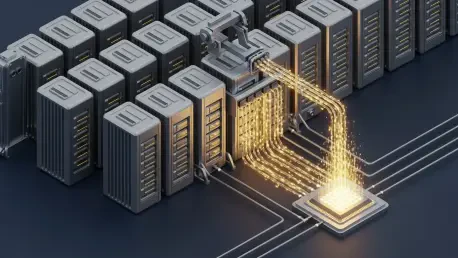

The relentless expansion of generative artificial intelligence has fundamentally altered the global perception of data center architecture, transforming traditional storage providers into the backbone of modern computing while proving that massive compute power is effectively useless without a robust and scalable method to house the petabytes of training data and inference outputs generated every single second. As organizations shift their focus from initial model training to the long-term maintenance of autonomous systems, the hardware responsible for storing vast libraries of code, proprietary documents, and multimedia files has moved from a secondary consideration to a primary strategic asset. This shift has propelled companies like Seagate, Sandisk, and Western Digital into a new era where they are no longer viewed as cyclical commodity vendors but as essential architects of the digital frontier. The industry is witnessing a structural transformation where storage capacity is becoming the ultimate barometer for the health and scalability of the entire artificial intelligence ecosystem.
Financial Momentum: The Growth of Datacenter Revenue
Recent fiscal disclosures highlight a staggering acceleration within the storage sector, with Sandisk leading the charge by reporting a massive revenue increase of over 250% compared to previous cycles. This surge is primarily driven by a 645% explosion in its dedicated datacenter division, showcasing how the demand for high-speed flash memory has outpaced even the most optimistic analyst projections. To combat the historical volatility associated with memory chip pricing, the company has successfully negotiated long-term supply agreements worth more than $42 billion, ensuring a level of fiscal predictability that was previously unheard of in the semiconductor space. This strategic pivot allows manufacturers to plan complex production cycles with greater precision, reducing the risk of oversupply while catering to the specific needs of hyper-scale cloud providers who require constant upgrades to their solid-state drive arrays to handle intensive read and write operations.
Building on this financial success, Western Digital and Seagate have also reported significant gains, with revenue growth reaching 45% as they capitalize on the renewed importance of high-capacity hard disk drives. While flash memory remains the preferred choice for speed, the sheer volume of data generated by AI models necessitates the cost-effective density that traditional spinning disks provide. Every major AI workload eventually finds a home on physical hardware, and the current market dynamics suggest that the industry has entered a “new era of growth” where supply chain constraints are being managed through deeper partnerships between hardware firms and software developers. These companies are successfully shedding their reputations for erratic performance by embedding themselves directly into the AI supply chain, making their products as critical as the GPUs used for processing. This transition has redefined the competitive landscape, placing a premium on firms that can deliver both speed and massive scale.
Infrastructure Bottlenecks: The Crucial Role of Physical Media
The current technological landscape reveals that storage is no longer a peripheral component but a fundamental bottleneck that can determine the success or failure of large-scale AI deployments. As models become more sophisticated, the latency involved in retrieving training data from slow or poorly optimized storage arrays can significantly hinder the efficiency of high-performance processors. This realization has forced engineers to rethink the relationship between logic and memory, leading to the adoption of advanced tiered storage architectures where frequently accessed data resides on ultra-fast drives while the vast bulk of historical information is kept on high-density platters. The ability to manage these complex data flows effectively has become a core competency for hardware manufacturers, who are now providing integrated solutions that optimize how information moves across the network, thereby reducing energy consumption and cooling requirements in crowded modern data centers.
Furthermore, the evolving demands of AI inference—the process by which a trained model generates predictions or content—require a unique blend of durability and accessibility that only specialized storage hardware can offer. Unlike the initial training phase, which is compute-heavy, inference relies on the rapid retrieval of stored weights and biases, placing a constant load on the storage subsystem. This shift in usage patterns has driven a wave of innovation in drive controllers and firmware, allowing companies like Western Digital to tailor their products specifically for AI-driven workloads. Despite this progress, market sentiment remains cautious as investors now demand exceptional performance milestones to justify current valuations. The challenge for these hardware firms lies in sustaining their current momentum while navigating a market where triple-digit growth is increasingly viewed as the baseline expectation. Success will depend on their ability to maintain pricing power while continuing to expand their capacity to meet the world’s growing hunger for data.
Strategic Evolution: Future Implications for Hardware Providers
The integration of advanced storage solutions into the core of artificial intelligence infrastructure established a new paradigm for how physical hardware supports digital innovation. Decision-makers in the tech sector recognized that the longevity of their AI initiatives depended on more than just processing speed; it required a resilient foundation capable of preserving data integrity over years of continuous operation. Companies that prioritized the acquisition of high-capacity drives early in this cycle managed to avoid the supply shortages that plagued late adopters, demonstrating that storage procurement had become a vital component of corporate risk management. The industry moved toward a model where hardware reliability was synonymous with service uptime, prompting a shift in investment toward firms that demonstrated consistent manufacturing excellence and a clear roadmap for future density improvements. This strategic foresight proved essential for maintaining competitive advantages in a rapidly maturing and crowded technological marketplace.
Looking back at the trajectory of the past few years, the data storage sector successfully transformed its identity from a low-margin hardware provider to a cornerstone of the global economy. Organizations that embraced these infrastructure changes found themselves better equipped to handle the computational demands of 2026, as they had already built the necessary pipelines to feed their hungry algorithms. The actionable lesson for future stakeholders involved the necessity of treating storage as a dynamic resource rather than a static expense, ensuring that hardware scalability kept pace with software advancements. As the buzz surrounding AI began to focus more on practical utility and less on speculative potential, the firms that provided the physical space for this data were the ones that secured the most stable long-term positions. It became clear that while processors might capture the headlines, the underlying storage infrastructure was the silent engine driving the entire technological revolution toward its next significant phase.