
The very artificial intelligence systems designed to augment human intellect are grappling with a surprisingly human-like flaw: they can learn a new skill with remarkable speed, only to inexplicably forget what they already knew. This phenomenon, known as catastrophic forgetting, presents a fundamental barrier to creating truly adaptable and continually learning AI, forcing organizations to adopt cumbersome and costly workarounds that limit the technology’s full potential. Now, a novel approach that allows an AI to become its own teacher is emerging, offering a potential path toward a future where a single model can accumulate knowledge without losing its memory. This development is not just a technical curiosity; it addresses the core challenge of how to make AI models grow and evolve in a way that is both efficient and sustainable.
Why an AI That Learns a New Skill Suddenly Forgets Its Old Tricks
At the heart of the AI memory problem lies a phenomenon called “catastrophic forgetting.” When a Large Language Model (LLM) is trained on a new, specialized task—a process known as fine-tuning—the intricate network of parameters that underpins its knowledge is updated. However, this update is often a zero-sum game. The model’s neural connections are reconfigured to optimize performance on the new skill, but in doing so, the carefully calibrated weights that encoded its previous abilities are overwritten or degraded. An AI once proficient in both legal analysis and software development might become an expert in the former while losing its fluency in the latter.
This issue stems from the static nature of most current training methodologies. Models are typically trained on vast but fixed datasets, creating a snapshot of knowledge at a particular moment. The process of continual learning, where new information is integrated without erasing the old, is not an inherent capability. As a result, every attempt to expand a model’s skill set risks compromising its foundational, generalist capabilities, forcing a trade-off between specialization and versatility that has significant practical consequences for real-world deployment.
The Model Zoo a Consequence of Catastrophic Forgetting
The operational fallout of catastrophic forgetting is a management challenge that industry experts have termed the “model zoo.” Faced with the risk of skill degradation, many enterprises have resorted to creating and maintaining a separate, isolated model for each distinct business function. One model might handle customer service inquiries, another might specialize in financial forecasting, and a third could be dedicated to marketing copy generation. This proliferation of models creates an immense administrative burden, driving up operational costs and complicating governance.
This approach is not only inefficient but also inherently limiting. Each model in the zoo requires its own lifecycle management, from training and deployment to monitoring and regression testing. The complexity multiplies with every new skill the organization wishes to implement, creating a brittle infrastructure that is difficult to scale. Moreover, this siloing of intelligence prevents the AI ecosystem from developing a holistic understanding, as insights gained in one domain cannot be easily transferred or leveraged by a model operating in another.
A New Paradigm the AI That Teaches Itself
A groundbreaking technique developed by researchers at MIT, the Improbable AI Lab, and ETH Zurich offers a compelling alternative to the model zoo. Known as Self-Distillation Fine-Tuning (SDFT), this method reframes the learning process by enabling a model to act as its own instructor. Instead of simply training on a new dataset, the AI leverages its existing in-context learning abilities to generate its own training signals, effectively guiding itself through the acquisition of new skills without discarding prior knowledge.
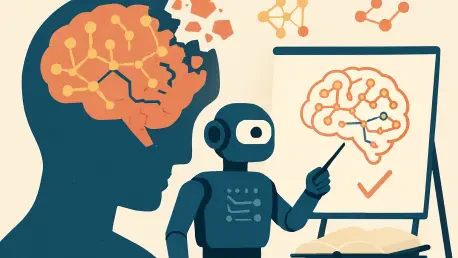
The process is elegantly simple in concept. The same model operates in two roles simultaneously: a “teacher” and a “student.” The teacher is given a query along with expert examples, allowing it to generate a high-quality, reasoned response. The student, which only receives the query, then adjusts its internal parameters to align its output with the teacher’s more informed answer. By learning from its own on-policy generated data, the model reinforces existing knowledge while carefully integrating new information, sidestepping the need for complex external reward systems often required in reinforcement learning.
The Evidence How Self-Teaching Stacks Up
Experimental results have demonstrated that SDFT not only meets but often exceeds the performance of traditional Supervised Fine-Tuning (SFT). Models trained using this self-teaching method consistently achieve higher accuracy on newly acquired tasks. More importantly, they show a substantial reduction in catastrophic forgetting, successfully retaining proficiency in previously learned skills. This allows a single, unified model to sequentially accumulate diverse capabilities, from coding to contract analysis, without the performance regression that plagues conventional approaches.
This capability could fundamentally streamline how enterprises manage and deploy AI. The consolidation of multiple skills into a single model promises to reduce operational complexity, lower maintenance costs, and simplify governance. An organization could continually update its primary production model with new, specialized knowledge, creating a more robust and adaptable AI asset. The long-term vision is an AI that evolves alongside the business it serves, continuously improving without the need for a complete overhaul or the creation of yet another inhabitant for the model zoo.
The Reality Check Hurdles on the Road to Smarter AI
Despite its promising outcomes, the road to widespread commercial adoption of self-teaching AI is not without obstacles. SDFT is a computationally intensive process, demanding approximately 2.5 times the computing power and significantly more training time than standard fine-tuning methods. This initial investment in resources may be a barrier for some organizations, even if the long-term benefits of avoiding skill degradation offer a compelling return. The success of the technique also depends on the quality of the base model, requiring a highly capable AI with strong in-context learning abilities to serve as an effective teacher for itself.
Furthermore, while SDFT may eliminate the need to manage a quantity of models, it shifts the operational challenge toward ensuring the quality and governance of a single, evolving one. As noted by Sanchit Vir Gogia of Greyhound Research, the complexity moves from model quantity to governance depth. Organizations must implement strict version control and artifact logging to ensure the reproducibility and safety of a model that learns from its own outputs. Consequently, initial deployments were seen in lower-risk internal applications, such as developer tools. The transition to highly regulated domains like finance and medicine, where the risk of a “self-taught error” carries significant consequences, required further validation and the development of robust oversight frameworks.