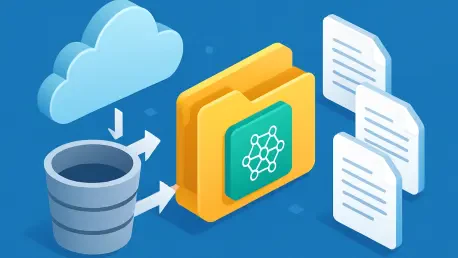

The modern data landscape has reached a critical inflection point where the traditional boundaries between high-capacity object storage and high-performance file systems are finally beginning to dissolve. As generative AI and autonomous agents become the primary consumers of cloud resources, the friction caused by incompatible storage architectures has transformed from a minor inconvenience into a major bottleneck for global innovation. AWS has responded to this challenge with S3 Files, a native interface that fundamentally changes how developers interact with massive datasets. This shift provides the agility of a local directory with the virtually infinite scale of Amazon S3, allowing for a more cohesive approach to data-heavy workflows that define the current technological cycle.
Bridging the Gap Between Object Storage and Generative AI
The rapid ascent of generative AI and agentic workflows has placed unprecedented demands on cloud storage infrastructure. While Amazon S3 has long been the industry standard for scalable object storage, its architecture was fundamentally built for “write-once, read-many” patterns, which often clashed with the high-interactivity requirements of modern AI development. With the launch of S3 Files, Amazon Web Services is introducing a native file system interface that allows S3 to behave like a traditional file system. This development eliminates architectural friction, providing a seamless bridge between cost-effective bulk storage and the agile data needs of AI agents and machine learning models.
The Evolution of Cloud Storage: From Objects to Interactive Assets
Historically, developers faced a rigid choice between object storage like S3 and file storage like Amazon Elastic File System. Object storage offered massive scalability and low costs but lacked the ability to perform standard file-level operations like partial updates or native locking mechanisms. Conversely, traditional file systems provided the necessary interactivity but at a higher price point and with different management overhead. In the past, engineering teams often resorted to third-party FUSE drivers to make S3 appear as a local drive. However, these workarounds were prone to consistency issues and latency spikes that hampered production environments. The introduction of S3 Files marks a shift in the cloud landscape, moving away from fragmented storage tiers toward a unified architecture that supports high-velocity data cycles.
Optimizing AI Performance and Operational Efficiency
Reducing Latency Through Native NFS Support
A critical aspect of S3 Files is its native support for the Network File System v4.1 protocol. This allows AI agents and applications to perform standard actions—creating, reading, updating, and deleting files—directly within the S3 environment. By eliminating the need to move, synchronize, or stage data between different storage layers, AWS significantly reduces the operational latency that previously hampered large-scale training jobs. Data consistency and locking mechanisms, which were historically difficult to manage in object storage, are now handled natively. This ensures that multi-node workloads can interact with a shared dataset without the risk of data corruption, making it a robust solution for complex machine learning pipelines.
Simplifying the Developer Experience and Tool Integration
One of the most essential angles of this launch is its impact on the developer workflow. Previously, many legacy tools and libraries used in data science were built to interact with files, not objects. Migrating these tools to S3 often required extensive code rewrites or the maintenance of complex data pipelines to fetch and push data. S3 Files allows these existing tools to function out-of-the-box, effectively treating S3 as a local directory. This compatibility reduces the time-to-market for AI products and lowers the barrier to entry for smaller teams who may not have the resources to build custom middleware for data orchestration.
Architectural Unified Governance and Cost Management
Beyond technical performance, S3 Files addresses the broader complexities of data governance and infrastructure costs. For many enterprises, maintaining duplicate copies of data across various storage tiers—one for long-term archival and another for active processing—created data silos and increased the attack surface for security breaches. By positioning S3 as a single source of truth, IT leaders can apply unified security policies and access controls across the entire data lifecycle. This consolidation not only simplifies compliance but also yields significant cost savings by eliminating redundant storage costs and the compute resources previously required for constant data synchronization.
The Future of Agentic AI and Autonomous Data Layers
The launch of S3 Files is a harbinger of a more integrated future for cloud computing, where the lines between different storage types continue to blur. As AI agents become more autonomous, they will require persistent memory that is both durable and fast. We can expect AWS to further optimize these interfaces, potentially introducing even lower latency tiers specifically tuned for real-time AI reasoning. Additionally, as regulatory frameworks around AI data provenance tighten, having a unified storage layer will become a competitive necessity for tracking data lineage and ensuring ethical AI training practices.
Strategic Implementation and Best Practices for Enterprises
To maximize the benefits of S3 Files, organizations should focus on consolidating their data pipelines to reduce unnecessary hops between storage environments. IT managers should audit their current AI workloads to identify bottlenecks where data staging is currently used; these are the primary candidates for S3 Files integration. Furthermore, teams should leverage the AWS Management Console and CLI to automate the provisioning of these file interfaces, ensuring that storage scales dynamically with compute needs. By adopting a file-first approach to object storage, businesses can achieve a more agile infrastructure that is ready for the next generation of data-heavy applications.
Conclusion: A New Standard for Data-Centric AI
The shift toward S3 Files provided a definitive answer to the long-standing problem of storage fragmentation in the enterprise. Instead of managing disparate silos, organizations gained the ability to treat their entire data lake as a live, interactive environment. This transition allowed for more aggressive experimentation with autonomous agents that required immediate access to shared memory. By the end of this implementation phase, the integration of file-level operations into object storage had already begun to influence how new machine learning frameworks were designed. Ultimately, this advancement ensured that data accessibility remained a catalyst for growth rather than a hurdle for complex system architectures.