
The transition from experimental artificial intelligence pilots to full-scale operational deployments has revealed a harsh reality where even the most sophisticated neural networks remain paralyzed without a robust physical infrastructure to sustain them. While organizations often focus on the computational “brains” of the intelligence revolution, the true limitation is frequently the “nervous system”—the network connectivity that allows data to flow from the point of origin to the point of decision. In the current enterprise environment of 2026, a dropped connection is no longer a mere inconvenience but a total operational shutdown for a workforce that has become fundamentally digital and autonomous.
The shift toward generative agents and decentralized systems has forced a reevaluation of the underlying hardware that supports these innovations. A brilliant algorithm is essentially useless if the necessary data cannot reach it in real time, or if the latency of the response renders the output obsolete. As businesses integrate these tools into the very fabric of their daily operations, the network has evolved from a background utility into a strategic asset that determines the ceiling of an organization’s digital potential.
The Nervous System of the Intelligence Revolution
The discourse surrounding artificial intelligence often prioritizes the scale of datasets and the complexity of large language models, yet the physical constraints of data transmission are the silent arbiters of success. In a landscape where autonomous systems and generative agents are tasked with high-stakes decision-making, the reliability of the network serves as the primary conductor for intelligence. When a network fails, the entire infrastructure of a modern organization grinds to a halt, demonstrating that connectivity is now as essential as electricity was for industrial-age factories.
Moreover, the complexity of today’s workloads means that traditional networking protocols are often insufficient. The demand for instantaneous data retrieval and processing creates a high-pressure environment for legacy systems that were designed for much simpler tasks, such as basic file sharing or email communication. Consequently, firms are discovering that their AI ambitions are directly tethered to the bandwidth and stability of their connections, making infrastructure upgrades a prerequisite for any further progress in automation.
Why Connectivity is the New Primary Bottleneck
As organizations move away from isolated pilots toward mission-critical deployments, the underlying network has transitioned from a supporting role to the primary bottleneck of corporate productivity. The sheer volume of information required for real-time inference and the constant fine-tuning of models is pushing traditional infrastructures to their absolute limits. This surge is driven by a data explosion that legacy systems were never built to handle, ranging from high-definition industrial sensor feeds to multi-angle media broadcasts.
The traditional model of centralizing all data in a single cloud repository is becoming increasingly untenable due to rising bandwidth costs and the crippling effects of latency. Between 2026 and 2030, the reliance on real-time data will only intensify, making the distance between the data source and the processing unit a critical factor in performance. For both human field technicians and autonomous robotics, constant uptime is no longer a luxury; it is a functional requirement for job performance, effectively making network stability synonymous with overall corporate output.
Critical Pillars of Modern AI Infrastructure
Successfully scaling intelligence requires a comprehensive overhaul of how data moves across various environments, including cloud providers, private data centers, and the physical edge. Industry forecasts suggest that by 2028, over two-thirds of enterprise-managed data will be processed outside traditional data centers. This move toward edge processing is designed to minimize the distance data must travel, allowing for immediate local action without the delays inherent in round-trip cloud communication.
Furthermore, forward-thinking organizations are adopting an agnostic and multi-layered approach to connectivity. By blending traditional cellular links, private cloud connections, and high-capacity satellite networks, firms can ensure 100% availability regardless of geographic location. This redundancy is further protected by AI-driven security tools that monitor network traffic in real time. Ironically, the very complexity that AI introduces to the network requires AI-driven filters to manage the mountain of data packets and identify security threats before they compromise the system.
Lessons from the Field: Industry Case Studies
Examining how different sectors navigate these challenges reveals that infrastructure needs are highly specialized. Telecommunications giants like AT&T illustrate the difficulty of modernizing a century-old foundation shaped by fragmented data and legacy applications. Their current strategy involves the deployment of “agentic AI” to support a mobile workforce. Because these employees operate in diverse and often remote environments, the company has integrated satellite partnerships to provide a consistent connectivity backbone that empowers technicians regardless of their physical location.
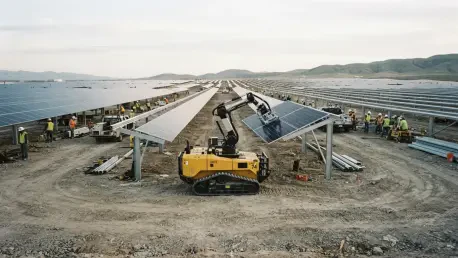
In contrast, the robotics sector provides a glimpse into machine-centric infrastructure requirements. Luminous Robotics, which utilizes autonomous units to install solar infrastructure, operates in bandwidth-constrained environments where high-speed internet is rarely available. Their tiered strategy utilizes local edge inference for immediate mechanical decisions, while reserving satellite bandwidth for safety logs and off-hour batch processing. As these operations scale, the primary hurdle shifts from mechanical design to the management of limited networking capacity.
The sports and entertainment industry, represented by organizations like the Boston Celtics, faces a different version of this data explosion. With games broadcast through multiple channels and tracked by dozens of statistical sensors, the sheer variety of data sources necessitates a high-bandwidth network capable of syncing these disparate streams. This environment requires sophisticated network monitoring to manage the resulting security implications, highlighting how even non-industrial sectors must prioritize their connectivity architecture to maintain a competitive edge.
Frameworks for a Scalable Connectivity Strategy
To avoid falling into the infrastructure trap, organizations must adopt a proactive networking architecture that anticipates growth. This begins with an edge-first philosophy, where processing is decentralized to reduce the strain on the primary network backbone. By investing in endpoints capable of local inference, companies can significantly decrease the volume of data that must be transmitted over long distances, thereby improving speed and reducing costs.
Additionally, the integration of satellite solutions should be treated as a core component of the IT stack rather than a niche backup for remote sites. As satellite networks become more reliable and accessible, they offer a vital layer of redundancy that ensures operations remain continuous even in the face of ground-based disruptions. Solving legacy data debt is equally critical; older enterprises must resolve the complexities of fragmented systems to create a clean foundation. Finally, planning for bandwidth elasticity allows a network to handle the massive spikes required for model training without interrupting the daily flow of business.
The realization that connectivity serves as the lifeblood of the intelligence era prompted a fundamental shift in capital expenditure. Organizations that prioritized infrastructure early found that their AI agents operated with a level of fluidity that their competitors could not replicate. They integrated high-capacity satellite links as a core utility rather than a fallback option, ensuring that bandwidth elasticity accommodated the sudden spikes of model fine-tuning. This proactive restructuring of the physical network ultimately transformed connectivity from a silent bottleneck into a competitive differentiator in the race for autonomous operational excellence. Leaders who successfully navigated this transition prioritized the resolution of legacy data debt before attempting to layer on complex generative tools, which proved essential for long-term stability.