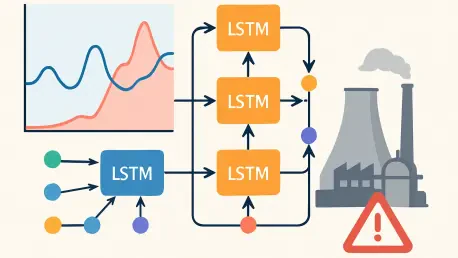

A lightweight scale-level attention module enables neural networks to adaptively shift focus between different temporal resolutions based on current system volatility. In the fast-paced industrial landscape of 2026, the reliance on dense sensor telemetry has created a data deluge that traditional monitoring frameworks can no longer navigate effectively. From massive electrical power grids to sophisticated chemical processing facilities, the interconnectedness of modern engineering systems means that every operational fault ripples across multiple dimensions simultaneously. Traditional methods often fail to catch these nuances because they lack the flexibility to view data through different temporal lenses. Researchers led by Liu Wei have introduced the Multi-scale Attention-based Feature fusion LSTM (MAF-LSTM) to address this exact gap. This framework does not just track individual data points; it interprets the complex, coupled deviations inherent in multivariate monitoring streams. By integrating multi-resolution forecasting with a sophisticated correlated residual analysis, the researchers provide a method for high-performance computing centers and smart factories to maintain stability despite the inherent non-linearity of real-world sensor data. This breakthrough signifies a shift toward more autonomous and self-aware monitoring infrastructures that can distinguish between expected operational shifts and genuine mechanical failures.
The Core Limitation: Why Traditional Models Fail
Traditional unsupervised detection techniques generally fall into three categories: statistical methods, reconstruction models, and forecasting architectures, yet each faces significant hurdles in the high-dimensional environments of 2026. Statistical methods like Isolation Forest identify outliers based on distribution but often fail to account for the temporal context of time-series data. This lack of situational awareness makes them less effective for monitoring systems where the sequence of events is just as important as the individual values recorded. For instance, a sudden temperature spike might be normal during a specific equipment startup phase but catastrophic during steady-state operations. Statistical models frequently lack the historical memory needed to differentiate between these two scenarios, leading to an unacceptable rate of false alarms or, conversely, missed critical failures. Without a temporal dimension, these algorithms remain blind to the evolving physics of the machinery they are tasked to protect.
Furthermore, reconstruction models such as autoencoders learn to compress and recreate normal sequences, flagging anomalies when the reconstruction error is high. However, these models can sometimes be too effective, inadvertently reconstructing outliers or losing fine-grained details during the compression process. This “overgeneralization” means that a subtle but significant deviation might be smoothed out by the network, appearing as normal behavior in the output. Meanwhile, standard forecasting models like conventional LSTMs predict future steps based on a fixed historical window, triggering alerts when the difference between predicted and actual observations exceeds a specific threshold. The primary limitation of these existing frameworks is their reliance on a single input window length. By committing to one temporal resolution, these systems often misclassify seasonal extremes as errors or overlook subtle, gradual deviations that only become visible over a longer operating cycle. This rigid approach creates a significant gap in detection capabilities for complex industrial processes that operate on multiple time scales.
Architectural Innovation: The Multi-Scale Strategy
The Multi-scale Attention-based Feature fusion LSTM (MAF-LSTM) resolves these issues by analyzing temporal sequences through parallel multi-resolution windows. This design removes the need for operators to manually fine-tune observation horizons for different types of equipment, a task that has become increasingly impossible given the scale of modern sensor networks. The process begins with continuous min-max normalization, which preserves extreme physical measurements to ensure that out-of-range signs of failure remain visible to the neural estimators. Unlike traditional methods that might clip these values to fit a specific range, the MAF-LSTM architecture ensures that the most telling signs of an impending anomaly are not lost before the analysis even begins. This preservation of raw data integrity is crucial for identifying physical decoupling events where sensors begin to drift away from their expected correlation patterns.
Building upon this foundation, the framework processes normalized data through parallel LSTM encoders, each corresponding to a different window length. Shorter windows are specifically tuned to capture rapid transitions and local fluctuations, such as electrical surges or sudden pressure drops, while longer windows maintain the overarching operational context and seasonal trends. By extracting the final hidden state from these varied branches, the model achieves a comprehensive view of the data across multiple temporal resolutions simultaneously. This hierarchical approach allows the system to perceive both the “trees” and the “forest,” ensuring that no single event is judged in isolation from its broader temporal background. The use of 64 hidden units per layer across a two-layer LSTM structure provides the necessary depth to model the complex, non-linear dependencies that characterize 2026 industrial telemetry.
Advanced Fusion: Dynamic Weighting and Scoring
Once features are extracted from the multi-scale branches, they are merged into a single vector using a lightweight scale-level attention module. This module dynamically calculates weights for every time step, allowing the network to shift its focus based on current conditions. For instance, the model may prioritize shorter-scale LSTMs during periods of high volatility, such as a load shift in a power grid, while focusing on longer-range trends during steady-state operations. This adaptability is key to reducing false positives, as it allows the model to “understand” when a fluctuation is merely a byproduct of transient system activity versus a persistent fault. The result is a highly adaptive fused representation that maps directly to a multi-channel one-step-ahead forecast, providing a more reliable baseline for anomaly detection than any single-scale model could achieve.
The final stage of the framework involves anomaly scoring via the multivariate Mahalanobis distance. Unlike simpler error metrics like Mean Squared Error, which treat each sensor as an independent variable, this method captures how forecasting errors across interrelated variables co-vary during normal operations. By adding a regularizing ridge term for numerical stability, the system can flag “physical decoupling events” where individual sensors appear to be operating within normal statistical boundaries, but the underlying relationship between them has shifted. This is particularly vital in 2026 for monitoring interconnected assets like high-voltage transformers, where the relationship between oil temperature and load current is strictly governed by physics. A shift in this relationship, even if both values remain within their typical ranges, is a clear indicator of a subtle operational fault that requires immediate investigation.
Empirical Validation: Proving Superiority in Real-World Scenarios
Researchers validated the MAF-LSTM framework against four distinct physical datasets, including electrical metering and chemical process control benchmarks like the Tennessee Eastman Process. The model consistently outperformed existing algorithms such as Isolation Forest, DAGMM, and USAD across diverse scenarios. Statistical analysis showed that MAF-LSTM exceeded the strongest baseline models by an average of 3.20 percentage points in AU-ROC and 5.33 percentage points in AU-PR, proving its superior accuracy in both detection and precision. These benchmarks are representative of the complex data streams found in modern infrastructures, where hundreds of variables must be monitored in real time. The ability to maintain high performance across such varied datasets suggests that the framework is robust enough for wide-scale industrial deployment.
The framework reached high F1-scores across all tests, reaching peaks like 92.07% on chemical process benchmarks, which demonstrates its reliability in different industrial contexts. Using paired Wilcoxon signed-rank tests, the researchers confirmed that the performance advantages were statistically significant, with p-values far below the standard thresholds for academic and industrial rigor. These results indicate that the multi-scale approach provides a more robust foundation for monitoring systems that require high precision and low false-alarm rates. In an era where downtime can cost millions of dollars per hour, the reliability of the MAF-LSTM framework offers a tangible economic advantage to operators of critical infrastructure. By reducing the noise inherent in multivariate data, the system allows maintenance teams to focus their efforts on genuine risks rather than chasing phantom anomalies.
Insightful Ablation: Deconstructing the Performance Edge
Ablation studies conducted during the research revealed that the Mahalanobis distance scoring method had the most significant impact on the model’s overall efficacy. When this metric was replaced with simpler Euclidean distance, the performance dropped drastically, confirming that understanding sensor correlations is vital for modern industrial monitoring. The studies also showed that the gap between single-scale and multi-scale models grows wider as window lengths increase, suggesting that single-resolution models are essentially “blind” to certain dynamics that occur outside their fixed horizon. This finding reinforces the necessity of the multi-scale approach, particularly for complex systems where anomalies may manifest over different durations. Without the ability to correlate errors across sensors, even the most advanced forecasting engine remains limited in its diagnostic power.
Further analysis of specific anomaly types showed a strong correlation between the temporal fluctuation of an error and the effectiveness of the multi-scale model. Essentially, the more an anomaly is characterized by complex time-based patterns rather than simple offsets, the better the MAF-LSTM performs. This ability to “smooth out” noise while highlighting meaningful deviations is a key strength of the architecture, especially when dealing with data that has a high degree of “fluctuation share.” For example, in electrical metering data where usage patterns shift throughout the day, the multi-scale model can distinguish between a spike caused by a legitimate surge in demand and one caused by a faulty meter. This deep dive into the architecture’s mechanics proves that its success is not merely a result of increased complexity, but a direct consequence of its ability to mimic the multi-layered temporal logic of the physical systems it monitors.
Operational Constraints: Addressing Practical Implementation Challenges
Despite its success, the researchers were transparent about several constraints that must be addressed for real-world deployment in 2026. The framework assumes a degree of statistical stationarity, meaning it expects that “normal” behavior does not drift significantly over time due to wear and tear. If the physical properties of a machine change—such as a bearing gradually wearing down over months—the residual statistics must be updated to prevent the system from triggering false alarms as the machine’s “normal” signature evolves. This requirement for periodic updates highlights the need for an integrated lifecycle management strategy for industrial AI models. Without such oversight, even the best detection system can become obsolete as the hardware it monitors undergoes natural aging or environmental shifts.
The framework also carries a higher computational cost because each scale requires its own LSTM branch, which could impact its use on resource-constrained edge devices. While high-performance computing environments can easily handle this overhead, deploying MAF-LSTM on a simple sensor node might require architectural pruning or hardware acceleration. Additionally, the framework requires a clean set of verified normal data for its initial training phase, which can be difficult to obtain in some industrial settings where machines are rarely in a “perfect” state. These considerations are important for engineers looking to implement the system in brownfield environments where data might be messy and compute power is at a premium. Nevertheless, for critical systems where the cost of failure is high, the extra computational investment is often easily justified by the increased detection accuracy.
The Road Ahead: Future Enhancements for Industrial Reliability
Future developments for the MAF-LSTM framework are expected to focus on making the system more adaptive to changing environments through online learning and more flexible covariance modeling. Researchers are already looking into online residual re-estimation and regime-switching covariance models to handle physical drift and varying load states without requiring manual recalibration. These improvements would allow the system to maintain its accuracy over longer periods, automatically adjusting its definition of “normal” as the machinery ages. This would move industrial maintenance closer to a “set-and-forget” paradigm, where the AI acts as a continuous, self-correcting guardian of operational integrity. Such advancements will be vital as industries move toward fully autonomous operations where human intervention is minimized.
Another area of intense interest involves adaptive scale selection strategies that can automatically identify the most dominant signal periods for a specific machine or process. By dynamically choosing the most relevant window lengths, the framework could become even more efficient, reducing computational overhead while maintaining high detection standards. This evolution would solidify the framework’s position as a versatile tool for modern condition-based maintenance across diverse engineering sectors, from aerospace to renewable energy. The study concluded that the MAF-LSTM framework provided a robust and scalable solution for the modern industrial era, offering a clear path forward for systems that demand the highest levels of reliability. By effectively bridging the gap between multi-scale temporal modeling and correlated sensor analysis, the researchers established a new standard for how we detect and respond to anomalies in the complex systems of 2026.