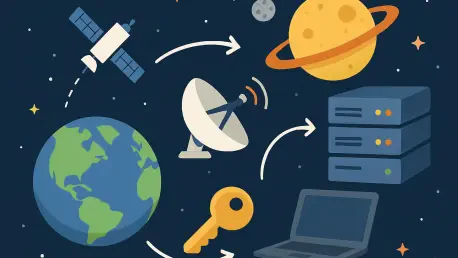

Historical anomalies in spacecraft acceleration, such as the Pioneer Anomaly, illustrate the critical need for tools that can reliably decode and visualize decades-old radiometric archives. For many years, the primary challenge of deep space exploration has not just been the physical distances involved, but the incredible complexity of the data transmitted back to Earth through the Deep Space Network. These signals, which contain the pulse of robotic missions across the solar system, are often locked within binary-formatted files that remain virtually unreadable to the standard software tools used by most researchers. To navigate this digital labyrinth, a team of specialized researchers developed the Planetary Data System Radio Science Data Viewer, commonly known as PRSDV. This open-source solution serves as a critical bridge, transforming opaque binary archives into interactive visual narratives that allow scientists to monitor spacecraft motion and signal performance with unprecedented clarity. By democratizing access to this high-precision data, the software eliminates the traditional requirement for researchers to be experts in low-level file architecture, allowing them instead to focus on the fundamental physics of the planetary bodies they are investigating.
Overcoming the TRK-2-34 Technical Bottleneck
The structural complexity of NASA’s radiometric archives has long acted as a gatekeeper, preventing a wider range of scientists from engaging with mission data. At the heart of this issue is the Tracking and Navigation File format, technically designated as TRK-2-34, which stores observations in Standard Formatted Data Units. These files are inherently non-human-readable, meaning they cannot be opened by standard text editors or common data analysis programs like Excel. Historically, any scientist wishing to analyze the Doppler shifts or signal strengths of a mission had to write custom scripts to parse these binary sequences, a task that required an intimate knowledge of the bit-level specifications of the Deep Space Network. This technical hurdle frequently led to delays in scientific discovery and meant that valuable archival data remained underutilized because the cost of entry, in terms of both time and specialized expertise, was simply too high for many academic institutions or independent research groups.
PRSDV addresses this specific architectural challenge by automating the translation of binary records through the modern PDS4 archive standard. By pairing raw binary data with detailed Extensible Markup Language metadata labels, the software can automatically identify specific data fields, apply the correct physical units, and render accurate visualizations without manual intervention from the user. This approach fundamentally changes the workflow of planetary science, moving it away from the tedious manual decoding of legacy formats and toward a streamlined process of visual scientific evaluation. The software essentially serves as an interpreter that speaks both the language of modern planetary science and the legacy binary protocols of the Deep Space Network, ensuring that the wealth of information gathered from decades of exploration is instantly available for inspection and rigorous analysis.
Functional Versatility and Open Source Accessibility
In a landscape where scientific tools are often siloed behind expensive licensing fees or limited by specific operating systems, PRSDV stands out for its commitment to broad accessibility. Although the tool was originally developed within the MATLAB App Designer environment, it is distributed as a standalone executable that does not require a commercial MATLAB license to function. This ensures that researchers across the globe, regardless of their institutional funding, can run the software on Linux, macOS, or Windows using a free runtime package. For organizations that require more specialized integrations, such as mission operations centers or advanced data labs, the developers have released the full source code under the Apache License 2.0 through the NASA-PDS GitHub repository. This open-source model encourages community-driven improvements and ensures that the tool can be adapted to meet the evolving needs of the international space exploration community over the coming years from 2026 to 2030.
Beyond its accessibility, the software provides robust support for three essential types of radiometric data that are foundational to space science. It handles Type 1 downlink carrier phase data, which is vital for studying how radio signals interact with planetary atmospheres and gravitational fields. It also decodes Type 9 frequency ramps, used to track frequency changes during uplink transmissions, and Type 16 carrier frequency observables, which are the primary source for Doppler shift analysis and determining spacecraft velocity. To manage the immense volume of data generated during a typical mission, PRSDV includes a sophisticated filtering system. Scientists can isolate data subsets based on specific ground stations or frequency bands, such as the X-band or Ka-band. This targeted approach allows researchers to drill down into specific observation windows, ensuring they can focus on the precise moments of a flyby or orbital insertion that are most relevant to their scientific hypotheses.
Historical Precedents and the Value of Long-Term Archives
The scientific necessity of making these tracking files accessible is underscored by the landmark investigations that have relied on radiometric data to solve complex mysteries of the solar system. The most famous example is the Pioneer Anomaly, where an unexplained deceleration of the Pioneer 10 and 11 spacecraft was finally understood only after researchers painstakingly analyzed decades of archived tracking data. Without the ability to preserve and eventually decode these records, scientists would have lacked the evidence needed to confirm that the anomaly was caused by thermal radiation pressure rather than new physics. Similarly, the loss of the Mars Climate Orbiter in the late 1990s provided a stark lesson in the importance of radiometric diagnostics. Doppler and ranging observations were the only way to reconstruct the navigation errors that led to the spacecraft’s destruction, proving that high-fidelity radio data is essential for both scientific discovery and mission safety.
By supporting a vast library of missions ranging from the legacy of Voyager and Magellan to the high-stakes operations of modern orbiters like OSIRIS-REx and MAVEN, PRSDV ensures that multigenerational datasets remain viable for modern comparative planetology. This is particularly important for geophysical studies, such as those conducted by the InSight mission on Mars. By using high-precision phase measurements, scientists were able to probe the internal structure and core of the Red Planet, extracting subtle gravitational signatures from the noise of space communication. The software provides the necessary environment to revisit these datasets, allowing new generations of researchers to apply modern analytical perspectives to historical data. This continuity is essential for longitudinal studies of planetary environments, where comparing observations taken decades apart can reveal long-term trends in atmospheric dynamics or orbital mechanics.
Juno at Jupiter as a Proof of Practical Application
The practical efficacy of the PRSDV tool was vividly demonstrated through its application to the Juno mission, specifically during its intense Perijove-14 flyby of Jupiter. As the spacecraft swept close to the gas giant, it was subjected to extreme gravitational forces and complex plasma interactions that were reflected in the characteristics of its radio signal. Researchers used the software to load the PDS4 labels for Juno’s tracking archives and quickly isolated the carrier signal-to-noise spectral density. By filtering for signals received by the 70-meter antenna at the Goldstone Deep Space Communications Complex, the team generated detailed plots of residual frequency variations. These visualizations were not merely descriptive; they allowed for a clear distinction between one-way and three-way radio propagation, which is a fundamental requirement for scientists trying to model the internal density and gravitational field of a planet as massive as Jupiter.
This case study highlights how the software serves as a “quick-look” diagnostic tool that can handle the massive data volumes associated with flagship missions. Before committing to weeks of deep-dive numerical analysis, a scientist can use PRSDV to verify the quality of a data pass or identify an anomaly in real time. In the case of the Juno flyby, the ability to rapidly visualize signal variations around the point of closest approach allowed the team to confirm the integrity of the data before passing it to more complex geophysical modeling software. This streamlined workflow is crucial for modern mission teams who must operate under tight schedules and process vast amounts of incoming telemetry. The software’s ability to turn a wall of binary code into a clear, interpretable plot in a matter of seconds represents a significant leap forward in operational efficiency for planetary radio science.
Synergizing Visualization with Advanced Numerical Modeling
While visualization is an essential first step in understanding deep space data, it is rarely the final stage of scientific inquiry. Recognizing this, the developers of PRSDV integrated an automated data export function that bridges the gap between observation and advanced modeling. Whenever a researcher generates a plot within the interface, the software simultaneously creates an ASCII-formatted text file containing the filtered data. This feature allows scientists to move seamlessly from visual inspection to external fitting algorithms, orbital determination software, or joint analysis with other scientific datasets. By providing a clean, preprocessed text output, the tool saves researchers hours of manual data cleaning and reformatting, which is often the most tedious and error-prone part of the scientific process. This ensures that the transition from raw tracking data to a publication-ready figure or a complex gravitational model is as smooth as possible.
In the broader context of the planetary data ecosystem, PRSDV occupies a vital middle ground between overly simple data viewers and complex programmatic libraries. While standard PDS4 viewers are useful for looking at static images or simple tables, they lack the specialized logic needed to decode nested binary structures. On the other hand, libraries like SpiceyPy offer immense power for automated pipelines but require significant coding expertise and have no visual interface. PRSDV combines the specialized decoding capabilities of these advanced libraries with the intuitive ease of a graphical user interface. This makes it an ideal tool for scientists who need the depth of a specialized radio science application without the steep learning curve associated with custom programming. It provides a level of professional accessibility that encourages exploration while maintaining the rigorous standards required for peer-reviewed scientific research.
Evolutionary Milestones and the Path to Comprehensive Context
As we look toward the future of planetary exploration starting from 2026, the ongoing development of PRSDV Version 2.0 represents a major step forward in creating a holistic understanding of our solar system. The most anticipated update is the integration of SPICE orbital and planetary ephemeris kernels, which are the industry standard for space geometry. By incorporating these kernels, the software will be able to provide spatial context for the radiometric data it displays. Instead of seeing a signal strength or Doppler shift in isolation, researchers will be able to see exactly where the spacecraft was, what its orientation was relative to the planet, and how the geometry of the solar system influenced the radio link at any given second. This integration will effectively bridge the gap between engineering-focused tracking data and the scientific geophysical context needed to make sense of the observations.
The commitment to continuous improvement was evident in how the research team incorporated feedback from active mission cycles to refine the software’s filtering logic and user interface. Moving forward, the tool was positioned as a cornerstone of the infrastructure supporting upcoming flagship missions such as Europa Clipper and the VERITAS mission to Venus. By standardizing the way we access and visualize deep space data, the developers ensured that the global scientific community could continue to unlock the secrets hidden within NASA’s communications for years to come. These proactive steps were taken to ensure that as mission complexity grows, the tools used to interpret them remain equally sophisticated. The project successfully established a new benchmark for data transparency, ensuring that every byte of information sent across the void between worlds can be fully realized by the scientists who study them.