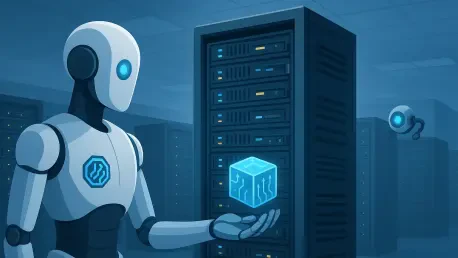

An AI agent acting as a reasoning tool can query historical clusters and pull node-specific information to provide engineers with a comprehensive root-cause analysis. This technological leap addresses the escalating complexity of modern high-performance computing environments, where the sheer density of hardware components makes manual oversight increasingly impractical. Data centers are no longer just passive warehouses for servers; they have transformed into living, breathing physical ecosystems characterized by delicate balances in power distribution, thermal regulation, and coolant flow dynamics. When managing large-scale AI training clusters, even a minor hardware degradation can lead to significant downtime or the corruption of expensive computational runs. To combat these risks, the industry is shifting toward a more proactive maintenance posture that integrates generative intelligence directly into the operational fabric. By deploying sophisticated agents that navigate the bridge between digital telemetry and physical hardware, operators can pinpoint subtle anomalies that would typically elude traditional threshold-based monitoring systems. This strategy ensures that the massive computational power required for the next generation of artificial intelligence remains stable and reliable, reflecting a broader trend where the management of infrastructure is becoming as advanced as the workloads it supports.
The Architect Role: Agents Building Deterministic Tools
The management of a modern data center requires processing an overwhelming volume of information, often exceeding five million telemetry signals in a single twenty-four-hour period. Because of this massive scale, utilizing a large language model to monitor every individual data stream in real-time is neither practical nor cost-effective. Furthermore, the non-deterministic nature of generative AI poses a significant hurdle for reliability in production environments; a monitoring system must be predictable, providing the same alert for the same set of conditions every time. To bridge this gap, agents are employed as “builders” in an offline capacity, functioning similarly to an automated data science team. These agents work within a specialized engineering harness, where they analyze massive archives of historical data to identify the precursors of hardware failure. Instead of acting as the live detector themselves, they write the code and develop the logic for fixed, deterministic models that are then deployed to the production environment. This approach allows the organization to benefit from the creative problem-solving abilities of AI during the development phase while maintaining a rigid and auditable software stack for actual data center operations.
This dual-layered strategy effectively isolates the “black box” nature of generative models from the critical infrastructure path, ensuring that every alert generated is grounded in verifiable logic. When an agent is tasked with building a new detection tool, it experiments with various feature engineering techniques and evaluates its performance against a set of known historical incidents. This iterative process continues until the agent produces a software artifact that meets strict accuracy and reliability thresholds. Once the tool is finalized, the agent is removed from the loop, leaving behind a lightweight, high-speed detection engine that can process millions of signals per second without the latency or cost associated with active inference. This methodology also facilitates rapid adaptation; as hardware configurations change or new types of failures emerge, the agent can be reactivated to rebuild the tool, incorporating the latest data into the updated model. By treating the agent as a sophisticated software engineer rather than a permanent operator, the system achieves a level of consistency that is essential for maintaining the integrity of large-scale computational clusters.
The Analyst Role: Live Reasoning and Root-Cause Analysis
Once a deterministic tool flags an anomaly, the operational challenge transitions from broad scanning to intensive qualitative investigation. This is the stage where the AI agent is utilized as a reasoning engine, sitting directly in the live diagnostic path to assist human engineers. When a potential hardware failure is identified, the reasoning agent is activated to interpret the specific context of the event, looking at more than just a single sensor reading. It examines the entire signal window, compares the behavior of the affected node against its neighbors in the cluster, and cross-references the current symptoms with documented failure modes in historical runbooks. This capability is vital because a drop in fan speed or an increase in voltage might be a harmless fluctuation or a precursor to a catastrophic short circuit, depending on the surrounding environmental variables. By providing a context-aware judgment, the agent drastically reduces the time human operators spend on manual investigation, allowing them to focus on physical remediation rather than data sifting.
To ensure the highest levels of accuracy during this live reasoning phase, the agent is restricted from relying on its internal training memory to provide answers, which effectively eliminates the risk of hallucinations. Instead, the agent is designed to interact with the data center’s infrastructure through a series of secure tool calls. It must query the actual telemetry database, pull specific logs from the hardware components in question, and retrieve verified documentation before making a recommendation. Every conclusion the agent reaches must be supported by a trail of evidence that a human engineer can easily verify. Crucially, the agent does not possess the authority to execute changes on the live hardware autonomously; its role is strictly advisory. It presents a detailed root-cause analysis and a suggested course of action to a qualified technician, who then makes the final decision. This human-in-the-loop model preserves safety and accountability while leveraging the speed and analytical depth of AI to navigate the vast complexity of physical system diagnostics.
The Physical AI Loop: Economic Scaling Through Intelligent Automation
A defining feature of this integrated approach is the creation of a continuous feedback mechanism known as the Physical AI Loop. This cycle ensures that the system becomes more intelligent and more cost-efficient the longer it operates. As reasoning agents handle various anomalies, they inevitably encounter patterns that begin to repeat. When the system recognizes that a certain type of hardware behavior is being identified and resolved in the same way consistently, that specific task is no longer viewed as a complex reasoning problem. Instead, it is identified as a candidate for automation. The knowledge gained by the reasoning agent is then used to update the offline builder agents, which codify the new pattern into a simple, deterministic rule. This migration of tasks from the expensive, flexible reasoning side of the architecture to the inexpensive, fixed-code detection side is what allows the system to scale economically. In traditional infrastructure management, costs typically rise linearly with the amount of data being monitored, but this loop reverses that trend by constantly simplifying the operational overhead.
The economic implications of this strategy are profound, especially as the demand for massive GPU clusters continues to grow. By automating the transition from human-assisted reasoning to fixed-code detection, the platform reduces its reliance on expensive computational resources for routine maintenance. This evolution transforms the data center from a reactive environment, where engineers respond to alarms, into a proactive one, where failures are anticipated and mitigated before they can disrupt customer workloads. The Physical AI Loop also fosters a culture of continuous improvement, as every new failure mode encountered becomes a learning opportunity for the entire system. Over time, the library of deterministic detectors grows more robust, covering a wider range of potential issues with extreme precision. This structure not only protects the hardware but also optimizes the utilization of human talent, as engineers are freed from repetitive troubleshooting and can instead focus on high-level architecture and strategic optimization. The result is a highly resilient infrastructure that actually becomes cheaper and more reliable as it expands in size and complexity.
Operational Prerequisites: Building Foundations for Physical Intelligence
The transition toward agent-led data center management was built upon several non-negotiable pillars that ensured the system remained grounded in reality. It was established that the effectiveness of any AI agent was fundamentally limited by the quality and depth of the historical telemetry available for analysis. Without years of meticulously archived data covering various hardware generations and failure types, the agents would have lacked the necessary benchmarks to distinguish between normal operational variance and genuine degradation. This requirement necessitated a long-term commitment to data preservation and curation, ensuring that every sensor reading from the past was accessible and accurately labeled. The archive served as the ultimate training ground, allowing the agents to simulate thousands of failure scenarios before ever being trusted with a live production environment. This historical foundation proved to be the single most important factor in developing a system that could accurately predict and resolve hardware issues with high confidence.
Beyond the technical data, the success of the implementation relied heavily on the integration of deep domain expertise and structured engineering frameworks. It was recognized that identifying patterns in telemetry is a task of limited value unless those patterns are interpreted through the lens of physics and mechanical engineering. Human experts who understood the thermal limits of silicon and the electrical characteristics of high-density power delivery were essential in defining the success metrics for the agents. These experts provided the necessary guardrails, ensuring that the AI was solving the right problems and adhering to safety protocols that govern live electrical equipment. Furthermore, the development of a robust software harness allowed for the seamless interaction between agents, data sources, and human operators. This integrated environment moved the industry away from the era of static, “frozen” tools and toward a dynamic model of living software that evolved alongside the physical infrastructure. These strategic choices collectively demonstrated that the future of physical AI depends not just on the models themselves, but on the rigorous engineering and human wisdom that surround them.