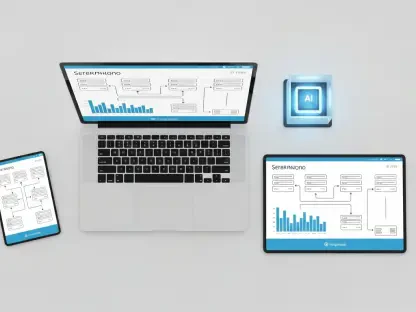

Mid-market organizations are currently navigating a complex fiscal environment where the traditional separation between financial planning and business intelligence has become a significant operational liability. For years, finance teams have been forced to operate within a fragmented workflow, toggling between specialized budgeting software and external data visualization tools to produce meaningful reports for leadership. This persistent “data gap” often requires professionals to export vast amounts of raw information, manually clean it in spreadsheets, and then rebuild visualizations in static presentation decks. Such a disjointed approach not only introduces a high risk of human error but also delays the delivery of critical insights during volatile market conditions. The integration of embedded business intelligence (BI) directly into the financial planning and analysis (FP&A) ecosystem represents a fundamental shift in how mid-sized firms approach fiscal strategy, allowing them to merge reporting and advanced analytics into a single, unified environment that fosters immediate action.
By embedding sophisticated analytical capabilities into the core planning platform, organizations can finally eliminate the friction that has historically hindered agility. This transformation ensures that every stakeholder, from the finance analyst to the chief executive, is working with a single source of truth that reflects real-time financial realities. Instead of waiting days or weeks for a comprehensive report, decision-makers can access live, interactive dashboards that provide granular visibility into departmental performance, cash flow trends, and operational efficiency. This move toward a unified intelligence hub allows finance departments to transition away from being perceived as back-office record keepers and toward becoming strategic partners who drive value through data-driven storytelling. The ability to move from raw data to board-ready insights without leaving the primary work environment is not just a convenience; it is a competitive necessity for mid-market companies aiming to achieve enterprise-level sophistication without the prohibitive costs of legacy systems.
Bridging the Divide Between Planning and Analysis
Historically, the structural divide between specialized financial planning tools and the business intelligence platforms used by executive leadership created a bottleneck that stifled organizational speed. Finance departments were often caught in a cycle of manual reconciliation, trying to ensure that the numbers used for budgeting matched the visual reports presented during board meetings. This disconnect frequently led to conflicting interpretations of the same data, as different tools utilized different refresh cycles or calculation logic. Embedded BI addresses this fundamental flaw by providing real-time, customizable intelligence natively within the FP&A interface. This integration ensures that the visual layer is directly tied to the underlying financial engine, meaning any change in a budget forecast or an actual expense is instantly reflected in the associated charts and graphs. Consequently, the distance between data entry and data visualization is reduced to virtually zero, enabling a more responsive and accurate financial reporting cycle.
When visual intelligence becomes a native component of the daily workflow, the finance team can provide immediate answers to complex strategic questions during live discussions. Instead of promising to follow up with a report after several hours of data manipulation, a controller or CFO can drill down into a dashboard during a meeting to uncover the specific drivers behind a budget variance. This level of transparency builds significant trust between the finance department and other business units, as it removes the “black box” perception of financial modeling. Furthermore, the use of native BI tools allows for a higher degree of customization, enabling finance teams to create specific views for different departments, such as sales, marketing, or operations, without requiring specialized IT support. By democratizing access to these insights, organizations ensure that every leader is empowered with the exact information needed to optimize their respective areas of the business in real time.
Accelerating Efficiency Through Artificial Intelligence
The current landscape of financial technology is defined by an unprecedented pace of innovation, specifically through the application of artificial intelligence to handle the most labor-intensive aspects of data management. In the recent months of 2026, the introduction of AI-driven integration frameworks has revolutionized how mid-market firms sync their financial data with enterprise resource planning (ERP) systems. Traditionally, creating custom code to map data between these disparate systems could take several months of technical effort. However, modern AI tools can now automate this process, reducing the onboarding and integration timeline to a matter of days. This shift allows finance teams to bypass the technical hurdles of data ingestion and move straight to analysis. By leveraging machine learning to handle the “heavy lifting” of system connectivity, organizations can ensure that their FP&A environment is fully operational and populated with accurate data far faster than was previously possible.
Beyond the initial setup, machine learning is also transforming the mundane task of account mapping and data categorization. Finance professionals no longer need to spend weeks manually assigning general ledger accounts to specific categories within their planning software; instead, intelligent algorithms can now perform these tasks with a single click. This advancement effectively eliminates the risk of miscategorization that often plagues manual entries, ensuring a cleaner and more reliable dataset for forecasting. These efficiencies allow the finance department to refocus its energy on high-value activities, such as scenario modeling and strategic advisory, rather than being bogged down by data entry and troubleshooting. As these AI tools become more deeply embedded in the FP&A workflow, they act as a force multiplier for small finance teams, providing them with the analytical bandwidth typically reserved for much larger corporations with massive administrative staffs.
Empowering Decision-Makers with Advanced Visualization
The modern era of financial reporting has moved far beyond the constraints of static spreadsheets, focusing instead on making complex fiscal realities accessible to non-finance executives. Enhanced visualization tools now allow for a sophisticated representation of financial trends that can be understood at a glance, using heat maps, waterfall charts, and interactive trend lines to tell a cohesive story. This is particularly important for leadership teams who may not have a background in deep accounting but are responsible for making high-stakes decisions based on financial health. By strengthening the bond between the FP&A platform and major ERP systems like NetSuite, these dashboards ensure that every visual element is fueled by live data. This persistent connectivity removes the need for manual refreshes and gives stakeholders the confidence that they are viewing a current snapshot of the business rather than a week-old approximation.
Furthermore, the design of these advanced dashboards is increasingly user-centric, catering to both the power user who builds the reports and the executive who consumes them. This dual-focus design ensures that the tool is robust enough for deep-dive analysis while remaining intuitive for quick, high-level decision-making. Executives can interact with the data, toggling between different scenarios—such as a “best case” versus “worst case” revenue forecast—to see the immediate impact on the company’s bottom line. This level of interactivity transforms the dashboard from a static report into a dynamic planning tool. By providing a clear, visual bridge between operational activities and financial outcomes, these tools help align the entire organization around common goals. When every leader can see how their department’s spending or performance directly influences the company’s overall fiscal trajectory, it fosters a culture of accountability and proactive management that is essential for sustained growth.
Democratizing Financial Intelligence for the Mid-Market
For a significant period, the most advanced business intelligence capabilities were the exclusive domain of Fortune 500 companies, as mid-market organizations simply lacked the IT infrastructure and budgets to support such complex systems. The rise of embedded BI is effectively leveling the playing field by offering these enterprise-grade capabilities within a unified, affordable platform specifically designed for mid-sized firms. This democratization allows a mid-market CFO to access the same level of analytical power and visual depth as their counterparts at much larger organizations. By eliminating the traditional tradeoff between system complexity and ease of use, these platforms empower smaller teams to compete more effectively. They can now conduct sophisticated variance analysis, workforce planning, and capital expenditure modeling with a level of precision that was once out of reach, ensuring that their growth strategies are grounded in rigorous data.
The evolution of financial planning is clearly trending toward a future of automated, mobile-first intelligence that transcends the traditional office environment. Current developments in the sector are prioritizing the creation of mobile reporting applications that allow finance leaders to access live dashboards and critical alerts from their mobile devices. This ensures that financial intelligence is “in the room” where decisions happen, whether that is on a manufacturing floor, in a client meeting, or during a remote strategy session. Additionally, the next phase of AI integration is moving toward automated insight generation, where the platform identifies anomalies or emerging trends without being prompted. For example, the system might automatically flag a sudden spike in operational costs or a deviation from a seasonal sales pattern, allowing the finance team to investigate and intervene before the issue escalates. This shift transforms the role of the finance analyst from a gatherer of data into a strategic advisor who proactively manages risk and identifies opportunities.