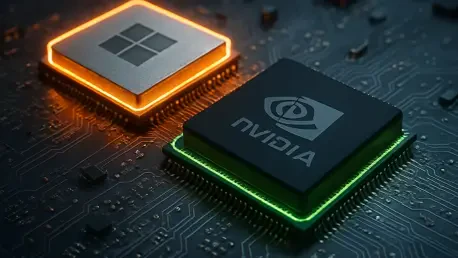

With the enterprise AI landscape in constant flux, we sat down with Chloe Maraina, a leading business intelligence expert, to dissect the latest developments in cloud hardware. Chloe’s passion lies in translating complex data trends into compelling visual stories, giving her a unique perspective on the strategic implications of the tech industry’s biggest moves. Our conversation explores the ripple effects of Microsoft’s new Maia 200 AI accelerator, delving into the practical choices facing IT leaders today—from workload optimization and vendor lock-in to the shifting balance of power in the fiercely competitive AI chip market.
Microsoft is expected to use its new Maia 200 AI accelerator heavily for internal workloads like Copilot. How might this internal adoption create a domino effect for enterprise cloud buyers, and could you detail the steps that might lead to increased Nvidia GPU availability on Azure?
It’s a fascinating and potentially very welcome scenario for many enterprise customers. You have to picture the current situation: Microsoft is both a massive consumer and a massive supplier of Nvidia GPUs. They’ve been buying them up by the truckload to power their own services like Copilot while also selling access to their Azure customers. This creates a really challenging internal competition. By shifting a huge, high-volume workload like Copilot onto their own custom-built Maia 200 chips, they essentially take themselves out of the running for a large portion of that Nvidia supply. That single move could free up a significant amount of their Nvidia inventory, which can then be redirected and offered to Azure customers who have been struggling to get the capacity they need. It’s a classic case of eating your own dog food, and in this instance, it could mean the long queue for premium GPUs on Azure finally starts to shorten.
The Maia 200 chip is reportedly optimized for high-volume inference tasks like chatbots, whereas systems like Nvidia’s Vera Rubin target more complex reasoning. For an enterprise IT leader, what workload characteristics would make Maia a better fit, and can you provide a practical business example for each?
This is really about matching the right tool to the right job, and the distinction is crucial for cost and performance. Maia is built for massive scale and efficiency, focusing on high throughput at the lowest possible margin. Think of a large e-commerce company’s customer service chatbot. It handles millions of relatively simple queries a day—”Where is my order?” or “What is your return policy?” The goal isn’t deep, multi-step reasoning; it’s about delivering fast, accurate answers to a huge volume of users simultaneously and cost-effectively. That’s the sweet spot for a chip like Maia. On the other hand, a system like Nvidia’s Vera Rubin is designed for a completely different beast of a problem. Imagine a pharmaceutical research firm using AI to analyze complex molecular interactions for drug discovery. A single query might trigger a massive, intricate reasoning chain to simulate and predict outcomes. That requires a different level of computational power and complexity, which is where Vera Rubin would shine.
The transition from established platforms like Nvidia’s CUDA to a new one like Microsoft’s Maia SDK presents significant technical hurdles. What are the main challenges AI engineers face when migrating workloads, and what metrics should a company use to evaluate if potential cost-savings justify the effort?
The migration challenge is immense; you can’t just flip a switch. The analogy of two incompatible rail lines is perfect. Nvidia’s CUDA is a deeply entrenched ecosystem with decades of development, libraries, and community support. Shifting to a new platform like the Maia SDK means your AI engineers are essentially learning a new language and rebuilding their applications to run on a completely different infrastructure. The primary challenges are re-architecting the applications themselves, ensuring all the software dependencies are compatible, and rigorously testing to ensure you don’t suffer performance degradation. To justify this effort, a company has to look beyond the sticker price of the hardware. The key metric is Total Cost of Ownership (TCO). You must calculate the projected cost savings from using cheaper Maia accelerators over, say, three years. Then, you have to honestly weigh that against the immense cost of engineering hours for the migration, potential business disruption during the transition, and the risk that the new platform might not be as mature or well-supported as the one you’re leaving behind.
Enterprise leaders now face a choice between the potential cost savings of a platform-specific accelerator and the multi-cloud portability offered by Nvidia. How should a CIO weigh this trade-off, and what long-term strategic risks should they consider when committing to a single cloud provider’s proprietary hardware?
This is the central strategic dilemma for CIOs in the AI erportability versus price. On one hand, committing to a proprietary accelerator like Maia on Azure can offer far better economics. You’re operating in a vertically integrated environment optimized for cost and performance, which is incredibly tempting when AI budgets are ballooning. However, that choice comes with a significant risk of vendor lock-in. By building your core AI workloads on a platform-specific SDK, you’re tying your fate to a single cloud provider. The long-term risk is a loss of negotiating leverage. If that provider decides to raise prices, change their service terms, or falls behind technologically, migrating away becomes a monumental and costly task. Sticking with Nvidia, while more expensive upfront, preserves that flexibility to move between clouds. A CIO has to weigh the immediate financial benefits against the long-term strategic freedom and risk of being cornered in an ecosystem you can’t easily leave.
With major cloud providers developing their own AI accelerators, some predict Nvidia’s market share will normalize from its current dominance. What key adoption metrics would signal a genuine shift in market power over the next few years, and what factors could solidify Nvidia’s position despite these new competitors?
While it’s easy to see the appeal of in-house chips, dethroning Nvidia is a marathon, not a sprint. The most obvious metric to watch is their market share; analysts had it pegged at an astronomical 94%, so any sustained dip would be significant. But beyond that, I’d watch the developer and ecosystem metrics. How many enterprise applications are being written or migrated to run on Maia, TPUs, or Trainium? What does the community support and talent pool look like for these new SDKs compared to CUDA? A true shift will be signaled when major companies begin deploying mission-critical, revenue-generating workloads on these alternative chips at scale. However, Nvidia’s position is solidified by its mature, proven architecture and, most importantly, the CUDA ecosystem. For the next three to four years, their combination of customer mindshare, overwhelming demand, and a deeply integrated software-hardware stack creates a powerful moat that will be very difficult for competitors to cross.
What is your forecast for the AI accelerator market?
I believe we’re entering a period of diversification, but not necessarily dethronement. Nvidia’s absolute dominance, that 90%-plus market share, will likely normalize over time as the market itself expands exponentially. There is more than enough room for multiple players to thrive. Chips like Maia, Google’s TPU, and AWS’s Trainium will carve out significant niches, especially for high-volume, cost-sensitive inference workloads within their own cloud ecosystems. However, I forecast that Nvidia will retain its crown in the high-performance training and complex reasoning sectors for the foreseeable future. The market won’t be a zero-sum game; instead, it will segment. Enterprises will have more choices, leading to a healthier, more competitive landscape where specific accelerators are matched to specific tasks, but Nvidia’s foundational role, powered by its massive software ecosystem, will ensure it remains a central and powerful force for years to come.