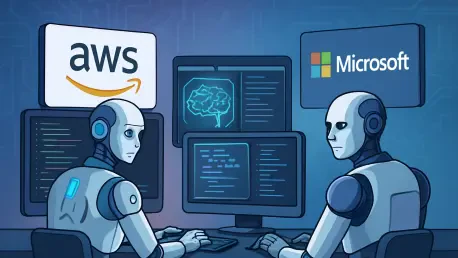

What if the tools developers use could think, adapt, and secure enterprise systems without constant human intervention? In a landscape where AI is no longer a luxury but a necessity, Amazon Web Services (AWS) has launched a formidable challenge to Microsoft with the debut of the Kiro AI IDE and transformative updates to the AgentCore platform. This isn’t just another tech update; it’s a seismic shift in how enterprises approach software development and operational efficiency. With businesses grappling to integrate AI securely at scale, AWS’s latest offerings promise to redefine productivity and governance in ways that could unsettle Microsoft’s dominance.
Why This AI Showdown Deserves Attention
The stakes couldn’t be higher in the enterprise AI arena. As companies race to adopt AI solutions, they face persistent hurdles: fragmented tools, looming security risks, and governance gaps that can derail even the most promising projects. AWS’s strategic push with Kiro and AgentCore isn’t merely about catching up; it’s about addressing these pain points head-on, offering a direct counter to Microsoft’s established tools like GitHub Copilot and Agent 365. This rivalry matters because it shapes the future of how businesses build, maintain, and secure their digital infrastructure in an increasingly automated world. The outcome could determine which cloud giant becomes the go-to partner for enterprises navigating the complexities of AI integration.
Unpacking AWS’s Game-Changing Tools
Diving deeper into AWS’s innovations reveals a calculated effort to outmaneuver competitors by blending cutting-edge technology with practical enterprise needs. The Kiro AI IDE and AgentCore updates stand as pillars of this strategy, each targeting distinct yet interconnected challenges in the AI development lifecycle. Their combined impact positions AWS as a serious contender in a space long dominated by Microsoft’s ecosystem.
Kiro AI IDE: A New Era for Developers
At the heart of AWS’s offensive is Kiro AI IDE, a tool designed to revolutionize how developers code. Unlike conventional assistants that lose context after each session, Kiro maintains continuity, remembering preferences and applying consistent error-handling patterns across projects. This persistent intelligence reduces repetitive tasks, allowing teams to focus on innovation rather than rework. Additionally, features like “Kiro powers” bundle relevant tools and configurations into unified packages triggered by specific prompts—think of instantly loading Stripe integrations for a payment feature—streamlining workflows in ways traditional tools can’t match.
When compared to GitHub Copilot, Kiro’s edge lies in its spec-driven development and runtime support. While Copilot excels in repository-specific efficiency, Kiro aims to support applications long after the initial code is written. Industry analysts have noted this distinction, with some suggesting that Kiro’s broader applicability could appeal to enterprises managing complex, long-term projects. This isn’t just a coding tool; it’s a partner for the entire software lifecycle.
AgentCore Updates: Fortifying AI at Scale
Equally compelling are the enhancements to AgentCore, AWS’s platform for managing AI agents in production environments. The standout feature, AgentCore Policy, embeds real-time, deterministic controls at the gateway level, ensuring AI agents interact with enterprise data and tools only within defined boundaries. For industries like finance or healthcare, where a single misstep can be catastrophic, this level of control is non-negotiable. It’s a direct response to widespread concerns about unchecked AI behavior in sensitive settings.
Beyond security, AgentCore Evaluations enable continuous monitoring of agent performance, while AgentCore Memory allows agents to learn from past interactions, boosting reliability over time. These features contrast with Microsoft’s Agent 365, which focuses on structured integration within its ecosystem. AWS’s approach to governance, prioritizing predictability through gateway-level policies, offers a fresh perspective on how to scale AI safely—a perspective that could resonate deeply with risk-averse sectors.
Frontier Agents: AI Beyond the Code
AWS doesn’t stop at development tools; it extends its vision with frontier agents tailored for operational challenges. Take the security agent, which proactively protects applications by identifying vulnerabilities before they’re exploited, or the DevOps agent, which accelerates incident resolution by automating root-cause analysis. These specialized tools signal AWS’s ambition to be more than a coding platform; they aim to address end-to-end enterprise needs, from creation to maintenance to crisis management. In doing so, AWS positions itself as a holistic solution provider, potentially outpacing competitors who remain focused on narrower aspects of AI application.
What the Experts Are Saying
To gauge the true impact of these innovations, insights from industry leaders and analysts provide a grounded perspective on AWS’s bold moves. Their voices add weight to the discussion, framing the technical advancements within the broader context of enterprise demands and competitive dynamics.
Jason Andersen of Moor Insights & Strategy describes Kiro and the frontier agents as forming a “complete, alternative solution” to Microsoft’s offerings. This isn’t about one standout feature but rather the collective strength of AWS’s ecosystem, which he believes could sway enterprises looking for comprehensive tools. Meanwhile, Torsten Volk from Omdia highlights Kiro’s potential to establish best practices in AI development, tackling issues like “vibe coding”—where prototype code fails to scale in production environments. Volk remains cautiously optimistic, noting that real-world validation will be key to proving these frameworks’ worth.
From within AWS, leadership echoes this focus on practicality. At the re:Invent conference, CEO Matt Garman emphasized that features like AgentCore Policy directly address customer struggles with secure AI deployment. This customer-centric mindset, prioritizing deployable solutions over flashy tech, underscores AWS’s intent to build trust with enterprises wary of untested innovations. Together, these perspectives paint a picture of a company not just innovating but listening—and that could be its greatest strength.
How Enterprises Can Capitalize on AWS’s Offerings
For businesses watching this AI arms race, the question isn’t just who’s ahead but how to leverage these tools for tangible gains. AWS’s latest releases offer opportunities, but adopting them requires a strategic approach tailored to organizational needs. The following insights provide a roadmap for navigating this terrain.
One critical step is assessing whether Kiro’s context-aware capabilities align with specific development goals. Enterprises maintaining sprawling applications might find Kiro’s runtime focus invaluable compared to Copilot’s strengths in initial coding phases. Similarly, AgentCore’s security features demand evaluation against internal governance standards, particularly for sectors with stringent compliance requirements. A thorough audit of current pain points—be it fragmented workflows or security lapses—can guide whether AWS’s tools are the right fit.
Implementation also calls for a phased approach. Starting with pilot projects using Kiro can test its autonomous agents and bundled toolsets on targeted use cases, such as automating payment processing integrations. Meanwhile, deploying AgentCore requires defining clear access boundaries for AI agents and leveraging Evaluations to track performance metrics over time. Balancing AWS’s flexibility, enabled by Amazon Bedrock’s diverse model choices, with the need for structured user experiences will be crucial. For some, a hybrid strategy—combining AWS’s customization with Microsoft’s curated ease—might strike the right chord for varied project demands.
Reflecting on a Pivotal Moment in AI Evolution
Looking back, the launch of Kiro AI IDE and AgentCore updates marked a defining chapter in the enterprise AI narrative. AWS stepped boldly into Microsoft’s territory, offering tools that addressed developer productivity, security, and operational breadth with unparalleled focus. These innovations weren’t just technical feats; they were responses to real-world challenges that had long hindered AI adoption at scale.
For enterprises that seized the moment, the next steps involved rigorous testing and strategic integration of these tools into existing systems. Exploring pilot programs with Kiro’s context-driven coding or implementing AgentCore’s governance controls offered a path to mitigate risks while maximizing impact. Beyond individual organizations, the industry stood at a crossroads, poised to witness how this rivalry would further shape standards for secure, scalable AI. The journey ahead promised deeper collaboration between cloud giants and businesses, ensuring that AI’s potential was not just imagined but fully realized in everyday operations.