
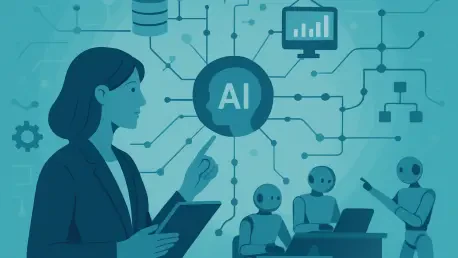
The rapid maturation of artificial intelligence has moved beyond the simple generation of text and images into a sophisticated era where autonomous agents perform complex business functions. Dataiku is currently undergoing a strategic transformation, evolving from its established roots as a

Modern enterprise leaders find themselves caught in a high-stakes race where billions of dollars flow into artificial intelligence, yet the vast majority of these sophisticated pilots never successfully migrate from the experimental laboratory to the rigorous demands of the live production floor.

Digital audio workstations serve as the foundational architecture for modern recording environments, where the delicate balance between complex feature sets and software stability determines the success of a professional studio session. As engineers and producers increasingly rely on open-source

The architectural complexity of modern commerce has reached a point where the seamless flow of data is no longer a luxury but the primary engine of operational survival. In the current landscape of 2026, global brands are moving away from the era of isolated software applications toward an

The exponential growth of sensitive information moving through generative AI pipelines and decentralized cloud architectures has rendered traditional, perimeter-centric security models virtually obsolete in the face of modern persistent threats. As information moves across endpoints and

Chloe Maraina is a distinguished expert in Business Intelligence and data science, specializing in the intersection of big data and user-centric software architecture. With years of experience helping organizations bridge the gap between complex data management and intuitive visual storytelling,

The difference between a high-fidelity digital replica and a static digital graveyard often depends on the invisible structural integrity of the underlying data architecture. While many organizations rush to visualize their assets through flashy 3D interfaces, the real value of a digital twin lies

The traditional methodology of manually scripting every endpoint and validation rule is rapidly dissolving as autonomous agents begin to take the wheel of the entire application programming interface lifecycle. While the initial wave of artificial intelligence in software engineering focused on

The transition from interpreting past financial failures to anticipating market fluctuations before they occur has become the primary differentiator between industry leaders and those struggling to maintain relevance in the current economic landscape. In the business environment of 2026, the

The modern cybersecurity landscape has witnessed a fundamental shift where phishing is no longer a collection of easily identifiable, poorly written scams, but has instead matured into a series of highly sophisticated, multi-layered offensive operations that leverage generative intelligence and


