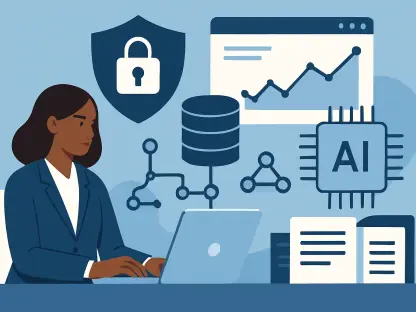

As a Business Intelligence expert with a deep passion for data science, Chloe Maraina has built her career on transforming vast datasets into compelling visual stories. She joins us to discuss the critical balance between human ingenuity and machine efficiency, exploring how IT leaders can strategically implement automation without losing the invaluable human touch that drives true innovation and resilience. We’ll delve into the practical challenges and solutions in today’s IT landscape, from managing complex database workflows to fostering a culture of continuous improvement in an age of ever-expanding AI.
Automation can free up IT personnel for more strategic work. Can you share an example of a DBA team that successfully made this shift? What specific maintenance tasks, like index defragmentation, did they automate, and what new strategic initiatives did they then pursue?
Absolutely. I worked with a database administration team that was constantly in a reactive, firefighting mode. Their days were consumed by routine maintenance for their Microsoft SQL Server environment. We helped them automate the most time-consuming yet critical tasks: index defragmentation routines, nightly backups, and scripts to update index statistics and check for data corruption. The change was palpable. Instead of just keeping the lights on, they suddenly had the bandwidth to be proactive. They started analyzing long-term performance trends, working with development teams to optimize new application queries before they hit production, and contributing directly to strategic discussions about scaling the company’s data infrastructure for future growth. They shifted from being system janitors to system architects.
Many teams face complex workflows with cascading if-then-else decisions. Why does manual processing often remain the norm in these cases, and what is the tipping point where the massive development effort to automate them becomes worthwhile? Please provide a step-by-step example.
This is a classic dilemma. Manual processing persists in these scenarios because the logic is so convoluted that programming it feels like trying to map a spiderweb. Every step branches into multiple possibilities, and each of those branches has its own complex set of if-then decisions. The development effort required to automate this flawlessly is massive and, frankly, intimidating. The tipping point arrives when the cost of not automating becomes greater than the cost of development. This usually happens when the volume of manual work becomes unmanageable, or when a series of human errors in the process leads to a significant business impact. Imagine a workflow for provisioning a new client database. Manually, a DBA might check the client tier, then decide on a server cluster, then check the required compliance, and so on. Automating this means scripting every single one of those decisions. It becomes worthwhile only when the team is provisioning hundreds of clients a month and a single mistake could lead to a major data breach or outage.
Over-reliance on automation can create a “black box” system, leading to a loss of institutional knowledge. What specific documentation and training practices can leaders implement to prevent this, ensuring junior team members understand the “why” behind the automation?
This is one of the biggest hidden dangers of automation. To prevent it, documentation and training have to be non-negotiable. It’s not enough to just have the script; you must document the entire workflow and, most importantly, the reasoning behind it. We insist on detailed comments within scripts and a central knowledge base that explains what each automated process does, why it was built, and what business problem it solves. For training, you can’t just show junior members how to run the tool. You have to mandate regular sessions where they walk through the automation’s logic, learn to troubleshoot common failures, and understand the potential impact if it goes wrong. This transforms them from passive users into active guardians of the system, preserving that crucial institutional knowledge.
An error in an automated script can replicate a mistake at scale, potentially destroying backups or deleting data. How can IT leaders implement a “human-in-the-loop” format to prevent such disasters? At what critical checkpoints should a human provide final approval before execution?
The “human-in-the-loop” model is the essential safety net. An automated script is incredibly powerful but has no judgment. Therefore, you must build critical checkpoints for any high-stakes operation. A perfect example from the database world is a major update or data migration. An automated script can do all the heavy lifting—preparing the environment, running pre-checks, and staging the data—but the final “go” command should require explicit approval from a senior DBA. Other critical checkpoints include executing scripts that delete large volumes of data, overwriting primary backups, or making schema changes to a production database. At these moments, the system should pause and present a human with a clear summary of what is about to happen, forcing a conscious decision before proceeding.
To strike the right balance, a strategic audit is recommended to identify tasks suited for automation. Can you walk us through the key metrics and criteria you would use during such an audit to differentiate a repetitive, high-volume task from one requiring creative, deep thinking?
A strategic audit is the foundation for any successful automation initiative. The first thing I look for are tasks that are highly repetitive and rule-based. We measure the frequency—is this done daily, weekly, hourly? We also look at the volume—does it involve processing hundreds of records or just a few? These high-volume, repetitive workflows are prime candidates. Think of tasks like clearing log files or running standardized reports. On the other side of the spectrum are tasks that require creativity, critical problem-solving, and collaboration. An example would be designing a new database architecture or resolving a novel, complex performance issue. These require deep thinking and human teamwork, qualities that automation simply can’t replicate. The audit clearly separates the rote, mechanical work from the strategic, intellectual work.
Creating a culture of constant enhancement is vital for successful automation. What practical steps can a manager take to encourage team members to regularly evaluate automated workflows and feel comfortable suggesting improvements, rather than letting them become rigid and outdated?
This culture doesn’t happen by accident; it must be intentionally built. A manager can start by scheduling regular, dedicated “automation review” sessions where the team’s sole purpose is to examine existing scripts and workflows. It’s a safe space to ask, “Is there a better way to do this now?” It’s crucial to celebrate suggestions for improvement, even small ones, to show that input is valued. Another practical step is to create a transparent process for submitting, testing, and deploying changes to automated systems. When team members see their ideas being implemented, it empowers them to stay engaged and look for further enhancements. The goal is to treat automation not as a one-time project, but as a living system that evolves with the business and technology.
What is your forecast for the future of IT operations as agentic AI becomes more powerful and ubiquitous?
My forecast is that the most successful businesses will be those that recognize a fundamental truth: humans will always sit at the center of proper automation and tooling. As agentic AI becomes more integrated into our workflows, its role will be to augment human capability, not replace it entirely. It will handle the vast majority of repetitive, predictable tasks with incredible speed and accuracy, freeing up IT professionals to focus on the complex, creative, and strategic challenges that drive real business value. The future of IT operations isn’t a world run by machines; it’s a world where humans, empowered by incredibly intelligent tools, can achieve a level of innovation and resilience we can only begin to imagine today. The balance will always be the key.