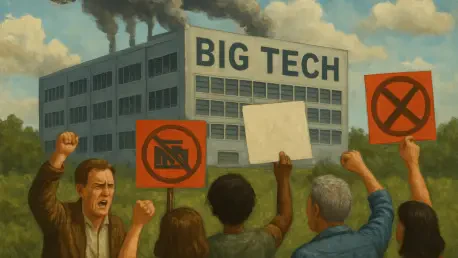

The relentless expansion of artificial intelligence and cloud services has created an almost insatiable hunger for computational power, driving technology companies and developers to scout new locations in the quiet corners of suburban and rural America. This push into new territories, however, is now colliding with an unexpectedly powerful and organized wall of local resistance. Communities that were once seen as prime real estate for these massive digital factories are now becoming battlegrounds, where residents are fiercely fighting back against the encroachment of Big Tech. This burgeoning grassroots movement is transforming the once-straightforward process of infrastructure development into a complex and contentious socio-political struggle, fundamentally altering the landscape for an industry built on rapid growth and posing a significant threat to its multi-billion-dollar expansion plans.
The Rise of a Grassroots Movement
The Anatomy of Local Resistance
Across the nation, a significant shift has occurred as residents are no longer acting as passive observers to major development projects in their backyards. Instead, they have become empowered and highly organized activists, leveraging digital tools and shared knowledge to mount effective campaigns. Learning from the successes and failures of similar battles fought in other towns, these community groups utilize social media to coordinate strategy, share information, and mobilize supporters, transforming once-procedural municipal meetings into packed forums for impassioned dissent. This coordinated and well-informed opposition has rapidly evolved into a formidable, and often project-derailing, obstacle for developers who have historically operated with minimal public scrutiny. The era of quietly securing land and permits without engaging the local populace has definitively come to a close, replaced by a new reality where community buy-in is paramount.
Fueling this widespread pushback is a remarkably consistent set of grievances that transcends geographic boundaries, touching on deep-seated environmental, economic, and quality-of-life concerns. At the forefront are anxieties over the immense resource consumption of data centers. Residents express profound worry about the facilities’ staggering demand for electricity and water, fearing that the strain on local grids and aquifers will lead directly to higher utility bills for everyone and the potential depletion of essential natural resources like community wells. Beyond these practical concerns, there is a powerful desire to preserve the fundamental character of their communities. Many are fighting to protect farmland, forests, and open spaces from being converted into sprawling industrial sites, which they believe will bring constant noise from massive cooling systems, potential pollution from fleets of on-site diesel backup generators, and a negative impact on their property values.
The Tangible Impact on Big Tech
This groundswell of community resistance has transcended being a mere nuisance and is now widely recognized within the industry as a significant operational risk that is actively derailing major, multi-billion-dollar investments. According to experts at the commercial real estate firm JLL, this trend represents a “huge problem” for the continued growth of the data center sector. This assessment is strongly supported by quantitative evidence from industry consultancies. Data Center Watch, for instance, recently reported that in a single quarter, between April and June, local and state-level opposition was directly responsible for blocking or significantly delaying a staggering $98 billion worth of data center proposals spanning 11 different states. This figure accounted for a full two-thirds of all the projects the consultancy tracked during that period, illustrating a systemic disruption rather than a series of isolated, anecdotal incidents.
The threat posed by local dissent has become so pronounced that it is now being formally acknowledged at the highest echelons of the technology industry. In a clear sign of this new reality, Microsoft, one of the world’s largest data center operators, explicitly identified this challenge in a recent securities filing. The company listed “community opposition, local moratoriums, and hyper-local dissent” among the most significant operational risks that could impede or delay the development of its critical global infrastructure. This formal admission from a Big Tech titan serves as definitive confirmation that the industry no longer views grassroots resistance as a fringe issue. Instead, it is now seen as a serious and direct threat to core business strategies and ambitious expansion plans, forcing a fundamental reevaluation of how these essential facilities are planned, proposed, and built.
The Shifting Battlefield
How Local Battles Unfold
These intense community conflicts are frequently ignited by a pervasive sense of secrecy and a feeling of betrayal among local residents. A common pattern, as illustrated in a recent case in Hermantown, Minnesota, involves residents discovering that their local and state officials had been engaged in private, behind-the-scenes discussions with developers for many months, and sometimes up to a year, before any public disclosure of the project. This profound lack of transparency in the early stages of planning almost invariably erodes public trust and acts as a powerful catalyst, galvanizing opposition forces. It fosters a deep-seated belief that critical decisions affecting the community’s future are being made without their input or consideration, driving ordinary citizens to organize and fight back against what they perceive as a fundamentally undemocratic process that prioritizes corporate interests over their well-being.
The political consequences for local officials who choose to support these increasingly unpopular projects have become severe and career-threatening. In a telling example from Matthews, North Carolina, a proposed data center that promised to generate enough revenue to fund nearly half of the city’s annual budget was abruptly withdrawn. The withdrawal came after the mayor candidly informed the developers that the project faced certain and overwhelming defeat in a council vote. He starkly noted that public opposition was “999 to one against” the facility and stated with certainty that any council member who voted in its favor would have been swiftly voted out of office in the next election. This scenario powerfully demonstrates that the political cost of approving a controversial data center can now easily outweigh any of its promised economic benefits, shifting the balance of power decisively toward organized and vocal community groups.
The Industry’s Evolving Strategy
Caught largely off-guard by the intensity and effectiveness of this widespread pushback, the data center industry and its constellation of stakeholders are now being compelled to fundamentally adapt their development playbook. In a significant strategic shift, developers are becoming more risk-averse, with some now considering selling valuable properties after securing a power source but before engaging in what could become an unwinnable and costly zoning fight. Influential trade groups like the Data Center Coalition are actively urging their members to abandon their traditionally insular approach in favor of one that is far more proactive and conciliatory. The new recommended strategy involves engaging with communities much earlier in the planning process, transparently highlighting potential economic benefits such as job creation, and actively supporting local initiatives as a way to build crucial goodwill before a formal proposal is even submitted.
This new reality forced the industry to reckon with the fact that technical viability was no longer the sole determinant of a project’s success. The playbook shifted toward a more sophisticated model of public relations and community partnership. Companies began to publicly promote their efforts to conserve water and energy, hoping to mitigate the environmental concerns that so often fueled opposition. However, a deep sense of frustration remained within the industry, which often believed that some of the most potent opposition was based on “falsehoods” and misinformation about environmental impact and resource consumption. The era when data centers could be built with minimal public scrutiny had ended. Success now depended less on engineering prowess and more on a developer’s ability to navigate intense local dissent and earn the social license required to build the physical backbone of the digital age.