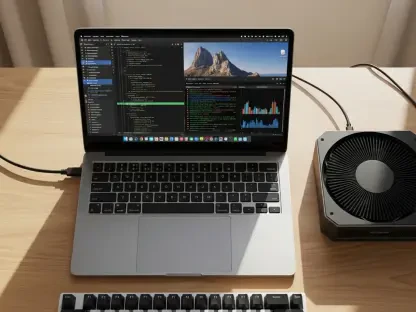

The ubiquitous loading spinner has become the digital equivalent of a waiting room, a subtle yet constant reminder that our modern devices are often treated as mere hollow shells by the applications they run. Despite the immense processing power tucked into every smartphone and laptop, the standard architectural model continues to offload critical logic and data management to distant servers. This dependency creates a fragile user experience where a flickering Wi-Fi signal or a congested API can bring productivity to a grinding halt. Local-first web development aims to dismantle this hierarchy, transforming the browser into a high-performance, autonomous data center that treats the network as an optional convenience rather than a lifeline.
This shift represents a significant departure from the “thin client” era that dominated the early 2020s. By prioritizing local state and persistence, developers are finally moving beyond the limitations of ephemeral web sessions. The movement is not merely about adding an “offline mode” to existing apps; it is a fundamental re-engineering of how software interacts with hardware. This review examines the technical mechanisms making this possible and evaluates whether the current ecosystem is robust enough to replace the entrenched REST and GraphQL paradigms that have defined the industry for a generation.
The Evolution of Client-Side Architecture
Historically, the pendulum of computing power has swung between centralized mainframes and distributed personal machines. For the past decade, the industry leaned heavily toward the server, viewing the browser as a simple document viewer that must request permission for every update. However, as of 2026, the arrival of more sophisticated runtime environments has allowed the pendulum to swing back. We are seeing the rise of the “thick client,” where the application resides entirely on the user’s machine, capable of performing complex computations and data mutations without waiting for a server round-trip.
This structural change is driven by the realization that modern hardware is largely underutilized in web environments. By treating local storage as the primary source of truth, developers eliminate the inherent latency of the “request-response” cycle. When a user interacts with a local-first application, the UI responds instantly because the data is already there, residing in a local database engine. This architecture fosters a sense of resilience, ensuring that software remains functional in tunnels, on airplanes, or in regions with intermittent connectivity, fundamentally changing the social contract between users and their digital tools.
Technical Pillars: The Local-First Ecosystem
PGLite and Isomorphic PostgreSQL
One of the most impressive technical feats in this space is the emergence of PGLite. For years, developers struggled with “impedance mismatch,” where the client used one database language (like IndexedDB) while the server used another (like PostgreSQL). This required a complex translation layer that was prone to bugs and performance bottlenecks. PGLite solves this by using WebAssembly (WASM) to run the actual Postgres codebase directly inside the browser environment.
The result is “isomorphic” data handling, allowing the same SQL queries and database logic to function identically across the entire stack. This implementation is unique because it brings enterprise-grade relational features—such as complex joins and triggers—into the client. Unlike lightweight alternatives that sacrifice functionality for size, PGLite provides the full power of a mature database, making it the preferred choice for applications that require more than just simple key-value storage.
Shape-Based Synchronization: Logical Replication
Managing data volume is the primary hurdle for any browser-based database, as it is impractical to sync a multi-terabyte production database to a mobile device. The industry has addressed this through shape-based synchronization, which allows the client to subscribe only to relevant “shapes” or subsets of data. This is achieved by tapping into the PostgreSQL Logical Replication protocol and the Write-Ahead Log (WAL), streaming only the necessary changes to the client.
This approach is superior to traditional polling or manual fetching because it is granular and reactive. When a row changes on the server, the sync engine pushes that specific delta to the local PGLite instance via WebSockets. This ensures that the local copy is a consistent, live reflection of the global state. This method provides a level of data integrity that simple REST caches cannot match, as it maintains the relational constraints and transaction atomicity of the original server-side data.
Conflict-Free Replicated Data Types (CRDTs)
The “split-brain” problem—where two users edit the same piece of data while offline—has long been the Achilles’ heel of distributed systems. Local-first development mitigates this through the use of Conflict-free Replicated Data Types (CRDTs). These are specialized mathematical structures that allow concurrent changes to be merged automatically without the risk of data loss or the need for manual conflict resolution.
Unlike the “last-write-wins” approach common in basic cloud storage, CRDTs preserve the intent of every contributor. Whether it is a collaborative text editor or a shared task board, the merging logic is deterministic and handled at the data layer itself. This mathematical certainty is what allows local-first apps to feel as seamless as a desktop application, enabling a level of collaboration that was previously restricted to proprietary, heavy-weight software suites.
Origin Private File System: High-Speed Storage
For a database to perform well, it needs fast access to the underlying storage hardware. Historically, web developers were stuck with IndexedDB, which is notoriously slow for random-access patterns. The shift toward the Origin Private File System (OPFS) has changed the game. OPFS provides a low-level, high-performance file system that allows databases like PGLite to perform random-access writes, modifying specific pages of data without rewriting the entire database file.
This hardware-level optimization is the critical link that enables server-like performance on a local device. By bypassing the overhead of traditional browser storage APIs, OPFS allows for massive datasets to be queried and updated with microsecond latency. This capability is what finally bridges the gap between web applications and native desktop software, allowing for complex data-intensive tasks like video editing or large-scale financial modeling to happen entirely within a browser tab.
Innovations: Data Reactivity and Transport
The shift toward local-first architecture is quietly rendering the traditional JSON API obsolete. In a standard web app, developers spend a significant amount of time writing code to fetch data, transform it into JSON, send it over the wire, and then rebuild the state on the client. In contrast, modern reactive databases like RxDB allow developers to simply “subscribe” to a query. When the local data changes—whether due to a user action or a sync event—the UI updates automatically.
This “query-as-a-service” model simplifies the developer experience by removing the middle layer of transport logic. There is no need for complex state management libraries like Redux when the database itself is the single, reactive source of truth. However, this transition requires a mindset shift; developers must move away from thinking in terms of discrete “endpoints” and start thinking in terms of continuous data streams. This reduction in architectural coupling leads to leaner codebases and fewer points of failure in the application lifecycle.
Sector Impact: Real-World Applications
Local-first technology is finding its strongest footing in sectors where reliability is non-negotiable. Field service industries, such as energy and construction, often operate in environments where connectivity is non-existent. By using local-first architectures, these workers can maintain full application functionality, recording data and performing audits locally. Once they return to a network, the sync engine seamlessly integrates their work back into the corporate database without any manual intervention.
Moreover, the creative tool sector has seen a massive performance boost. Collaborative design platforms and code editors that utilize CRDTs and local databases offer a “zero-latency” experience that is impossible to achieve with server-centric models. The ability to manipulate complex canvases or large codebases with instant feedback, regardless of network speed, has set a new standard for what users expect from professional-grade web software.
Challenges: Adoption and Complexity
Despite the clear benefits, the path to widespread adoption is fraught with the “ballast of familiarity.” The majority of the global developer workforce is trained in REST and GraphQL, and migrating legacy systems to a sync-first model is a daunting task. There is also the challenge of “distributed systems complexity.” When the database lives on the client, developers must suddenly care about things like local storage limits, data eviction policies, and the nuances of merging divergent states.
Furthermore, privacy and security take on new dimensions in a local-first world. While having data on the device is great for privacy, it also means that sensitive information is physically present on the user’s hardware. Implementing robust encryption and fine-grained access control within a browser-based database requires a level of expertise that many front-end teams may not yet possess. These hurdles suggest that while the technology is ready, the broader industry may take several more years to fully adapt its workflows.
Final Assessment: The Future of Web Development
The transition to local-first development marked a definitive end to the “pauper client” era. By unifying database engines across the stack and leveraging native hardware acceleration through WASM and OPFS, this architectural pattern provides a level of performance and resilience that was previously unattainable on the web. It successfully addresses the latency and connectivity issues that have plagued cloud applications since their inception, offering a viable path toward truly “desktop-class” web software.
Looking forward, the industry must prioritize the standardization of synchronization protocols to lower the barrier to entry. While PGLite and RxDB have laid a strong foundation, the next phase of growth will likely involve more seamless integration with existing cloud providers and better tooling for debugging distributed state. The ultimate goal is a development environment where the “offline” state is not a secondary feature but the fundamental baseline.
The decision for organizations was clear: those requiring high-performance, collaborative, and resilient applications found the local-first model to be an indispensable upgrade. While the complexity of managing a distributed fleet of databases remained a valid concern, the benefits of instant interactivity and data sovereignty outweighed the costs. Software engineering teams started prioritizing data-sync layers over traditional API development, signaling a permanent change in how digital products are built and maintained. This movement proved that when the browser is treated with the respect its hardware deserves, the results are nothing short of transformative.