
In a world awash with data, Chloe Maraina stands out as a leader who sees not just numbers, but narratives. As a celebrated Business Intelligence expert, she has built her career on transforming complex datasets into clear, actionable strategies, guiding organizations through the seismic shifts brought by artificial intelligence. Today, we explore her vision for the future of leadership, where success is defined not by command, but by collaboration with intelligent systems. This conversation delves into the necessary evolution of the executive mindset, the practical steps for rewiring deep-seated organizational habits, and the art of calibrating risk in an era of unprecedented speed. We will also touch upon how to foster a culture of confident decision-making and identify the core capabilities needed to build the winning “human-AI decision ecosystems” of tomorrow.
You described a leadership shift from “command-and-decide” to “orchestrate-and-collaborate” in an AI-driven world. Could you share a specific example of how you’ve guided a team through this mindset change and what initial challenges you faced in building trust with these intelligent systems?
Absolutely. I recently worked with a seasoned logistics team whose identity was built around their almost intuitive ability to manage inventory. We introduced an AI partner designed to optimize their decisions. The initial friction was palpable. The AI’s first major recommendation was completely counterintuitive, suggesting we shift a significant amount of stock away from a historically high-performing distribution center. The team’s gut reaction was to dismiss it outright. My role wasn’t to command them to follow the machine, but to orchestrate a dialogue. We didn’t bet the farm; instead, we ran a small, controlled simulation of the AI’s scenario alongside our traditional model. The primary challenge was moving from a place of control to one of curiosity. Trust wasn’t built through a mandate; it was earned when the AI’s transparent reasoning, which factored in subtle shifts in regional demand signals humans couldn’t see, proved more accurate in the simulation. That small win was the crack in the dam, allowing the team to see the AI not as a replacement, but as a new, incredibly powerful lens to augment their own expertise.
You mentioned the difficulty of rewiring “organizational muscle memory” for human-AI collaboration. What are the first practical steps a leader can take to operationalize this shift in a high-stakes area like supply chain forecasting, and what metrics would indicate you’re on the right track?
Rewiring that muscle memory is probably the hardest part of this entire transformation because you’re challenging decades of ingrained behaviors. The first practical step is to never go for a full “rip and replace” approach. In supply chain forecasting, for instance, I always advocate for running a parallel system. Let the human experts create their forecast using their established methods, while the AI generates its own. For the first few cycles, the goal isn’t to pick a winner, but to compare the outputs and, most critically, the underlying assumptions. This creates a safe space for learning. The second step is to build a transparent interface—a collaboration dashboard—where the AI doesn’t just give an answer but shows its work, highlighting the causal factors it weighed most heavily. This demystifies the process. As for metrics, in the beginning, I’m less concerned with pure forecast accuracy. I look for engagement metrics. How many times did the human team query the AI for more data? How many of their final decisions incorporated a direct insight from the system? A key indicator you’re on the right track is a decrease in the decision-making cycle time, because the team is spending less time arguing over data and more time debating strategy informed by both human and machine intelligence.
I’m interested in your idea of treating risk as a “dial, not a switch.” Can you walk us through a scenario where you intentionally calibrated that dial for a bold bet? Please detail how narrowing the decision’s scope enabled your team to move with more confidence and speed.
We were facing a major decision on whether to invest in a new, highly automated manufacturing technology. The AI-driven simulations, factoring in everything from future labor costs to potential supply chain disruptions, all pointed toward a massive, all-in investment. It was a classic high-stakes, high-friction moment, and the sheer scale of the proposal was causing analysis paralysis. It felt like a binary, on-off switch, and nobody wanted to be the one to flip it. So, we changed the frame. Instead of asking, “Do we build the factory of the future?”, we asked, “What is the single most critical variable our forecast depends on?” The answer was the efficiency of one specific, novel robotic system. We turned the risk dial down from a “10” to a “6” by narrowing the scope. We made a bold bet, but only on integrating that single robotic system into our existing line. This smaller, focused investment allowed us to test the AI’s most crucial assumption in the real world. By shrinking the decision, we paradoxically unlocked momentum. The team moved with incredible speed and confidence because the stakes were clear, the potential failure was survivable, and the learnings would be invaluable, regardless of the outcome.
You advocate for making decisions a “team sport” with a single owner who invites “constructive friction.” Could you describe the process you use to structure these discussions? For example, how do you ensure the friction remains productive without undermining the accountable owner or slowing things down?
Structuring this is an art, and it starts with absolute clarity. We make it known from the outset that every major decision has one, and only one, accountable owner. Their job is not to seek consensus, which is often a slow path to a mediocre outcome. Their job is to seek the best possible answer, and that requires stress-testing ideas. To make friction productive, I often structure the process like this: First, the accountable owner frames the decision and the desired outcome. The AI then acts as a neutral first voice, generating initial scenarios, surfacing data conflicts, and highlighting potential human biases. Then, we bring in the human experts. I assign specific roles—one person’s job is to be the “customer advocate,” another is the “risk officer.” Sometimes we even have someone role-play as our top competitor. This ensures that the friction isn’t personal; it’s structural. The debate is about the idea, not the people. The owner’s role is to absorb this focused, constructive friction, ask clarifying questions, and then, ultimately, make the call. Their authority is reinforced, not undermined, because the entire process is designed to equip them with the most rigorously vetted information possible.
You argue that mastering “human-AI decision ecosystems” will create the next winners. Beyond just adopting technology, what specific organizational capabilities and talent profiles should leaders start building now to develop these ecosystems and gain that competitive edge over the next decade?
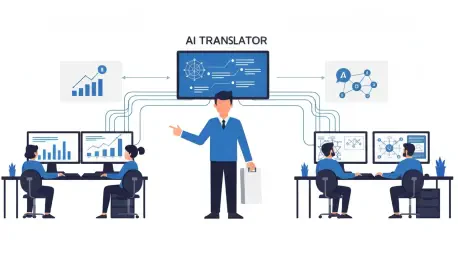
This is the most critical question. The technology is becoming a commodity; the real differentiator is the ecosystem you build around it. The first capability is what I call “intelligent orchestration.” This is a leadership skill. It’s the ability to design and manage these fast feedback loops between human intuition and machine intelligence. It’s less about being the smartest person in the room and more about being the best conductor of all the intelligence—human and artificial—at your disposal. The second capability is widespread data literacy, but with a twist. It’s not just about reading charts; it’s about fostering a culture of critical thinking and inquiry where people are comfortable asking, “What assumptions is this algorithm making?” As for talent, we desperately need more “AI Translators.” These are people who can stand with one foot in the world of business strategy and the other in data science. They can explain a model’s limitations to a CEO and articulate the nuances of a business problem to an engineering team. These translators are the essential connective tissue. Without them, your AI is just a powerful engine sitting disconnected from the chassis of your company.
Do you have any advice for our readers?
My advice is to start now, but start with intention, not just technology. Find one of those high-stakes, high-friction decisions in your organization—one that is perpetually stuck in debate—and make that your laboratory. Frame the experiment not around replacing human judgment, but around amplifying it. Create a small, cross-functional team and empower them to partner with an AI tool to explore the problem differently. The goal in the beginning is not a perfect outcome; it’s to begin rewiring that organizational muscle memory. Focus on building trust and transparency in the process. The leaders and companies who embrace this with curiosity and a willingness to be challenged—even by their own systems—will be the ones who not only survive but thrive in the decade to come. The future belongs to the collaborators.