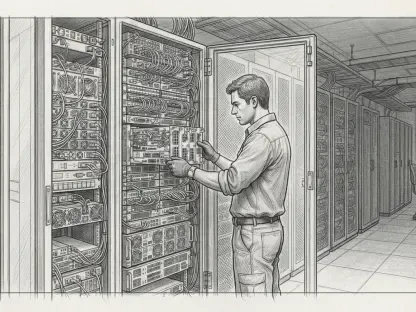

The era where engineers spent weeks waiting for physical server rack installations and manual patching has vanished, replaced by an environment where the speed of code delivery defines business success. When cloud computing first disrupted the industry, the primary value proposition centered on eliminating the physical limitations of local data centers. Organizations flocked to these providers to trade capital expenditures for operational flexibility, utilizing APIs to spin up virtual machines in minutes rather than months. This initial wave of cloud adoption focused heavily on the “how” of infrastructure—optimizing storage classes, configuring complex networking protocols, and managing virtualized resources. Today, however, that infrastructure is increasingly treated as a utility that remains largely hidden from the daily operations of the average software engineer. The focus has decisively shifted toward the developer’s immediate environment, turning the once-vaunted cloud console into a secondary concern behind the fluidity of the development workflow itself.
Redefining the Primary Interface of Innovation
The Transition Toward Workflow-Centric Thinking
The modern development landscape is characterized by an explosion of choice, yet this abundance has created a cognitive load that often slows down the very teams it was meant to empower. Navigating the thousands of distinct services offered by major hyperscalers often feels like wandering through a digital labyrinth where every turn requires a specialized certification or deep configuration knowledge. As a result, engineering teams are increasingly rejecting the “everything store” approach to cloud infrastructure. Instead of spending valuable time toggling through sprawling dashboards to set up identity access management or load balancers, developers are looking for paths of least resistance. The goal is to reach a state where the underlying machinery is entirely abstracted, allowing the focus to remain strictly on the business logic. This shift represents a move away from the manual assembly of infrastructure components toward a more cohesive, integrated experience where the platform anticipates the application needs.
Industry Trends: Shift in Developer Mindshare and Tooling
Statistical evidence from recent industry assessments reveals a significant decline in the prestige and direct usage of traditional cloud management consoles among front-line developers. While major cloud providers continue to generate massive revenues by providing the backbone of the internet, they are losing their position as the primary mental map for new software projects. In contrast, tools like Docker, npm, and Kubernetes—viewed as workflow utilities—regularly capture higher levels of daily engagement and mindshare than specific cloud vendor features. This fragmentation suggests that the core of the development process is no longer anchored in the data center but in the ecosystem of tools that reside on the developer’s local machine or integrated development environment. By prioritizing the toolchain over the host, developers are treating cloud providers as interchangeable execution layers rather than destination platforms. This allows for greater portability and ensures that engineering effort is spent on unique value.
Dominating the Early Stages of Development
Ownership of the First Mile
The “first mile” of software creation, encompassing the journey from a local Git commit to an initial staging deployment, has become the new battleground for developer loyalty. Historically, this phase was dictated by the requirements of the cloud provider, often forcing engineers to adapt their code to fit specific proprietary environment variables or deployment pipelines. Today, the power dynamics have flipped, as the command center of modern programming has migrated into the workspace where the code actually lives. Platforms such as GitHub and specialized integrated development environments like Visual Studio Code have successfully positioned themselves as the primary interfaces for this early stage. Because these tools are where developers spend the vast majority of their working hours, the technical nuances of cloud configuration have become secondary to the speed of the immediate feedback loop. Success is now measured by how few steps are required to move from an idea to a live preview.
Innovation: Impact of AI on Infrastructure Visibility
Artificial intelligence has acted as a primary catalyst in this transition, fundamentally altering how engineers interact with the underlying components of their stack. With the widespread adoption of AI-powered coding agents and advanced completion engines, the manual labor of writing boilerplate configuration scripts is rapidly becoming obsolete. These intelligent systems effectively act as intermediaries, translating high-level intent into functional code and deployment instructions without requiring the human developer to touch a cloud console. For a developer working in an AI-native environment, the traditional cloud management interface is often viewed as a disruptive distraction that pulls them away from their creative flow. When an automated agent can handle the logistical details of provisioning resources and optimizing performance, the infrastructure effectively becomes invisible. This placement of the workflow at the heart of the creative process ensures that the technical complexities do not impede the rapid iteration.
The Success of Outcome-Oriented Platforms
Prioritizing Developer Experience and AI Integration
Emergent platforms that prioritize outcomes over configuration are experiencing massive momentum by successfully shielding the user from the complexities of the underlying cloud. Services like Vercel or Supabase allow teams to think in terms of specific application features, such as edge functions or real-time database updates, rather than the servers required to host them. By providing an opinionated, high-velocity workflow, these platforms offer automated performance optimizations and instant deployments that would normally take a dedicated DevOps team days to configure. This evolution demonstrates a clear preference among modern engineers for developer experience, or DX, which values speed and simplicity above the granular control offered by traditional infrastructure. Instead of managing a fleet of virtual machines, a developer can now interact with a database or a scaling engine that feels like a native extension of their application code. This seamless integration allows for a much higher level of engineering productivity.
Intelligence: Generative AI and the Orchestration Paradigm
Generative AI is also redefining the priorities of the development cycle by shifting the focus from resource management to the orchestration of large language models. For the current wave of applications built on top of complex AI agents, the primary concerns are no longer related to virtual machine sizing or memory allocation but to model selection and data retrieval strategies. Leading technology companies are increasingly positioning themselves as complete ecosystems that provide the necessary APIs and vector databases to build intelligent, autonomous systems. In this new paradigm, the developer’s attention is firmly locked onto the logic of the AI agent and the quality of the underlying dataset, further distancing the development process from manual cloud management. As the cloud evolves into a programmable substrate for AI, the value shifts from the raw compute power to the ease with which that power can be harnessed through intuitive workflows, allowing the focus to remain on high-level application logic.
Balancing Prototype Speed with Enterprise Scale
Maintaining Growth in the Second Mile
While the focus on rapid prototyping has revolutionized the early stages of development, the transition to the “second mile” remains a significant challenge for modern engineering teams. This phase involves moving from a successful proof of concept to a fully scaled, enterprise-grade production environment that demands rigorous security, compliance, and reliability. Large organizations still rely heavily on the robust identity management systems and comprehensive observability tools that only established hyperscalers can provide at a global scale. The disconnect often occurs when a high-speed, workflow-oriented prototype needs to be retrofitted into a complex corporate infrastructure that prioritizes governance over agility. To bridge this gap, teams must find ways to maintain the fluidity of their initial development experience while satisfying the stringent requirements of production-level operations. This requires a sophisticated approach to platform engineering to create standardized and secure environments.
Strategy: Strategic Integration and the Future Path
Traditional infrastructure providers recognized that the key to their long-term survival in an AI-centric world resided in meeting developers exactly where they were already working. The creation of “golden paths”—standardized, pre-approved workflows for common tasks—allowed organizations to simplify complex operations like securing an API or deploying a globally distributed application. By embedding these paths directly into the developer’s existing toolchain, companies eliminated the friction often associated with moving to the cloud. The focus for the upcoming development cycles shifted toward making the cloud truly invisible, transforming it into a self-healing and self-optimizing layer that supported the developer without requiring manual intervention. These strategies necessitated a deep commitment to integrating advanced capabilities into the IDE and version control systems. Organizations that prioritized creating a frictionless transition from idea to scalable product found themselves better positioned for success.