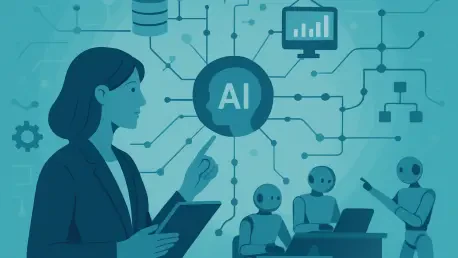

The rapid maturation of artificial intelligence has moved beyond the simple generation of text and images into a sophisticated era where autonomous agents perform complex business functions. Dataiku is currently undergoing a strategic transformation, evolving from its established roots as a collaborative data science studio into a centralized orchestration layer designed specifically for these autonomous AI agents. With the introduction of the Platform for AI Success, the company aims to solve the inherent friction between experimental AI prototypes and the rigorous, often unforgiving demands of governed, large-scale business operations. By providing a unified ecosystem, Dataiku intends to bridge the gap between simple task execution and high-stakes decision-making, ensuring that artificial intelligence becomes a scalable and reliable corporate asset. This shift represents a fundamental realization that the value of AI is no longer found in the model itself, but in the environment that manages its behavior. As organizations move through 2026, the focus has shifted from mere experimentation to the industrialization of intelligence, requiring a robust framework that can handle the complexities of multi-agent workflows across diverse IT landscapes.
The Challenge of Scale: Overcoming Fragmented AI Operations
Modern enterprises are currently facing a profound crisis of control as they race to adopt diverse AI technologies across various disparate departments and functional silos. This rapid proliferation has led to a fragmented landscape where AI agents often operate in complete isolation, creating significant governance blind spots, redundant operational costs, and unpredictable risks. Many leadership teams have discovered that deploying a single model is relatively simple, but managing a fleet of dozens or hundreds of agents requires a level of oversight that traditional IT tools cannot provide. This fragmentation often results in the duplication of efforts, where multiple teams develop similar solutions using different frameworks, leading to wasted computing resources and inconsistent results. Without a centralized orchestration layer, the promise of autonomous efficiency is frequently buried under the weight of technical debt and uncoordinated strategies that fail to align with the broader corporate vision for digital transformation.
Beyond the issues of fragmentation, many organizations find themselves stuck at a frustrating proof-of-concept plateau, unable to move AI systems into production environments. This stagnation occurs because they lack a standardized methodology to prove business impact or audit the complex logic behind autonomous decisions made by non-human actors. Stakeholders are often hesitant to authorize the full-scale deployment of agents that influence financial transactions or customer relationships without a clear understanding of the underlying decision-making process. Dataiku’s vision is to replace this chaotic and stalled environment with a structured orchestration layer that integrates artificial intelligence into the core fabric of the organization. By providing the tools necessary to validate and monitor these systems, the platform allows businesses to transition from small-scale laboratory tests to mission-critical applications that can be trusted by regulators, executives, and end-users alike.
Establishing Governance: The Pillars of Agent Management
The Dataiku Agent Management tool represents a primary pillar of this new strategy, specifically targeting the complex requirements of enterprise governance and return on investment. Designed as a comprehensive and standalone monitoring suite, it provides senior leaders with full visibility into every AI agent deployed across a company’s various IT environments, whether on-premises or in the cloud. This specialized tool is essential for tracking real-time performance against specific business goals, allowing teams to see exactly how much value each automated process is generating. Furthermore, it actively mitigates the risk of model drift, a phenomenon where an AI’s accuracy degrades over time as the underlying data changes, by alerting administrators to performance shifts before they impact the bottom line. By creating a transparent and immutable paper trail for every automated decision, the platform allows companies to defend the logic of their systems during audits or internal reviews.
To move beyond basic task automation, Dataiku is introducing Reasoning Systems that serve as the intelligence and logic center of the entire Platform for AI Success. This component allows businesses to embed their unique industry standards, specific regulatory requirements, and proprietary internal rules directly into the operational workflow of the AI. Instead of relying on the generic intelligence of a base model, these systems ensure that AI agents behave as part of a larger, governed decision-making process that reflects the specific expertise and values of the company. This transition from “black box” models to structured, rule-based reasoning is a critical step in making autonomous systems trustworthy enough for high-stakes enterprise deployment. By forcing agents to operate within these predefined logical guardrails, organizations can ensure that their digital workforce remains compliant with both legal mandates and the internal ethical guidelines that define their brand identity.
Bridging the Talent Gap: Democratizing Agent Development
The development process for sophisticated AI is being democratized through Dataiku Cobuild, a tool that allows non-technical business experts to participate directly in the agentic revolution. Using a natural language interface, stakeholders can describe their specific business objectives in plain English, and the platform will automatically generate the necessary data pipelines and AI agents to achieve them. This approach effectively removes the traditional coding barriers that have historically kept domain experts on the sidelines of technological innovation. By empowering those who understand the business problems best to build the solutions, Dataiku ensures that the resulting AI agents are highly relevant to the actual needs of the department. This democratization does not just speed up the development cycle; it ensures that the collective intelligence of the entire workforce is harnessed, rather than relying solely on a small, often overburdened group of specialized data scientists.
To maintain essential human oversight, Cobuild produces visual logic flows that allow experts to review and validate the reasoning of an agent before it is ever allowed to go live. This visual representation turns the abstract “thinking” of an AI into a tangible map that can be scrutinized, adjusted, and approved by human managers. This approach shifts the primary focus of the development team from managing complex infrastructure or writing boilerplate code to defining and refining executable business logic. By providing this layer of transparency, Dataiku addresses the common fear that autonomous agents might act in unpredictable or harmful ways. The ability to see exactly how an agent reaches a conclusion before it is deployed into a production environment creates a “human-in-the-loop” safeguard that is non-negotiable for large organizations. This ensures that while the execution is autonomous, the underlying strategy remains firmly under human control at all times.
Integrating the Ecosystem: Redefining the Enterprise AI Stack
This strategic pivot reflects a broader industry shift toward accountable AI, where visibility and rigorous human supervision have become non-negotiable requirements for success. By synthesizing data management, foundational models, and various third-party frameworks into a single governed layer, Dataiku positioned itself as the missing component in the modern enterprise technology stack. The platform ensured that artificial intelligence was no longer treated as a risky or isolated experiment but as a measurable and transparent part of everyday operations. This integration allowed different departments to collaborate on a shared infrastructure, reducing the technical friction that previously slowed down innovation. Ultimately, the goal was to provide a central environment where every agent remained grounded in actual corporate data and specific business logic, regardless of the underlying model. This architectural shift moved the focus toward a future where AI was both highly capable and strictly governed.
To capitalize on these advancements, organizations should have prioritized the creation of a centralized AI inventory to track all existing agents and their respective business impacts. It became clear that successful implementation required a shift in corporate culture where business experts and technical teams worked in a unified environment. Leaders who adopted these orchestration tools found they could scale their operations more rapidly while maintaining a clear view of their return on investment. The transition toward a structured orchestration layer proved that the most effective way to manage autonomous systems was to treat them as a digital extension of the human workforce. Moving forward, the focus remained on refining these reasoning systems to handle increasingly complex global regulations and market shifts. This proactive approach to orchestration ensured that the enterprise stayed resilient, adaptable, and fully accountable in an era defined by the rapid and continuous evolution of artificial intelligence.