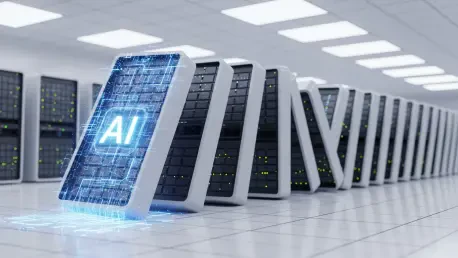

A seismic tremor recently rattled the foundations of the technology sector, wiping an astonishing $830 billion in market value from the S&P 500 Software and Services Index in a remarkably short period. This was not the result of a typical market correction or economic downturn, but rather the dawning realization of a profound paradigm shift driven by artificial intelligence. The market is grappling with a new and unsettling term: the “SaaSpocalypse,” a theory suggesting that the very business model of Software as a Service (SaaS) is facing an existential threat. The culprit is the rapidly advancing capability of AI models, which are beginning to demonstrate the power to perform complex, specialized tasks on demand, thereby questioning the necessity of dedicated software applications that have defined the digital workplace for over a decade. This event is more than a financial fluctuation; it’s a clear signal that the relationship between humans, software, and work itself is on the brink of a fundamental and irreversible transformation.
The Unraveling of a Digital Empire
The core value proposition of the SaaS industry has long been its ability to provide specialized, accessible tools for discrete business functions. However, the rise of sophisticated AI agents directly challenges this model by offering a more integrated and dynamic solution. This shift represents not just a competitive threat, but a potential dismantling of the established software ecosystem.
The Obsolescence of Specialized Applications
The threat to the established SaaS model is no longer a distant theoretical concept but an immediate and tangible reality reshaping enterprise technology strategies. The fundamental challenge stems from AI’s ability to execute highly specialized tasks that were once the exclusive domain of dedicated software platforms. Consider project management, a field dominated by tools that help teams track progress and resolve issues. When an AI can directly analyze code, identify bugs, suggest fixes, and even implement them with minimal human oversight, the need for a separate, manually updated project management tool like Jira becomes significantly diminished. The AI effectively collapses the entire workflow—from problem identification to resolution—into a single, intelligent interaction, rendering the intermediary software redundant. This pattern is repeating across numerous verticals, creating a domino effect that could destabilize the entire software industry as we know it today.
This disruptive capability extends far beyond the realm of software development, permeating industries that have heavily invested in digital transformation through SaaS. In the legal technology sector, for instance, websites built their business models on providing templates and tools for drafting standardized legal documents. An advanced AI, however, can now generate highly customized contracts, agreements, and legal notices tailored to specific circumstances in a matter of seconds, challenging the value of a static template library. Similarly, the world of Customer Relationship Management (CRM) is facing a potential upheaval. Companies invest immense resources in extensive licenses for platforms like Salesforce to manage sales pipelines and customer interactions. Yet, the emergence of AI agents capable of performing complex CRM tasks—from lead qualification and data entry to personalized customer outreach—threatens to drastically reduce a company’s reliance on these sprawling, costly systems, questioning the very necessity of a large-scale, per-seat licensing model.
Historical Precedent and the Future of the Developer
This technological displacement is not an unprecedented event but a recurring theme throughout human history, where transformative innovations consistently render established tools and professions obsolete. The transition from a world of manual labor to one of mechanization provides a clear and powerful parallel. The advent of electricity did not simply improve upon gas lamps and hand-cranked machinery; it fundamentally replaced them, and in doing so, it eliminated entire job categories, such as the lamplighter. In a similar vein, the invention of the transistor and the subsequent rise of the electronic computer made the role of the “human computer”—individuals who performed complex calculations by hand—entirely obsolete. These historical shifts demonstrate a consistent pattern: a breakthrough technology emerges that offers an order-of-magnitude leap in productivity and efficiency, leading to the displacement of the old paradigm. AI now stands as the modern equivalent of electricity or the transistor, poised to redefine the digital landscape.
The role of the software developer, once seen as one of the most secure and future-proof professions of the digital age, is now at the center of this transformative wave. The rapid advancement of AI-powered coding agents is accelerating the journey toward a future where the barrier to creating complex software is dramatically lowered. The day is fast approaching when an entrepreneur with a clear vision, but no formal coding expertise, can articulate their idea to an AI and have a sophisticated, scalable application built in a matter of hours, not months or years. In this new reality, the traditional role of a software developer, focused on writing line after line of code, could become as antiquated as that of a buggy whip maker after the invention of the automobile. The emphasis will shift from the mechanics of coding to the high-level architecture of ideas, strategic design, and creative problem-solving, forcing a complete reevaluation of what it means to build and innovate in the world of technology.
A New Renaissance of Work
While the prospect of mass obsolescence can seem daunting, history teaches us that such disruptions are often the catalysts for unprecedented growth and innovation. The elimination of old jobs has consistently paved the way for the creation of entirely new industries and professions, often in ways that were previously unimaginable.
The Inevitable Creation of Unforeseen Roles
The narrative of technological progress is not one of pure destruction but one of creative transformation. When a new technology meets a soaring societal or commercial demand, it invariably unleashes a wave of new economic opportunities. The widespread adoption of electricity serves as the quintessential example. While it ended the era of the gas lamplighter, it simultaneously created a massive demand for electricians, power plant technicians, electrical engineers, and a host of other professions necessary to build and maintain the new electrical grid. These were not merely one-to-one replacements; they were entirely new categories of work that supported a far more complex and productive economy. This historical pattern provides a powerful framework for understanding the potential impact of artificial intelligence. As AI automates existing tasks, it will inevitably create a new ecosystem of roles centered around its development, implementation, and oversight.
Speculating on the exact job titles of the future is an exercise in imagination, but the underlying principle remains sound. The productivity explosion spurred by AI will create new services, industries, and societal needs that we cannot yet fully fathom. We may see the rise of “AI integration strategists,” “prompt engineers,” or “autonomous systems ethicists”—roles that would sound as foreign to us today as “cloud services manager” or “social media coordinator” would have to a 19th-century lamplighter. The key takeaway from history is that human ingenuity does not stagnate in the face of automation; it adapts and elevates. The massive gains in efficiency and capability afforded by AI will free up human capital to focus on more creative, strategic, and complex challenges, ultimately driving a new era of innovation and economic expansion that will be defined by jobs and skills that do not yet exist.
The Ultimate Impact on Human Ingenuity
The technological upheaval driven by artificial intelligence was not just a market event but a fundamental recalibration of the future of work. The initial shock to the software industry underscored the immense disruptive power of a technology capable of not just assisting but supplanting established digital tools. This evolution mirrored historical shifts, where breakthrough innovations consistently rendered old professions obsolete while simultaneously creating new and unforeseen industries. The transition from manual processes to automated systems has historically spurred tremendous leaps in productivity and human potential. Ultimately, this massive technological advancement catalyzed human ingenuity, setting the stage for a future where a new generation would hold jobs and pursue innovations that were previously inconceivable, continuing the timeless cycle of progress and adaptation.