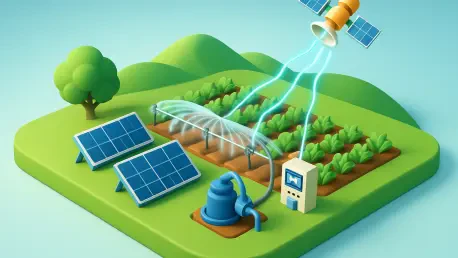

Solar water pumping systems are increasingly recognized as a foundational technology for sustainable agriculture, providing a clean and cost-effective method for irrigation that can liberate farmers from the volatility of fossil fuel prices and the limitations of unreliable electrical grids. This technology holds immense promise for reducing carbon emissions and operational expenses, yet its full potential is constrained by a fundamental and frustrating paradox: the very source of its power, the sun, is also the source of its greatest weakness. The intermittent nature of solar energy, subject to the whims of weather and seasons, introduces a significant level of operational uncertainty. This variability makes it exceedingly difficult for farmers to depend on a consistent water supply, a reality that directly threatens crop vitality, diminishes yields, and ultimately hampers the widespread adoption of an otherwise transformative green technology.
The Challenge of the Sun Why Solar Pumps Falter
The Unpredictability Problem
The primary obstacle to the widespread, confident use of solar irrigation systems is the inherent variability of their energy source. For a farmer, whose entire livelihood can hinge on the precise timing and volume of water delivery, this unpredictability poses a substantial risk. A day that begins with clear skies can quickly turn overcast, drastically reducing the pump’s output and disrupting meticulously planned irrigation schedules. This isn’t merely an inconvenience; it’s a direct threat to agricultural productivity. An unexpected drop in water supply during a critical growth phase can lead to stressed crops, reduced yields, and significant financial losses. This constant uncertainty forces farmers into a reactive posture, constantly adapting to fluctuating energy levels rather than executing a stable, long-term irrigation strategy. The financial investment in solar technology, therefore, becomes a gamble, one that many small-scale farmers cannot afford to lose, slowing the transition to more sustainable agricultural practices in the very regions that need them most.
Beyond Basic Forecasting
Compounding the problem of solar variability is the inadequacy of conventional forecasting methods. Traditional predictive models are typically deterministic, meaning they are designed to produce a single, fixed outcome based on a limited set of inputs. These models may offer a general estimate of solar availability, but they are fundamentally incapable of grappling with the complex and random nature of meteorological phenomena. They fail to account for the probability of different weather scenarios, offering a prediction that is often more of a rough guess than a reliable operational tool. For a farmer needing to make critical decisions about resource allocation, a simple forecast of “partly cloudy” is functionally useless. What is needed is a more sophisticated approach that can quantify uncertainty, providing a probabilistic outlook that allows for strategic risk management. Without the ability to understand the likelihood of different outcomes, farmers are left to plan based on hope rather than data, a precarious foundation for any modern agricultural enterprise.
A Smarter Solution The AI-Powered Hybrid Model
Embracing Uncertainty with Stochastic Modeling
A significant leap forward in addressing solar power’s intermittency comes from the application of stochastic modeling. Unlike their deterministic counterparts, stochastic frameworks are designed to embrace and analyze randomness. By processing extensive historical data sets on solar irradiance and weather patterns, these models can generate probabilistic forecasts rather than a single, absolute prediction. Instead of simply stating whether a pump will be operational, a stochastic model can calculate the likelihood of the system achieving various levels of performance over a given period. This provides farmers with a nuanced and far more realistic portrait of their potential water supply. They can see the probability of having enough water for full irrigation versus the risk of a significant shortfall. This paradigm shift from certainty to probability empowers users to make data-driven decisions, manage risk effectively, and plan irrigation strategies that are resilient to the inherent unpredictability of their energy source.
The AI Edge Nature-Inspired Algorithms
The true innovation, however, emerges when stochastic modeling is enhanced with artificial intelligence, particularly through the use of nature-inspired algorithms. These advanced computational methods are designed to solve complex optimization problems by mimicking natural processes, such as the principles of evolution or the collective intelligence of a swarm. Within the context of a solar irrigation system, these algorithms function as a continuous improvement engine. They actively analyze real-time data, including current weather conditions and system performance, and use this information to dynamically fine-tune the parameters of the stochastic model. This creates a powerful, self-learning feedback loop. The system doesn’t just predict; it adapts. It learns from its past inaccuracies and adjusts to changing environmental conditions, making its forecasts progressively more precise over time. This integration of AI transforms a static predictive tool into a dynamic, intelligent system capable of delivering the high-fidelity forecasts needed for modern precision agriculture.
From Theory to the Field Real-World Impact
Empowering the Modern Farmer
The practical application of this AI-driven predictive technology fundamentally alters the dynamic of farm management. It shifts irrigation from a reactive, often anxiety-inducing task to a proactive and strategic operation. Equipped with reliable, probability-based forecasts, farmers are empowered to make highly informed decisions. They can confidently schedule irrigation to coincide with periods of predicted peak solar energy, ensuring that crops receive water when it is most beneficial. This precision leads to a dramatic optimization of water usage, a critical advantage in arid or drought-prone regions. By minimizing water waste and ensuring crop needs are met, farmers can achieve more stable and often significantly higher yields. Ultimately, this technology transforms a volatile energy source into a dependable agricultural asset, enhancing food security, boosting farm profitability, and providing the operational stability necessary for long-term planning and investment.
Scaling Up for Global Impact
The implications of this technological advancement extend far beyond the boundaries of an individual farm. By demonstrating that solar irrigation can be a reliable and predictable resource, this hybrid modeling approach helps to de-risk the technology on a global scale. This newfound reliability builds confidence among farmers, agricultural cooperatives, and governmental agencies, encouraging wider adoption and investment in sustainable water management solutions. For policymakers in regions grappling with water scarcity and food insecurity, this technology provides a powerful tool to formulate effective strategies that promote a large-scale transition away from expensive and polluting diesel-powered pumps. As the performance of these systems becomes more predictable, it becomes easier to integrate them into regional water and energy grids, supporting a more resilient and sustainable agricultural sector worldwide and contributing meaningfully to global climate objectives.
A Forward-Looking Perspective on Smart Farming
Paving the Way for Fully Automated Systems
The development of this predictive model serves as a critical stepping stone toward a more integrated and intelligent future for agriculture. The next frontier involves creating fully holistic smart farming ecosystems where AI does more than just forecast energy availability. Future systems will likely integrate a much wider array of real-time data streams, pulling information from soil moisture sensors, weather stations, and even satellite imagery. This data, combined with specific information about crop type and growth stage, could feed into an advanced AI that doesn’t just predict but prescribes and automates. Such a system could automatically adjust irrigation schedules and water volume to optimize for plant health and resource conservation with unparalleled precision. This would represent a move toward a truly autonomous form of precision agriculture, where technology and nature work in a seamlessly optimized harmony to maximize efficiency and productivity.
The Crucial Role of Data Infrastructure
The successful development and deployment of these sophisticated predictive models underscored a critical and foundational requirement: the availability of high-quality, comprehensive data. The accuracy of the AI-powered forecasts was entirely contingent on the system’s ability to learn from extensive historical records of solar irradiance patterns and the corresponding water pumping outputs. This dependency highlighted the absolute necessity of establishing robust data monitoring infrastructure as a prerequisite for building the next generation of smart agricultural systems. The advancement from basic estimation to reliable prediction was not merely an algorithmic achievement; it was a testament to the power of data. This realization cemented the understanding that future progress in sustainable agriculture and effective resource management would depend on a concerted effort to collect, share, and analyze environmental and operational data on a massive scale.