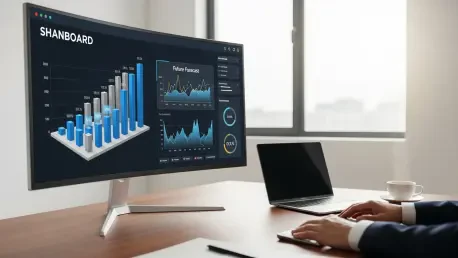

The transition from interpreting past financial failures to anticipating market fluctuations before they occur has become the primary differentiator between industry leaders and those struggling to maintain relevance in the current economic landscape. In the business environment of 2026, the reliance on retrospective data—once the gold standard for executive decision-making—is increasingly viewed as a liability rather than an asset. Traditional reporting methods often leave leadership in a defensive posture, reacting to problems that have already solidified into losses. However, the emergence of sophisticated predictive dashboards has fundamentally altered this dynamic by integrating machine learning models directly into the visual interface. According to research from McKinsey, organizations that successfully transition to these anticipatory tools can witness an additional 15 percentage points in EBITDA growth. This significant financial improvement suggests that the shift is not merely about aesthetic updates to software but represents a core evolution in how corporate strategy is formulated and executed across global industries.
Transforming Corporate Strategy Through Anticipatory Analytics
The New Standard: Dynamic Real-Time Intelligence
The fundamental architecture of modern business intelligence has moved beyond the simple aggregation of historical records to the synthesis of real-time predictive streams. Previously, dashboards were designed as static archives that detailed past revenue, operational costs, and website traffic, providing a clear but backward-looking view of the company. Modern design services now focus on embedding machine learning models that update continuously, creating what industry experts refer to as a living forecast. These interfaces provide a persistent stream of expectations based on incoming data, allowing for a level of precision that quarterly updates could never achieve. Instead of reviewing a sales slump after the month has ended, executives can now observe a projected decline weeks in advance. This transition from reactive damage control to proactive planning allows a company to remain agile, ensuring that resources are diverted to the most promising opportunities before the market shifts.
By moving away from a reliance on lagging signals, organizations can transform their internal data into a strategic asset that actively protects profit margins. Traditional key performance indicators often show what has already failed, which provides limited utility for immediate tactical adjustments. In contrast, predictive dashboards utilize leading indicators to provide early warnings of weak signals that might otherwise go unnoticed by the human eye. For example, rather than simply reporting on customer churn that occurred last month, a predictive system identifies specific behavioral patterns that suggest a client is likely to leave in the coming weeks. This foresight enables targeted interventions, such as personalized outreach or specialized incentives, which can retain the account and preserve revenue. The result is a proactive culture where every department is focused on future-proofing their operations rather than explaining away past discrepancies during high-stakes board meetings.
Operationalizing Foresight: Impact On Efficiency
The practical application of predictive analytics within a dashboard framework facilitates a dramatic shortening of the reaction cycle for large-scale operations. When leaders can visualize a forecast with a high degree of confidence, they are empowered to make earlier and more informed decisions regarding cost adjustments and production scaling. This capability is particularly vital in manufacturing and supply chain management, where delays in decision-making often lead to bloated inventories or missed delivery windows. By forecasting demand fluctuations before they fully materialize, companies can synchronize their production schedules with real-market needs, thereby reducing waste and maximizing resource utilization. The intelligence provided by these dashboards does not just highlight future trends; it provides a roadmap for resource allocation that ensures capital is always deployed where it will generate the highest possible return on investment.
Furthermore, the integration of predictive foresight into daily workflows helps to eliminate the volatility that often characterizes rapid growth phases. In a traditional setup, scaling production or expanding into a new territory involves a high degree of guesswork and risk. Predictive dashboards mitigate this risk by offering a data-driven projection of how various external factors, such as economic shifts or competitor behavior, will impact the success of a specific initiative. This allows stakeholders to simulate various scenarios and select the path that offers the most stable growth trajectory. When financial and operational data are viewed through the lens of foresight, the entire organization gains a sense of direction that is grounded in reality rather than optimism. This clarity of direction is what eventually converts foresight into tangible profit, as every action taken by the firm is aligned with a highly probable future outcome rather than a guess.
Building Confidence In Predictive Models
Transparency In Design: Visualizing Logic
One of the most significant barriers to the widespread adoption of predictive analytics has been the perceived black box nature of machine learning. Executives are often hesitant to commit significant resources based on a forecast if they do not understand the underlying logic that produced the projection. Modern dashboard design addresses this skepticism by prioritizing transparency and explainability in its visual representations. Instead of presenting a single, unexplained number, effective dashboards visualize confidence ranges and highlight the specific drivers behind a particular projection. When a leader can see that a predicted revenue dip is directly linked to a decline in pipeline velocity or specific conversion rates, they are far more likely to trust the data and take the necessary action. This approach demystifies the technology, turning complex mathematical models into intuitive tools.
Building trust through design requires a focus on clarity rather than just data density or complex visualizations that confuse the end user. By highlighting the relationship between different data points, a well-designed predictive dashboard provides a narrative that explains why a certain trend is expected to occur. This transparency ensures that stakeholders at all levels of the organization can engage with the data and provide their own qualitative insights. When the reasoning behind a forecast is visible, it invites a collaborative approach to problem-solving where data-driven insights are augmented by human expertise. This synergy between machine intelligence and executive judgment creates a robust framework for decision-making that is both scientifically sound and practically applicable. Ultimately, the goal is to create an environment where the data is not just seen but is fully understood and utilized as a foundation for every major strategic move.
Strategic Integration: Converting Insight Into Actionable Growth
The culmination of a successful predictive dashboard implementation was found in its ability to turn abstract data points into concrete strategic advantages. Organizations that adopted these tools moved beyond the phase of simple data visualization and entered an era of comprehensive business orchestration. By reducing the frequency of surprises in a volatile market, these companies were able to protect their margins while simultaneously fostering long-term growth through informed foresight. The synthesis of real-time data and predictive modeling allowed for a level of precision in budgeting and labor management that was previously unattainable. Leaders who utilized these systems effectively were able to anticipate the needs of their customers and the movements of their competitors with a degree of accuracy that defined the new standard for corporate excellence. This transition proved that the true value of data lies in its ability to predict.
Future considerations for businesses looking to remain competitive must include a commitment to continuous model refinement and user interface optimization. As machine learning algorithms become more sophisticated, the dashboards that host them will need to evolve to manage even more complex data sets without sacrificing ease of use. The organizations that succeeded in this transition were those that prioritized the human element of data interaction, ensuring that their tools were accessible to decision-makers who may not have a background in data science. Moving forward, the focus should remain on developing internal capabilities that allow for the rapid translation of predictive insights into operational reality. By investing in both the technology and the culture necessary to support it, companies ensured that they were not just keeping pace with the industry but were actively defining its future through the power of anticipatory intelligence and strategic clarity.