
The promise of the cloud data warehouse has always been one of boundless scale and centralized power, yet many organizations find their most critical analytics processes still tethered to the costly and risky practice of shuttling massive datasets back and forth between platforms. This constant movement not only inflates operational expenses but also introduces security vulnerabilities, creating a persistent drag on the quest for rapid, data-driven insights. For users of powerful analytics tools like Alteryx and cloud behemoths like Google BigQuery, this friction has been a long-standing challenge, pitting user-friendly data preparation against the robust governance of the data warehouse. A strategic shift in how these platforms interact, however, is fundamentally altering this dynamic, prompting a reevaluation of where and how analytics workflows should be executed.
Is Your Data Constantly on the Move? The Hidden Costs of Cloud Analytics
In the intricate architecture of modern data stacks, the journey of data is rarely a straight line. For many analytics teams, the process begins with data stored in a centralized cloud warehouse like Google BigQuery, chosen for its immense storage capacity and computational power. However, to perform the complex data preparation, blending, and transformation tasks necessary for analysis, teams often rely on specialized platforms such as Alteryx. This dependency necessitates a crucial, and often overlooked, step: moving the data out of its secure cloud environment. This extraction is not merely a technical step but a significant operational and financial event. Each gigabyte transferred incurs data egress fees, which, when scaled across terabytes or petabytes of data for daily or hourly workflows, can accumulate into a substantial and often unpredictable operational expense.
Beyond the direct financial impact, this constant data migration introduces a subtle but significant tax on performance and agility. The time spent extracting data from BigQuery, loading it into an Alteryx server, processing it, and then potentially loading it back creates inherent latency in the analytics pipeline. This delay can mean the difference between capitalizing on a fleeting business opportunity and acting on stale information. Moreover, this multi-step process complicates the overall data architecture, creating more points of potential failure and requiring more complex orchestration to manage. The dream of real-time, on-demand analytics becomes progressively harder to achieve when the foundational data is perpetually in transit, creating a workflow that is less a seamless pipeline and more a series of disjointed, time-consuming stages.
The Old Workflow: Why Moving Data Out of BigQuery Creates Problems
The traditional method of integrating Alteryx with BigQuery was a textbook example of a process burdened by its own architecture. To leverage Alteryx’s intuitive, low-code interface for data preparation, analysts had to first pull data out of the BigQuery environment. This practice, while functional, directly led to a significant financial drain through data egress fees. Cloud providers, including Google, charge for data moving out of their network, a cost that can quickly spiral out of control for organizations dealing with large-scale datasets or running frequent analytical queries. This recurring expense effectively penalizes companies for using their own data, turning a routine operational task into a budgetary concern that requires constant monitoring and often forces compromises on the scope or frequency of analysis.
Simultaneously, the act of moving data between platforms represented a considerable security gamble. Every time data leaves the governed and fortified environment of a cloud data warehouse, its exposure to potential threats increases. The transit itself, even if encrypted, creates a new vector for interception, while the temporary storage of that data on an intermediate Alteryx server introduces another endpoint that must be secured and monitored. This complicates governance and compliance efforts, as data stewards must now track the data’s lineage across multiple systems. For industries handling sensitive information, such as finance or healthcare, this added risk is often unacceptable, forcing teams into cumbersome workarounds or limiting their ability to use best-in-class tools for data preparation.
The New Paradigm: How “Live Query for BigQuery” Changes the Game
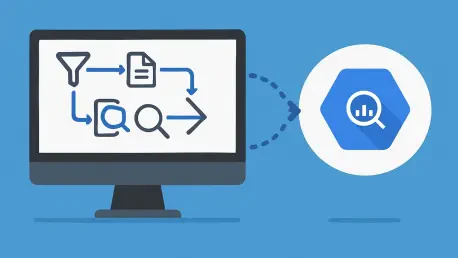
The introduction of “Live Query for BigQuery” marks a fundamental shift away from the legacy model of data extraction and toward a more efficient, secure, and scalable paradigm. This enhancement is built upon the concept of “pushdown” functionality, a technical approach that effectively reverses the flow of work. Instead of pulling data out of the warehouse to be processed by the analytics tool, the tool pushes the processing logic down into the warehouse itself. In this model, an analyst uses the familiar drag-and-drop Alteryx interface to design a workflow, but when that workflow is executed, Alteryx translates it into SQL queries that run directly within the Google BigQuery environment. The heavy lifting of data transformation, blending, and preparation is performed by BigQuery’s powerful distributed computing engine, right where the data resides.
This pushdown capability unlocks warehouse-scale execution for analytics workloads that were previously constrained by the capacity of an individual Alteryx server. As Donald Farmer, founder and principal of TreeHive Strategy, noted, this allows for “BigQuery-scale analytics” because Google’s infrastructure possesses far greater processing power than any on-premises or cloud-hosted Alteryx server. Consequently, teams can now operate on massive, multi-terabyte datasets with unprecedented speed, automating complex data pipelines that run at the full velocity of the cloud data warehouse. This not only accelerates the time to insight but also democratizes access to large-scale data processing. The new integration effectively bridges the gap for business users who value Alteryx’s accessibility but need the raw power of a governed platform like BigQuery, empowering them to perform sophisticated data work without needing to become SQL experts or data engineers.
The core value of this integration, according to Alteryx, is a four-point breakdown of benefits that directly address previous pain points. First, it enables direct data preparation, allowing users to apply complex business logic within Alteryx while the operations execute on data in BigQuery. Second, it delivers warehouse-scale execution, ensuring governed workflows run with the speed and scalability of the underlying cloud platform. Third, it enhances centralized governance by keeping all data and processing within the secure perimeter of Google Cloud, preserving its robust security and performance features. Finally, by streamlining the entire data preparation pipeline, it helps data, analytics, and AI teams accelerate the delivery of actionable insights, making the organization more agile and data-driven.
Industry Context and Expert Perspectives
This development is not occurring in a vacuum but is part of a broader, inevitable industry trend toward the deeper integration of specialized analytics platforms and major cloud data ecosystems. As Matt Aslett, an analyst at ISG Software Research, observed, the widespread enterprise adoption of cloud data platforms from providers like AWS, Microsoft, Snowflake, and Databricks has created a powerful gravitational pull. Analytics vendors like Alteryx must align their offerings more closely with these platforms to stay relevant and reduce friction for their mutual customers. While Alteryx had already introduced similar “Live Query” capabilities for Databricks and Snowflake, its extension to Google Cloud is a significant move that caters to the large and growing base of BigQuery users, offering them a proven path to enhanced performance, reduced complexity, and lower costs.
While the concept of pushdown query execution is not new, experts point to Alteryx’s specific implementation as a key differentiator. Donald Farmer highlighted that features such as the intuitive, drag-and-drop experience for building direct queries and the deep architectural optimization for BigQuery distinguish this offering from more generic solutions. However, he also offered a word of caution regarding the user experience. The live query model fundamentally alters the highly iterative “prepare-analyze-re-prepare” cycle that many Alteryx users are accustomed to. This familiar, rapid-feedback loop may feel diminished when queries are sent to the warehouse for execution. Despite this potential adjustment for users, Farmer conceded that for large-scale, production-level workloads, the immense performance and security benefits of in-place processing almost certainly outweigh this shift in workflow dynamics.
The strategic partnership between Alteryx and Google Cloud extends beyond this single feature. Plans are underway for “Alteryx One: Google Edition,” a version of Alteryx’s unified platform purpose-built for Google Cloud customers. This edition will be made available for streamlined purchase and deployment directly through the Google Cloud Marketplace, further lowering the barrier to adoption. Alteryx’s current product roadmap continues to emphasize efficiency, with goals to expand in-place execution capabilities across more platforms and transform business logic into a governed, reusable asset. A central focus remains on enabling customers to build trustworthy AI models and applications, a goal that relies heavily on the foundation of clean, well-prepared, and reliable data that this integration helps to ensure.
Practical Implications: What This Means for Your Team and Your Budget
For data teams, the most immediate and tangible impact of this new capability is a dramatic streamlining of the data preparation pipeline. The elimination of the extract-and-load step removes a major bottleneck, significantly reducing the time it takes to get data ready for analysis. This acceleration means that analysts can iterate more quickly, test more hypotheses, and deliver insights to business stakeholders faster than ever before. Workflows that previously took hours to run due to data movement can now be completed in a fraction of the time, freeing up valuable analyst hours for higher-value activities like interpretation and strategic recommendation instead of data wrangling and process monitoring.
From a security and governance perspective, keeping data in-place within BigQuery is a transformative improvement. It simplifies compliance by ensuring that sensitive data never leaves the controlled, audited environment of the cloud warehouse. This minimizes the attack surface, reduces the risk of data breaches during transit, and makes it easier for governance teams to maintain a clear and unbroken chain of data lineage. Centralizing both data and its processing logic within a single, governed platform reinforces security policies and ensures that all operations adhere to corporate standards, providing greater peace of mind for Chief Information Security Officers and data governance leaders.
However, this newfound power comes with a critical new responsibility. As users are empowered to run more complex and resource-intensive queries directly in the cloud, the risk of unexpected cost spikes increases. Donald Farmer identified the need for cloud cost governance tools as a critical missing piece in this ecosystem. Without a way to forecast the expense of a workflow before execution, organizations could face “bill shock” as users inadvertently run queries that consume a large number of BigQuery credits. An ideal future state would involve Alteryx integrating a cost-estimation tool that could predict the financial impact of a workflow, giving users and administrators the foresight needed to manage cloud spend effectively. This addition would complete the picture, marrying operational efficiency with fiscal responsibility.
This evolution in the Alteryx and Google Cloud partnership represented a significant step toward a more integrated, efficient, and secure analytics landscape. By allowing workflows to run directly within BigQuery, the collaboration addressed long-standing challenges related to data egress costs, security vulnerabilities, and performance bottlenecks. The “pushdown” functionality unlocked the full computational power of the cloud data warehouse for Alteryx users, enabling them to process massive datasets at scale while operating within a governed environment. While the shift required some adjustment to user workflows and highlighted a new need for cost governance tools, the strategic benefits were clear. The move reflected a mature understanding of customer needs and a broader industry trend toward seamless integration between analytics tools and the cloud platforms where enterprise data increasingly resides.