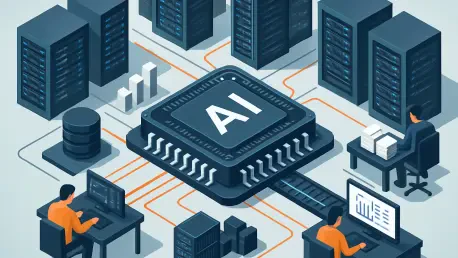

The accelerated convergence of high-performance silicon and enterprise-grade open-source orchestration is no longer a technical luxury but a fundamental requirement for businesses attempting to transition from experimental algorithms to industrial-scale automation. As the global artificial intelligence market matures, the focus has shifted from the excitement of initial discovery toward the gritty reality of sustainable, high-volume output. This evolution has birthed the concept of the AI Factory, a reimagined data center operation where raw data enters and refined intelligence emerges through a streamlined, industrial process.
Within this landscape, the distinction between high-performance computing and everyday enterprise operations is blurring. Hybrid cloud environments and edge applications now demand the same level of sophistication previously reserved for supercomputing laboratories. Influential market players are responding by moving away from fragmented software stacks that require months of manual tuning. Instead, the industry is witnessing a pivot toward turnkey, hardware-software integrated systems that treat the entire AI lifecycle as a single, cohesive unit rather than a collection of disparate parts.
The Paradigm Shift in Enterprise AI Infrastructure and Orchestration
The current state of the global market reflects a decisive move from experimental prototypes toward industrialized deployment at every level of the corporate hierarchy. Organizations are no longer content with isolated proof-of-concept projects that fail to scale; they are demanding infrastructure that mirrors the reliability of traditional manufacturing plants. This shift is particularly visible in the rise of the AI Factory, which serves as a blueprint for modernizing data centers to handle the massive throughput required by generative models and real-time analytics.
This modernization effort is notably aggressive in segments like high-performance computing and edge AI, where latency and processing power are non-negotiable. As businesses push AI closer to the point of data collection, the need for a standardized orchestration layer becomes paramount. The transition from fragmented software ecosystems to pre-integrated stacks allows enterprises to bypass the traditional “integration tax” that often stalls digital transformation. Consequently, the collaboration between hardware pioneers and software leaders is becoming the primary driver of infrastructure sales.
Decoding the AI Factory Architecture and Strategic Drivers
Proactive Engineering and the Evolution of the Partnership
Moving beyond the reactive nature of traditional open-source integration, the relationship between Red Hat and Nvidia has evolved into a model of proactive engineering. Historically, software developers waited for new silicon to be released before beginning the long process of optimization, creating a persistent enablement lag. By collaborating at the earliest stages of hardware design, these partners now ensure that the operating system and container platforms are fully optimized for the latest GPUs the moment they reach the data center floor.
This shift from manual integration to ready-to-ship solutions is embodied in the Red Hat AI Enterprise bundles. These packages simplify the complex lifecycle of Large Language Models by providing a unified environment for training, tuning, and serving models. By embedding Nvidia microservices directly into the OpenShift architecture, the partnership removes the guesswork from GPU orchestration. This allows IT departments to focus on delivering business value rather than spending hundreds of hours troubleshooting driver incompatibilities or memory allocation errors.
Market Dynamics and the Surge in Agentic Enterprise Demand
Current growth projections highlight an industry-wide push toward multi-agent AI systems that go beyond simple chat interfaces to perform autonomous workflows. These agentic systems require a level of performance and reliability that standard cloud environments struggle to provide. Performance indicators suggest that integrated stacks are essential for optimizing inference speeds, which is the lifeblood of any autonomous business process. As the demand for these systems grows, the readiness of the underlying infrastructure determines which companies can actually deploy these advanced tools.
Forward-looking data suggests that the rise of the agentic enterprise will necessitate a massive overhaul of how distributed workloads are managed. Integrated stacks are specifically designed to handle the bursty, unpredictable nature of AI agents as they interact with various corporate databases and external APIs. This preparation is not just about raw power; it is about the intelligent distribution of tasks across the network. The readiness of an organization to support these complex workflows is becoming a key indicator of its future market competitiveness.
Overcoming the Production Gap and Operational Skepticism
Addressing operational readiness remains a significant hurdle, as roughly 85% of businesses currently aspire to agentic status while only about 20% have successfully reached full production. This gap is often fueled by deep-seated operational skepticism regarding the complexity of the tools involved. Many organizations find themselves paralyzed by tool sprawl, where the sheer number of platforms like Snowflake, Databricks, and various cloud-native services creates a management nightmare. Integrating a unified stack with these existing environments is the only way to restore operational sanity.
Technological hurdles in AI inference also contribute to the production gap, particularly when it comes to maintaining security across distributed workloads. Strategies for proving the financial feasibility of a “one-stop-shop” infrastructure are becoming more sophisticated, focusing on the total cost of ownership rather than initial hardware prices. Proving the return on investment involves demonstrating how a pre-integrated factory model reduces the time to value and minimizes the risk of project abandonment.
Regulatory Frameworks, Compliance, and Data Sovereignty
Managing sensitive corporate data is increasingly complicated by strict data residency laws that dictate where models can be trained and deployed. For many highly regulated sectors, the public cloud is not an option for their most valuable proprietary data. This has led to a renewed focus on data sovereignty, where the AI Factory must function as effectively on-premises as it does in a hybrid environment. Utilizing BlueField DPUs and specialized observability tools allows for the creation of hardened environments that satisfy the most stringent security requirements.
Compliance standards for AI governance are also evolving to require greater transparency and safety. In finance and healthcare, every decision made by an AI model must be traceable and defensible. The integration of specialized security layers at the hardware level ensures that the AI lifecycle is protected from data poisoning and unauthorized access. By building these protections directly into the infrastructure, organizations can meet regulatory demands without sacrificing the performance needed for real-time inference.
The Future Landscape of Hybrid AI and Market Disruption
The hybrid cloud imperative is now defined by a balanced 30/30/30 split between on-premises, hybrid, and public cloud environments. This distribution reflects the reality that no single environment is perfect for every AI task. Emerging technologies like SuperNICs and automated checkpointing are becoming standard features in future-proofed AI investments, allowing for more resilient and efficient model training. These hardware advancements are critical for maintaining the high uptime required by mission-critical AI applications.
Competitive positioning in this space has become fierce, with integrated stacks from various vendors vying for dominance. Innovation serves as a major differentiator, particularly in the democratization of AI tools for non-data scientists. By simplifying the interface between the human operator and the GPU cluster, these platforms allow IT generalists to manage complex AI environments. This shift is essential for scaling AI across the economy, as the supply of specialized data science talent remains limited.
Closing the Gap: Future Outlook for the Agentic Enterprise
The strategic synergy between Red Hat and Nvidia established a new benchmark for how hardware and software interacted to drive business outcomes. Organizations that prioritized integrated stacks found they reduced the time to market for complex models significantly. IT departments discovered that shifting away from fragmented tools allowed them to focus on high-level strategy rather than low-level troubleshooting. Decisions made during this period emphasized the importance of vendor synergy in maintaining a competitive edge.
The AI Factory model proved its potential to standardize deployment, turning a once-cluttered technical landscape into a predictable utility. IT leaders who adopted these integrated architectures successfully bypassed the operational bottlenecks that plagued their peers. Future investments required a focus on flexible infrastructure that supported both local data control and cloud-scale performance. Scaling efforts moved away from manual configurations toward automated, policy-driven environments that grew alongside the business. This transition confirmed that the production gap was not a lack of intelligence, but a lack of infrastructure maturity.