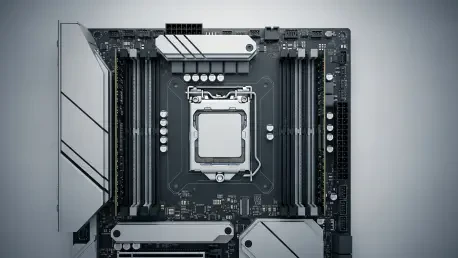

The traditional boundaries of semiconductor business models are dissolving as Arm transitions from a provider of digital blueprints to a direct manufacturer of high-performance silicon. This historic strategic pivot marks the end of a thirty-five-year era where the company functioned exclusively as an intellectual property provider, choosing instead to enter the arena as a primary producer of production-ready hardware. By delivering its own physical chips built on the proven Neoverse platform, Arm is providing a ready-to-deploy compute layer designed specifically for the rapidly industrializing artificial intelligence sector. This move is a direct response to the global surge in demand for AI-native data centers that require specialized, rack-scale efficiency rather than the general-purpose computing paradigms of the previous decade. The introduction of the AGI CPU serves as a foundation for the era of agentic AI, where autonomous software agents perform complex tasks across distributed networks. As the industry moves away from human-constrained input speeds toward autonomous machine-to-machine coordination, the infrastructure must evolve to handle massive, simultaneous computational loads that traditional architectures were never designed to manage. This transition signals a broader industry trend where the integration of hardware and software is no longer optional but a fundamental requirement for scaling the next generation of intelligent systems.
Orchestrating the Agentic AI Era
The Evolution of Data Center Architecture
In the emerging era of agentic AI, the central processing unit has transformed into the primary pacing element of modern infrastructure, moving far beyond its historical role as a simple host for the operating system. While graphical processing units and specialized accelerators handle the heavy mathematical lifting of neural network training, the Arm AGI CPU acts as the conductor of a digital orchestra, managing the intricate fan-out of work across thousands of autonomous agents. This orchestration is critical because agentic workloads do not follow linear paths; they involve complex, branching logic where one AI agent might trigger a dozen sub-tasks across a distributed cluster. The AGI CPU is specifically engineered to handle these coordination tasks, ensuring that the entire system remains synchronized even as workloads grow in complexity. By managing memory access, storage flows, and the high-speed networking required for agent-to-agent communication, this new architecture prevents the system bottlenecks that often plague traditional data centers when they are pushed to their computational limits.
Furthermore, the shift toward autonomous software agents necessitates a rethink of how data moves within the rack. In a world where agents interact with multiple large language models simultaneously to solve a single problem, the overhead of data movement can quickly eclipse the actual processing time. The Arm AGI CPU addresses this by serving as a high-performance traffic controller that optimizes the data paths between various specialized accelerators and the main system memory. This approach ensures that the “human bottleneck”—the delay caused by waiting for a person to provide input or review an output—is replaced by a high-frequency digital cycle where machines communicate at nanosecond speeds. Consequently, the data center architecture is evolving from a collection of isolated servers into a unified, rack-scale compute engine where the CPU provides the essential glue holding the disparate parts together. This evolution allows for a more fluid distribution of resources, enabling the infrastructure to adapt dynamically to the varying demands of real-time autonomous reasoning and decision-making processes.
Performance Through High-Density Engineering
Arm’s new silicon is engineered for unprecedented density and sustained throughput, providing a solution to the performance degradation issues that frequently affect legacy architectures under heavy load. In a standard air-cooled rack environment, the AGI CPU can support over 8,000 cores, but the true potential of this technology is realized in advanced liquid-cooled configurations. Developed in collaboration with partners such as Supermicro, these high-density setups can push the core count to an extraordinary 45,000 cores per rack. This level of density is achieved through the use of single-threaded Neoverse V3 cores, which offer a distinct advantage over the simultaneous multithreading found in traditional x86 designs. In a multithreaded environment, multiple virtual cores often compete for the same physical resources, leading to unpredictable latency and reduced efficiency. By focusing on single-threaded performance, Arm ensures that every core delivers consistent, high-speed execution, which is vital for the deterministic timing required by sophisticated AI agents operating in real-time environments.
This focus on high-density engineering also addresses the physical and thermal constraints of the modern data center. As the power requirements for AI compute continue to rise, the ability to pack more processing power into a smaller footprint becomes a competitive necessity. The AGI CPU architecture allows for a significant increase in threads of execution per rack without requiring a proportional increase in physical space or energy consumption. By optimizing the chip for rack-scale efficiency, Arm enables data center operators to maximize their computational output while operating within strict power envelopes. This is particularly important for edge deployments and urban data centers where space and cooling capacity are at a premium. The result is a hardware foundation that supports the massive parallelism of modern AI workloads while remaining practical for large-scale commercial deployment. This engineering philosophy moves the industry closer to a future where high-performance compute is not just powerful, but also fundamentally scalable and efficient across diverse operating environments.
Technical Superiority and Industry Integration
Benchmarking Efficiency and Bandwidth
Technical benchmarks and performance data indicate that the AGI CPU delivers more than double the performance per rack compared to the most advanced x86 systems currently available. This massive performance leap is largely driven by class-leading memory bandwidth, which is a critical factor in preventing data movement from becoming a bottleneck during intensive agentic workloads. In many traditional server configurations, the processor is frequently left idling while waiting for data to be retrieved from memory, a problem that is exacerbated by the sheer scale of the datasets used in modern AI inference. The AGI CPU’s architecture minimizes these wait times by providing wider and faster paths for data to flow between the processing cores and the memory subsystem. By focusing on the effective threads of execution per rack, Arm ensures that its architecture provides more actual work per clock cycle, allowing data center operators to achieve superior results while maintaining a manageable and predictable energy footprint.
Moreover, the efficiency of the AGI CPU extends to how it handles the specific mathematical operations required by the latest generation of large language models and autonomous agents. The architecture is optimized to handle a diverse range of data types and precision levels, which is essential for the varying demands of different AI tasks. This flexibility allows the CPU to maintain high throughput across a wide array of software frameworks, ensuring that performance remains high regardless of the specific AI models being deployed. When these architectural advantages are scaled across a full rack of thousands of cores, the cumulative effect is a dramatic reduction in the total cost of ownership for AI infrastructure. Data center operators can do more with less hardware, reducing the need for sprawling facility expansions and lowering the overall complexity of their systems. This focus on benchmarking actual output rather than theoretical peak performance provides a more accurate reflection of how the hardware performs in the real world, where efficiency and reliability are the primary drivers of success.
Forging Strategic Global Partnerships
The adoption of the AGI CPU is backed by a powerful coalition of industry leaders, headlined by Meta as the primary development partner and lead customer. Meta’s deep involvement in the co-development of this silicon highlights a growing trend toward hardware-software co-design at a gigawatt scale, where hardware is built from the ground up to support specific software ecosystems. By integrating these CPUs alongside its custom training and inference accelerators, Meta is creating a highly optimized infrastructure that can handle the demands of its global application family. This partnership serves as a proof of concept for the rest of the industry, demonstrating that the AGI CPU can serve as a robust foundation for even the most demanding hyperscale environments. The collaboration ensures that the hardware is not just a theoretical advancement but a practical tool that has been battle-tested against some of the most complex computational challenges in the world today.
Beyond hyperscale social media platforms, organizations like OpenAI and various AI hardware startups are leveraging the AGI CPU as a vital orchestration layer for their proprietary technologies. These companies recognize that even the most powerful specialized inference accelerators require a highly efficient and capable CPU to manage the networking, data flows, and complex logic that sit outside the realm of raw mathematical processing. Companies such as Cerebras and Rebellions are utilizing the AGI CPU to complement their high-speed hardware, creating a hybrid compute environment that maximizes the strengths of each component. Furthermore, enterprise software giants like SAP are finding that the architectural consistency of Arm allows them to scale their AI-powered business solutions more effectively. This widespread industry backing creates a virtuous cycle where increased adoption leads to better software optimization, further cementing the AGI CPU as the preferred standard for the next generation of data center infrastructure across a variety of sectors.
Standardization and the Future Roadmap
Promoting Open Infrastructure Standards
To accelerate global adoption and ensure that the benefits of this new technology are accessible to a wide range of players, Arm is prioritizing transparency and standardization through the Open Compute Project. By contributing its reference server designs, firmware, and diagnostic tools to the OCP community, Arm is lowering the barrier to entry for equipment manufacturers like Lenovo and ASRockRack. This move allows these manufacturers to quickly bring compatible systems to market, ensuring that data center operators have a choice of hardware providers rather than being locked into a single proprietary vendor. This open-source approach to hardware design is a strategic move that fosters a healthy, competitive ecosystem where innovation can thrive. By providing a standardized blueprint for AI-native infrastructure, Arm is helping to harmonize the industry around a common set of technical specifications, which simplifies the deployment and management of large-scale compute clusters.
This focus on standardization also extends to the software side of the equation, where Arm is working to ensure that its silicon is fully compatible with existing open-source tools and frameworks. By providing comprehensive debug frameworks and diagnostic tools to the community, Arm is making it easier for developers to optimize their code for the AGI CPU architecture. This reduces the time and effort required to migrate existing workloads to the new platform, making it a more attractive option for organizations that need to scale their AI capabilities quickly. The result is a more resilient and flexible infrastructure landscape where hardware from different vendors can work together seamlessly, supported by a unified software stack. This commitment to openness is a key differentiator for Arm, as it aligns the company’s interests with the broader goals of the global technology community, promoting an environment where the best ideas can be implemented at scale without the friction of closed, proprietary systems.
Establishing a Multi-Generational Vision
The AGI CPU is not a one-off product but the beginning of a multi-generational roadmap intended to define the future of high-performance compute for years to come. Arm has committed to a continuous cycle of innovation, with follow-on products already in development that will push the boundaries of performance and energy efficiency even further. This long-term vision is supported by a dual-track strategy where the new production-ready silicon line runs in parallel with Arm’s established intellectual property licensing business. This approach allows the company to serve two distinct markets: those who wish to build their own custom silicon using Arm’s blueprints and those who require a ready-made, high-performance processor they can deploy immediately. This strategy ensures that Arm remains at the center of the semiconductor world, providing the foundational technology for a wide variety of implementation styles while maintaining a unified architectural standard.
As the industry moves forward, the AGI CPU will likely serve as the benchmark against which all future data center computing is measured, particularly as AI systems continue to expand in scale and autonomous capability. By becoming a direct architect of physical infrastructure, the company moved into a position to exert greater control over how its architecture is optimized for real-world AI workloads. This transition allowed for a tighter synchronization between hardware and software, ensuring that every architectural advancement was directly translated into tangible performance gains for the end-user. The successful launch of the AGI CPU demonstrated that the move from IP provider to silicon producer was a necessary step to meet the urgent computational demands of the current era. Industry leaders and infrastructure architects responded by integrating these solutions into their long-term planning, recognizing that the efficiency and density offered by this new silicon foundation were essential for the sustainable growth of the AI-driven internet. By establishing this multi-generational path, the company secured its role as a primary driver of the technological infrastructure that supported the next industrial revolution.