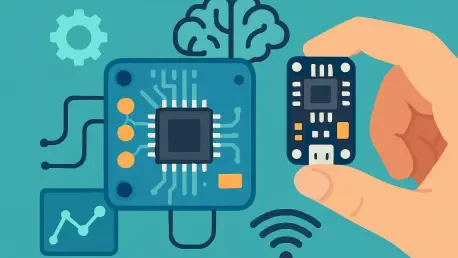

A quiet but profound transformation is reshaping the landscape of connected devices, from the factory floor to the wearable on your wrist. For years, the Internet of Things (IoT) model was simple: collect raw data from sensors and send it to a powerful cloud server for processing and analysis. This approach, while effective, introduced inherent delays, privacy concerns, and a heavy reliance on constant internet connectivity. Now, a different paradigm is taking hold, one where intelligence is not centralized but distributed. This is the world of TinyML, where fully functional machine learning models are deployed directly onto resource-constrained microcontrollers, sometimes no larger than a coin. These devices can now make instantaneous, autonomous decisions right at the source of the data, determining if a motor’s vibration signals an impending failure or if a spoken phrase is a command to wake up. This shift toward on-device intelligence is making IoT systems faster, more private, and significantly more energy-efficient, and it is largely being democratized by a growing ecosystem of powerful open-source frameworks.
1. Defining TinyML and Its Core Importance
When the term TinyML is mentioned, it is often misunderstood as a simplified or “lite” version of machine learning, but this perception is inaccurate. TinyML involves the deployment of complete and sophisticated neural network models onto microcontrollers, the same low-cost, low-power chips found in everyday items like smart appliances, industrial sensors, and fitness trackers. These devices operate under extreme constraints, typically possessing only a few hundred kilobytes of memory and consuming minuscule amounts of power, often running for months or years on a single small battery. The primary motivation for running complex algorithms on such limited hardware is not just a technical challenge but a response to critical real-world needs. By processing data locally, TinyML applications eliminate the latency associated with sending data to the cloud, enabling immediate responses crucial for tasks like emergency fall detection or industrial safety alerts. This on-device processing also inherently enhances privacy, as sensitive personal or proprietary data never needs to leave the device. Furthermore, it dramatically reduces bandwidth consumption and power usage, making it possible to deploy intelligent systems in remote locations with unreliable or non-existent network connectivity.
2. The Inherent Challenges of On Device Machine Learning
Deploying machine learning models on powerful servers with abundant memory and dedicated GPUs is a relatively straightforward process compared to the intricate engineering required for TinyML. The fundamental challenge lies in adapting complex algorithms to function within the severe resource limitations of microcontrollers. Most of these chips offer between 256KB and 1MB of flash storage for the model and application code, with even less RAM available for operations, leaving a tiny footprint for the neural network itself. They lack the specialized hardware like GPUs or multi-core CPUs that accelerate machine learning tasks, instead relying on simple processors with low clock speeds to conserve power. This focus on power efficiency is paramount, as many TinyML devices are battery-operated and designed for long-term deployment where every computation directly impacts their operational lifespan. Beyond hardware, logistical hurdles add another layer of complexity. Managing and updating the software models on thousands or even millions of distributed devices in the field presents a significant operational challenge, especially when these devices must continue to function reliably even without a persistent connection to a central network.
3. Open Source Frameworks Enabling the TinyML Revolution
Just a few years ago, implementing machine learning on a microcontroller was a highly specialized task requiring deep expertise in embedded systems and algorithm optimization. Today, the landscape has been transformed by a suite of powerful open-source frameworks that handle much of the underlying complexity, making TinyML accessible to a broader range of developers. Chief among these is TensorFlow Lite for Microcontrollers (TFLM), a specialized version of Google’s popular framework designed to run on bare-metal systems without an operating system. TFLM is highly optimized for memory and processing efficiency, supporting essential neural network layers for tasks like audio wake-word detection, gesture recognition, and sensor-based anomaly detection. For those seeking a more integrated, end-to-end solution, Edge Impulse provides a comprehensive platform that guides developers through the entire workflow, from data collection and labeling to model training, optimization, and final deployment on a wide variety of microcontrollers. For advanced users who require granular control over performance, Apache TVM and its subproject MicroTVM allow for the compilation of neural networks into highly efficient C code tailored for specific embedded targets, unlocking maximum optimization potential.
4. The Blueprint for Building a TinyML Application
The development process for a TinyML application follows a structured and repeatable sequence of steps that, once understood, becomes a natural workflow. The journey begins with data collection, which is arguably the most critical phase. High-quality, representative data must be gathered directly from the sensors on the target device to capture the specific nuances of the environment in which it will operate. This raw sensor data—be it from an accelerometer, microphone, or camera—is then preprocessed to clean it, normalize it, and extract the most relevant features for the machine learning model to analyze. The next stage is model training, where a neural network is designed and trained using the prepared dataset to learn the patterns necessary to perform its task, such as classifying different types of motion or identifying specific keywords in an audio stream. Following training, the model undergoes a crucial optimization phase. Techniques like quantization, which reduces the precision of the model’s numerical weights, and pruning, which removes unnecessary connections within the network, are applied to drastically shrink the model’s size and computational requirements without significantly compromising its accuracy, making it small and efficient enough to fit onto the target microcontroller for final deployment.
5. Real World Applications Demonstrating TinyMLs Power
The theoretical benefits of TinyML translate into tangible, high-impact solutions across numerous industries. In manufacturing, for instance, predictive maintenance has been revolutionized by this technology. Small, battery-powered vibration sensors can be attached to critical machinery on a factory floor. A TinyML model running directly on the sensor learns the machine’s normal operational vibration pattern and can instantly detect subtle deviations that signify a potential malfunction. By flagging the issue in real-time without requiring a round-trip to a cloud server, it allows for proactive maintenance, preventing costly downtime and catastrophic equipment failures. In the consumer electronics space, wake-word detection in smart speakers and assistants is a prime example of TinyML’s efficiency. A tiny, ultra-low-power model runs continuously, listening for a specific phrase like “Hey, Google.” Its sole purpose is to activate the device’s main processor and network connection only when needed, conserving significant energy while ensuring that private conversations are not being streamed to the cloud. This same principle of local processing for privacy and efficiency is also driving innovation in wearable health monitoring, where on-device models can analyze biometric data to detect falls or heart rhythm anomalies.
6. Integrating TinyML into the Broader IoT Ecosystem
While TinyML devices are designed for autonomous operation, their true value is often realized when they become part of a larger, interconnected system. To communicate their findings without sacrificing their low-power and low-bandwidth principles, these devices rely on specialized IoT protocols. MQTT is a widely adopted standard in this domain; it is a lightweight publish-subscribe messaging protocol that allows a TinyML device to send a very small, simple message, such as “anomaly detected” or “temperature threshold exceeded,” to a central message broker. From there, this data can be integrated into more complex workflows and systems. Visual programming tools like Node-RED provide an intuitive, flow-based interface for routing these messages to various services, enabling actions such as sending an email alert to a technician, logging the event in a database, or triggering another process in the system. For comprehensive management and analysis, platforms like ThingsBoard serve as a central control center. They can receive data from thousands of TinyML devices, visualize trends on interactive dashboards, manage device fleets, and allow operators to define rules that trigger automated responses based on the intelligent insights generated at the edge.
7. From Autonomous Devices to Agentic Systems
The evolution of TinyML ultimately transcended the mere compression of algorithms; it established a foundation for genuine device autonomy. What began as a method to run a single classification or anomaly detection model locally on a sensor matured into something far more significant. This development enabled the creation of distributed networks where countless tiny, intelligent devices could sense their environment, make independent decisions, and act upon them without waiting for external instructions. This marked a fundamental shift from the centralized, cloud-based “brain” model to a new paradigm of thousands of small, collaborative brains working in unison at the edge. The integration of efficient communication protocols and management platforms allowed these autonomous devices to form the building blocks for the next wave of intelligent, agentic systems. These systems were no longer passive data collectors but active participants that could sense, plan, and execute tasks with an unprecedented level of efficiency and responsiveness, paving the way for a more intelligent and interconnected world.