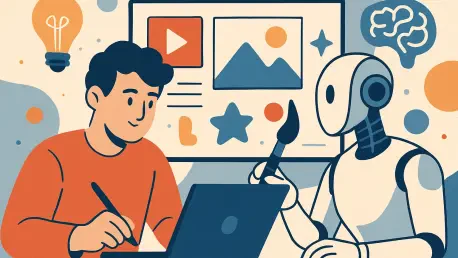

The romanticized image of a solitary creative genius wrestling with a blank page is rapidly becoming a relic of a bygone era, replaced by a dynamic dialogue between human artists and their intelligent digital collaborators. Generative artificial intelligence has moved beyond the realm of technological curiosity to become a foundational element of the modern creative toolkit. This shift is not merely an incremental upgrade but a seismic event that is fundamentally restructuring workflows, reshaping team dynamics, and compelling the industry to reconsider the very nature of creative work. In this new landscape, the central question is no longer if AI will change the creative industries, but how organizations and professionals can effectively harness this human-machine partnership to produce work that is more innovative, efficient, and resonant than ever before.
The Creative Landscape on the Brink of Transformation
Before the widespread integration of generative AI, the creative industries operated on a well-established, human-centric model. In sectors like marketing, design, and media, the workflow was predominantly linear and sequential. It began with extensive research and ideation, followed by laborious rounds of drafting, prototyping, and refinement. This process, while capable of producing extraordinary work, was often constrained by time, budget, and the sheer human effort required to explore multiple creative avenues. The value proposition was clear: creativity was a uniquely human endeavor, a blend of intuition, experience, and craftsmanship that could not be replicated.
The established players in this ecosystem, from global advertising agencies to boutique design studios, built their reputations on the talent of their people. The creative process was a collaborative yet often siloed effort, with writers, designers, and strategists contributing their specialized skills at distinct stages. While digital tools had certainly streamlined certain tasks over the past few decades—from graphic design software replacing drawing boards to digital editing suites supplanting film splicing—these innovations served primarily to digitize existing manual processes. They made creative work faster and more flexible but did not fundamentally alter the core methodology of thinking first and then making. This environment set the stage for a technology that would not just accelerate the old model but shatter it entirely.
The Dawn of a New Creative Partnership
The AI Catalyst How New Tools Are Forging New Processes
The arrival of sophisticated generative AI tools has ignited a paradigm shift, transforming the creative process from a linear “think, then make” sequence into an agile, iterative “think while making” loop. The once-intimidating challenge of a blank canvas is now mitigated by AI’s ability to generate a multitude of starting points in seconds. Tools like DALL-E, Midjourney, and ChatGPT act as tireless brainstorming partners, producing initial concepts, mood boards, and copy drafts that creatives can immediately begin to refine, redirect, and build upon. This collaborative dynamic collapses the traditionally separate stages of ideation and execution into a single, fluid motion.
This acceleration enables creative endeavors at a scale and speed that were previously unattainable. For instance, marketing teams can now develop hyper-personalized campaigns by generating thousands of unique visual and textual variations tailored to specific audience segments, a feat demonstrated by Warner Bros. in its promotion for The Flash. The ability to conduct rapid A/B testing with a vast array of AI-generated assets allows for data-driven optimization early in the process, eliminating ineffective concepts before significant resources are invested. Essentially, AI has taken on the role of producing the “first draft,” freeing human talent to focus their expertise on higher-value activities such as strategic alignment, conceptual validation, and the nuanced refinement that gives a project its final polish and emotional depth.
Quantifying the Revolution Productivity Metrics and Market Growth
The adoption of these transformative tools is no longer a niche trend but a market-wide reality. Current data indicates that an overwhelming majority of creative professionals have already integrated generative AI into their daily workflows, with reports of a four-to-fivefold increase in the speed from initial concept to final output. This is not just a perceived improvement; it is reflected in measurable gains in key performance indicators. Agencies and in-house creative teams are reporting dramatic reductions in project timelines, increased output volume, and greater efficiency in resource allocation, allowing them to take on more projects and explore more ambitious creative directions.
This surge in adoption is fueling explosive growth in the generative AI market within the creative sector. Forward-looking projections indicate that this trend will only accelerate, fundamentally altering the labor market in the process. Analysis suggests a significant portion of the workforce will need to transition into new or evolved roles by the end of the decade, as tasks involving content generation and iteration become increasingly automated. The economic impact is clear: organizations that successfully integrate AI into their creative operations are positioning themselves for a significant competitive advantage in a rapidly evolving marketplace.
Navigating the New Frontier Human and Technical Hurdles
Despite the immense potential, the widespread adoption of generative AI presents a series of complex challenges that demand careful navigation. One of the primary risks is the emergence of “aesthetic fatigue,” where an overreliance on popular AI models leads to a sea of homogenous, uninspired content that lacks originality and cultural resonance. These models, trained on vast but finite datasets, can inadvertently perpetuate biases and fail to grasp the subtle nuances of human experience, resulting in work that feels generic or, worse, culturally tone-deaf. The creative director’s role, therefore, becomes more critical than ever in ensuring that AI-generated outputs are guided by a distinct human vision and a deep understanding of context.
This technological shift also creates a significant talent development gap. As AI automates many of the entry-level tasks traditionally assigned to junior creatives—such as drafting social media copy, creating basic layouts, or generating stock imagery—it removes crucial opportunities for them to build foundational skills, develop their craft, and hone their creative judgment. Organizations must now proactively design new pathways for mentorship and skill acquisition, ensuring the next generation of creative leaders has the experience necessary to guide strategy and art direct both human and machine collaborators. Without this foresight, the industry risks creating a cohort of senior creatives without a pipeline of well-trained talent to support them.
Furthermore, integrating AI into established workflows introduces considerable operational complexities. Ensuring consistent quality control across outputs generated by various tools and prompts is a significant hurdle, requiring new review processes and governance structures. Managing these new hybrid teams—where humans prompt, curate, and refine AI outputs—demands a new style of leadership that blends creative direction with technical oversight. The seamless orchestration of human and AI contributions is an intricate process that requires careful planning, robust infrastructure, and a culture of continuous learning and adaptation.
Forging the Rulebook Governance Ethics and Intellectual Property
The rapid proliferation of AI-generated content has far outpaced the development of a clear regulatory framework, leaving organizations to operate in a legal gray area. Critical questions surrounding copyright, data ownership, and intellectual property for works created with generative AI remain largely unanswered by courts and legislative bodies. This ambiguity creates significant legal and financial risks, as companies must navigate the potential for infringement claims related to both the data used to train AI models and the outputs they produce. Even with indemnities offered by major AI providers, the ultimate responsibility for compliance and risk mitigation rests with the organization using the tools.
In response to this uncertainty, forward-thinking organizations are proactively establishing robust internal governance models to guide the ethical and responsible use of AI. These frameworks often rest on three core pillars: transparent disclosure of AI’s role in the creative process, a rigorous legal and ethical clearance process for all AI-assisted projects, and the implementation of strict brand safety guardrails to ensure that all content aligns with company values and standards. By creating their own rulebook, these organizations aim to build trust with audiences and protect themselves from reputational damage while still capitalizing on the benefits of the technology.
This internal governance extends to complex security and compliance measures. Establishing clear policies on which data can be used to prompt AI models is crucial to protect sensitive company information and prevent proprietary data from being absorbed into public models. Many organizations are also creating dedicated AI operations units tasked with testing new models, maintaining stylistic consistency, and serving as a central point of control for all AI-related creative work. These measures are essential for managing risk and ensuring that the pursuit of innovation does not come at the expense of legal, ethical, and brand integrity.
Envisioning the Next Act The Future of Creative Roles
The integration of AI is not eliminating creative jobs but rather transforming them, giving rise to new specializations and augmenting existing roles. The creative professional of today is increasingly becoming an orchestrator of technology, guiding AI systems to achieve a specific artistic or strategic vision. New titles like prompt engineer and AI content curator are emerging, signifying a shift toward skills that blend creative intuition with technical fluency. Copywriters are evolving into conversation designers who refine AI-generated text, while graphic designers are using AI to rapidly explore visual systems rather than painstakingly creating every element from scratch.
This evolution is fostering a symbiotic ecosystem where AI and humans perform the tasks best suited to their respective strengths. AI excels at managing scale, speed, and iteration, handling the heavy lifting of generating vast quantities of content and exploring countless permutations of an idea. This frees human creatives to focus on what they do best: providing the strategic vision, exercising ethical judgment, understanding emotional context, and infusing work with the originality and lived experience that machines cannot replicate. The future of creative work is not a competition between humans and AI, but a collaboration.
This new dynamic is fundamentally restructuring creative teams and agencies. Silos are breaking down as collaboration becomes more interdisciplinary, with creatives working alongside data scientists and AI specialists to optimize tools and workflows. We are seeing the rise of centralized AI operations teams responsible for governance and quality control, serving as a resource for the entire creative department. In the long term, this collaborative model may even lead to new forms of attribution, where creative credits acknowledge the distinct contributions of both the human visionaries and the AI tools they wielded, much like a producer is credited alongside an artist in music.
Orchestrating a Collaborative Future Final Insights and Recommendations
The analysis of the current creative landscape revealed that generative AI has firmly established itself as a powerful amplifier of human ingenuity rather than a replacement for it. The technology was found to accelerate production and expand creative possibilities, but its effectiveness was entirely dependent on the quality of human direction, curation, and strategic insight. The core finding was that the most successful applications of AI occurred when it was used to augment, not automate, the creative process.
Throughout this examination, the enduring value of uniquely human qualities became increasingly apparent. The report identified that emotional resonance, cultural awareness, and original vision remained the exclusive domain of human creators. The nuanced understanding of experiences like humor, love, and heartbreak—the very elements that make creative work connect with an audience on a deeper level—were qualities that AI could simulate but not genuinely comprehend. Ultimately, it was concluded that human sentiment and subjective taste would always serve as the final arbiters of creative value.
Based on these findings, it was recommended that creative professionals and organizations pivot toward a strategy of adaptation and investment. Professionals were advised to cultivate hybrid skill sets, blending their traditional creative craft with a deep literacy in AI tools and prompt engineering. For organizations, the strategic imperative was to invest not only in technology but also in new training programs and revised workflows. Building robust internal governance and fostering a culture that embraces human-machine collaboration were identified as the key steps for thriving in this new, AI-augmented creative world.