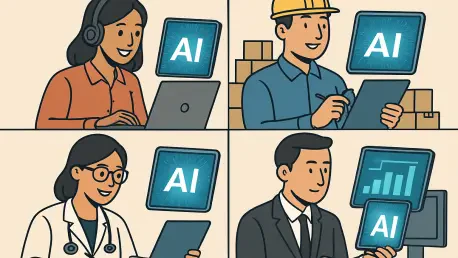

Beyond the pervasive headlines of revolutionary disruption and transformative potential, a much quieter and more practical application of Artificial Intelligence has taken firm root across the business landscape. Companies are increasingly turning away from costly, high-concept pilot programs and are instead focusing on how AI can provide immediate, tangible value within their current operational frameworks. The most successful implementations are not the standalone marvels of science fiction but are integrated tools designed to support existing processes, enhance the capabilities of human employees, and streamline complex decision-making in a clearly measurable way. The emerging consensus is that AI delivers its greatest value not through radical upheaval but through seamless integration, augmenting human skills rather than seeking to replace them. This strategic shift treats AI as a powerful decision-support layer, feeding actionable insights directly into daily workflows—from prioritizing sales leads to adjusting inventory levels—and transforming it from a background analytical engine into a real-time, indispensable operational partner that empowers teams to work smarter, not harder.
Enhancing Operations Without Disruption
One of the most significant barriers to successful AI adoption has proven to be operational friction, as the introduction of a separate, complex system often leads to failure and employee resistance. True success hinges on making artificial intelligence an intuitive and frictionless component of established workflows, allowing teams to harness its power without the burden of learning entirely new processes or managing complicated configurations. This principle is clearly demonstrated by companies that embed AI directly into the communication and collaboration platforms that businesses already depend on. For instance, instead of forcing teams to adopt a new application, AI-powered assistants are being integrated directly into existing Customer Relationship Management (CRM) systems and internal chat tools. These intelligent bots can adeptly handle a range of routine tasks, including data collection, administrative support, and answering frequently asked customer queries, thereby scaling customer interaction capabilities without disrupting a team’s established rhythm or requiring extensive retraining. The result is a model where AI functions as a valuable, non-disruptive operational enhancement that boosts efficiency from within.
This integration model effectively evolves AI from a passive, background analytical function into an active participant in the fabric of daily business operations. The focus is no longer on generating static reports or dashboards that require separate interpretation but on automating routine tasks directly within the flow of work itself, which in turn frees up human workers for more creative and strategic activities. The inherent value of this approach comes from its ability to significantly reduce the cognitive load on employees, allowing the technology to manage the mundane yet necessary processes of data collection, form-filling, and administrative support. By embedding these capabilities into familiar tools, businesses are discovering that AI can become a foundational operational backbone that not only improves efficiency but also enhances the employee experience. This shift allows human talent to be redirected toward high-value work that requires critical thinking, emotional intelligence, and complex problem-solving—areas where human expertise remains irreplaceable and most impactful for driving growth.
Balancing Automation and Human Judgment
In sectors such as commerce, finance, and insurance, where decisions carry significant financial and regulatory weight, the primary objective is not total automation but rather a carefully calibrated partnership between AI and human experts. The most effective strategies in these fields define clear boundaries for technology’s role: AI is tasked with handling high-volume data analysis, pattern recognition, and risk identification, while humans retain ultimate control over final judgments that demand accountability, nuanced intuition, and contextual expertise. For example, some platforms integrate AI into sales CRMs to help teams identify emerging opportunities and potential issues within live customer conversations, sharpening their judgment in the moment. In the highly regulated insurance industry, AI is being used to scan thousands of complex documents for compliance issues, automatically flagging potential risks for expert review. In both scenarios, the AI surfaces critical, data-driven information at a scale humans cannot match, but the final, high-stakes decisions are always rendered by qualified human professionals who can weigh factors beyond the data.
This model of human-in-the-loop automation is extending to the very core of commercial activity, creating what is known as the “decision layer” of a business. Companies are now embedding AI directly into their pricing, forecasting, and inventory platforms to translate predictive insights into immediate, actionable adjustments in real-time operations. This ensures that valuable forecasts do not languish in disconnected reports but directly influence day-to-day decisions on price modifications and stock allocation as part of an ongoing commercial process. Beyond internal efficiency, a new frontier is emerging in customer-facing applications. In banking, for instance, innovative institutions are beginning to leverage AI not just for internal cost-cutting but for proactive loan discovery and origination, deploying AI agents to identify and engage potential customers. This strategic pivot transforms AI from a mere efficiency tool into a powerful engine for revenue generation and market presence, highlighting its evolving role in not just optimizing the business but actively growing it in an increasingly competitive, AI-driven landscape.
Scaling Creativity and the Human Touch
Contrary to the persistent fear that AI will devalue and replace creative and empathetic professional roles, many businesses are discovering its power to enhance the human element of their work. By automating the more repetitive, time-consuming aspects of creative and service-oriented jobs, AI is freeing professionals to dedicate their focus to what they do best: deep strategic thinking, genuine personalization, and the cultivation of meaningful customer relationships. In the design world, for instance, AI-assisted tools are helping interior designers to quickly generate initial layouts and visualize a multitude of concepts, accelerating the tedious parts of the process. This allows designers to invest more of their time and energy in creative problem-solving and deep collaboration with clients to deliver truly bespoke outcomes. Similarly, communications and branding agencies are leveraging AI as a powerful research assistant, capable of scanning vast media landscapes and drafting initial versions of content, while ensuring all final strategic, messaging, and editorial decisions remain firmly in the hands of human experts who guide the creative vision.
Perhaps one of the most surprising applications of this technology is its use in delivering what can be described as “empathy at scale,” particularly in sensitive and emotionally charged customer interactions. In complex financial processes such as inheritance management for credit unions, advanced platforms are utilizing AI-driven workflow automation to facilitate thoughtful, human-centric gestures that strengthen customer bonds. For example, when an inheritor uploads a death certificate into the system, it can be configured to automatically trigger an action like sending flowers to the family on behalf of the institution. This small but deeply meaningful gesture, enabled by intelligent automation, directly counters the perception of technology as inherently impersonal and cold. It demonstrates how automation can be thoughtfully designed to enhance the human experience during difficult times, proving that operational efficiency and genuine empathy are not mutually exclusive but can, in fact, work in powerful harmony to build lasting customer loyalty and trust.
Making the Physical World Smarter
The influence of artificial intelligence is now moving beyond the purely digital realm to help organizations manage complex physical operations and environments with unprecedented clarity and precision. By harnessing the power of computer vision, machine learning, and advanced data analysis, AI is making large-scale, real-world activity both visible and understandable, providing decision-makers with the concrete evidence needed to make better-informed choices about physical infrastructure and fieldwork. Cities, for example, are now applying AI and computer vision to manage intricate urban infrastructure like curb space. By analyzing video data from existing cameras, these platforms can identify parking patterns, monitor curb usage, and detect safety incidents at a scale that would be impossible through manual observation alone. This provides urban planners with the comprehensive, data-driven insights they need to make more effective decisions regarding traffic flow, enforcement policies, and future urban design, all based on empirical evidence rather than limited anecdotes.
This pragmatic application of AI found its footing in logistics and field operations, where success was measured in practical outcomes rather than technological novelty. For businesses with extensive field teams, AI was embedded into operational platforms to streamline tasks, flag anomalies in timesheets or forms, and surface potential risks without adding burdensome complexity for crews on the ground. In the logistics sector, AI helped small and mid-sized fleet owners make sense of their vast operational data, connecting signals from telematics and order patterns to optimize routes and schedules. The approach that ultimately succeeded was a pragmatic one, emphasizing the importance of clean data, focused performance indicators, and, most critically, the continued necessity of human oversight. It became clear that AI’s greatest strength was not in trying to imitate perfect planners but in its ability to amplify the skills of good ones. The focus definitively shifted from theoretical potential to practical support, proving that AI’s most valuable role was not as a revolutionary replacement for human intelligence but as a reliable, integrated infrastructure that sharpened judgment and provided the clarity needed to make better decisions in both the digital and physical worlds.