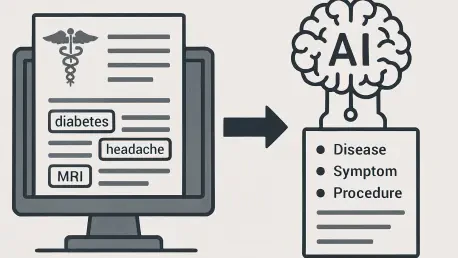

The extraction of structured clinical data from electronic health records typically requires thousands of labeled examples, creating a significant bottleneck for smaller biomedical research institutions. While large-scale healthcare systems can afford the extensive manual annotation required to train specialized models, many organizations struggle to bridge the gap between raw narrative text and actionable medical insights. Traditionally, Clinical Named Entity Recognition (CNER) has relied on discriminative models purpose-built for specific tasks, yet the rapid evolution of generative artificial intelligence has introduced a more flexible alternative. Recent investigations have pivoted toward evaluating zero-shot learning, where Large Language Models (LLMs) are tasked with identifying diseases, symptoms, and procedures without any prior task-specific training. This shift suggests a future where high-quality data extraction is accessible through well-crafted instructions rather than massive, labeled datasets. By examining how different model architectures and prompt structures influence accuracy, researchers are beginning to define the boundaries of what generative AI can achieve in the highly regulated and complex field of clinical documentation.
Comparing Architectures and Fine-Tuning Strategies
The effectiveness of clinical entity extraction is deeply rooted in the underlying architecture and the specific fine-tuning methods applied to the language model. In recent comparative studies, the Llama 2 and Mistral families have emerged as primary subjects for testing clinical utility in zero-shot environments. While foundational base models provide a broad understanding of language through next-token prediction, they often lack the specialized focus required to adhere to the strict constraints of medical data extraction. To address this, researchers have examined chat-optimized models and instruction-tuned variants, which are specifically trained to follow human-like directives. The distinction between these two is critical; instruction-tuned models, such as Mistral-7b-v0.2-instruct, demonstrate a much higher aptitude for maintaining the logical consistency needed for clinical tasks compared to their more conversational chat counterparts. This indicates that the way a model is taught to interact with users directly impacts its ability to parse dense, technical medical narratives without losing focus on the specific entities requested.
Building on the foundation of monolithic models, the Mixtral-8x7b-instruct architecture introduces a Sparse Mixture of Experts (SMoE) approach that significantly enhances its processing capabilities. Unlike standard models that activate all parameters for every prompt, Mixtral utilizes a gating mechanism to direct information through specific “expert” subnetworks. This design allows the model to scale its parameter count without incurring a proportional increase in computational cost, making it particularly adept at handling the nuanced boundaries of clinical terminology. During evaluations using “silver-standard” corpora—integrated datasets covering diseases, symptoms, and medical procedures—the Mixtral architecture showed a superior ability to resolve classification ambiguities. This was particularly evident when dealing with translated medical records, where the model had to navigate linguistic nuances from Spanish-to-English translations while maintaining the integrity of medical concepts. This suggests that specialized architectural routing is a key factor in achieving high-level semantic comprehension in specialized domains like healthcare.
Evaluating the Impact of Prompt Engineering
In the current landscape of generative AI, the structure and clarity of a prompt are just as influential as the model’s raw processing power. Research has highlighted that the cognitive load placed on a model increases when it is forced to adhere to complex output formats, which can paradoxically decrease its extraction accuracy. For instance, testing three distinct prompt variations—free-form natural language, a simple Python dictionary, and a strict JSON schema—revealed that models often perform better when formatting constraints are kept to a minimum. When a model is required to generate a perfectly valid JSON file, it must dedicate a portion of its internal attention to managing syntax, such as brackets and commas, rather than focusing solely on identifying medical terms like “myocardial infarction” or “tachycardia.” This trade-off suggests that for clinical professionals seeking the most accurate data, simpler prompt structures are often more reliable than complex programmatic requirements.
The hardware environments utilized for these evaluations, such as clusters powered by NVIDIA A40 GPUs, provide the necessary memory bandwidth to process dense clinical narratives without latency issues. However, even with robust hardware, software-side evaluation must be rigorous to distinguish between a model’s medical knowledge and its formatting adherence. Investigators employ “relaxed” and “strict” evaluation strategies; the former checks only for the presence of the correct medical term, while the latter mandates that the output perfectly match the requested data structure. These dual-metric approaches have shown that while instruction-tuned models are highly capable of following syntax, the “chat” versions frequently trigger safety filters. In an ironic twist of automated caution, these chat-tuned models occasionally refuse to label medical descriptions of trauma or injuries, misidentifying standard clinical documentation as “harmful content.” This highlights a significant hurdle in using general-purpose conversational AI for specialized medical record processing.
Analyzing Output Format and Accuracy Trends
A notable discovery in the study of generative clinical labeling is the inverse relationship between the complexity of the requested output schema and the precision of the extracted entities. Models consistently achieved their highest performance markers when utilizing a simple Python dictionary format, which provides enough structure for machine readability without the rigid overhead of more formal schemas. When these same models were pushed to generate complex JSON structures, researchers observed a measurable decline in their ability to accurately identify clinical entities. The cognitive distraction caused by strict syntactic requirements led to more frequent errors in term boundaries and entity categorization. This phenomenon emphasizes the need for practitioners to balance their desire for structured data with the model’s primary objective of accurate extraction, suggesting that post-processing a simple output might be more effective than demanding a complex one.
Furthermore, the data indicates that not all clinical entities are equally easy for generative AI to identify. Diseases and symptoms typically exhibit higher accuracy scores across various models because they often follow more standardized naming conventions and are frequently mentioned in the models’ training data. In contrast, medical procedures present a much greater challenge, as they are often described using varied, descriptive language rather than static terms. A procedure like “laparoscopic cholecystectomy” might be referred to in several different ways in a narrative clinical note, making it difficult for zero-shot models to consistently capture the full span of the mention. This linguistic variability suggests that while generative models are excellent for general clinical recognition, they still require specific guidance or perhaps hybrid strategies when dealing with the more descriptive and less standardized sections of electronic health records.
Assessing Mixtral and CodeLlama Performance
Among the diverse architectures tested in the clinical labeling space, the Mixtral-8x7b-instruct model has set a high benchmark for semantic versatility. Its mixture of experts allows it to adapt to the specific linguistic patterns of clinical notes more effectively than monolithic models of a similar or even larger size. This versatility is crucial when parsing documents that contain a mix of formal medical terminology, abbreviations, and shorthand common in healthcare settings. By routing information through the most relevant specialized subnetworks, Mixtral maintains a high degree of precision in entity extraction while avoiding the pitfalls of over-generalization. This performance demonstrates that sparse architectures might be the optimal path forward for high-stakes domains where both broad language understanding and specific technical accuracy are required in equal measure.
Conversely, models like CodeLlama-7b-instruct, which are heavily fine-tuned on programming languages and logical tasks, exhibit unique strengths and weaknesses when applied to clinical narratives. While CodeLlama is exceptionally good at maintaining rigid formatting—rarely failing a strict JSON syntax check—it occasionally suffers from what researchers call “behavioral drift.” In some instances, instead of performing the extraction task, the model may start to act as a medical consultant, providing diagnoses or summarizing the patient’s history based on the provided text. This drift occurs because the model’s training priorities favor logical completion and problem-solving over the simple, constrained task of entity extraction. This behavior underscores the importance of choosing a model whose fine-tuning aligns with the specific objective, as logical intelligence does not always translate directly to task-specific reliability in a zero-shot clinical context.
Generative Models vs Traditional Encoders
To place the performance of generative AI in context, it is essential to compare it against the long-standing gold standard: specialized encoder models like BioBERT and Clinical-XLM-RoBERTa. These traditional models are discriminative, meaning they are trained specifically to classify each word in a sentence as belonging to a certain category. When thousands of labeled examples are available, BioBERT remains the most accurate tool for clinical named entity recognition, achieving high F1 scores that generative models struggle to match in a zero-shot capacity. However, the performance gap is narrowing significantly. In recent benchmarks, the zero-shot performance of Mixtral was found to be comparable to several general-purpose encoders that had been fine-tuned on clinical data. This suggests that for many institutions, the trade-off in accuracy is outweighed by the massive reduction in the time and labor required for manual annotation.
The viability of generative AI as an alternative to traditional encoders becomes even more apparent in low-resource settings. Smaller research centers often lack the expertise or funding to build custom pipelines for every new medical specialty or emerging health crisis. In these scenarios, the ability to deploy an instruction-tuned model immediately—using only a well-defined prompt—is a transformative advantage. While an encoder model requires a static dataset that may become outdated as medical terminology evolves, a generative model can be updated simply by modifying the instructions or providing a few new examples in the prompt. This dynamic nature makes generative AI a highly scalable solution for the modern biomedical landscape, where the volume of data is increasing at an exponential rate and the need for rapid clinical insights is more pressing than ever.
Identifying Limitations and Practical Implications
The overarching conclusion from recent research was that instruction tuning served as the most vital factor for the success of zero-shot clinical tasks. Models specifically trained to follow prompts were found to be significantly more reliable than those optimized for general conversation, which often failed due to safety filters or lack of focus. However, the study also emphasized that generative models remained non-deterministic, meaning they could produce slightly different results if the same clinical note was processed multiple times. This variability presented a challenge for high-stakes production environments where absolute consistency was required. Furthermore, models frequently struggled with boundary consistency, occasionally missing a character or adding unnecessary words to a medical term, which could complicate downstream data integration if not carefully managed by automated validation tools.
Despite these limitations, the study proved that generative LLMs are ready to serve as transformative tools for the biomedical community, particularly in the initial stages of data labeling. Researchers advocated for a hybrid approach where generative models were used to rapidly generate “silver-standard” labels, which could then be refined by human experts to train more stable, discriminative systems. By utilizing instruction-tuned architectures and maintaining simple output formats, institutions achieved high-quality extraction with a fraction of the traditional setup time. This strategy allowed for a more agile response to new medical conditions or research priorities. Ultimately, the integration of generative AI into clinical workflows did not replace the need for precision but rather provided a powerful new method for overcoming the labeling bottlenecks that have long hindered the progress of large-scale biomedical research.